


Three-day WOAH PVS–PPP workshop concludes in New Delhi with strengthened State Action Plans, disease zoning and private-sector participation emerging as key pillars of India’s FMD-eradication strategy
NEW DELHI, 18 September 2026: India has taken another step toward its objective of achieving freedom from Foot-and-Mouth Disease (FMD) by 2030, with the Government of India and the World Organisation for Animal Health (WOAH) concluding a three-day technical workshop focused on developing scientifically credible FMD-free zones and compartments.
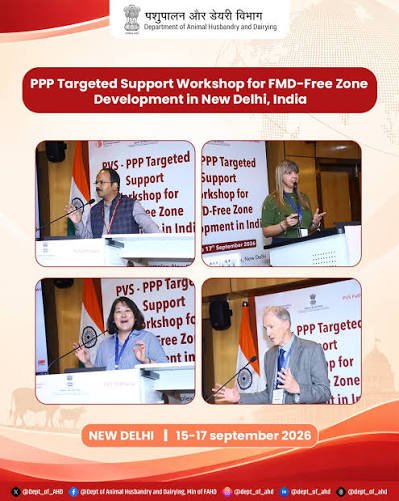
The WOAH PVS–PPP Targeted Support Workshop on “FMD-Free Zone Development in India” was held from 15–17 September 2026 at the National Agricultural Science Complex (NASC), New Delhi. The programme brought together the Department of Animal Husbandry & Dairying (DAHD), representatives from 12 State Animal Husbandry Departments, WOAH experts, Central and Regional Disease Diagnostic Laboratories, the National Dairy Development Board (NDDB), ICAR research institutions, industry and livestock-value-chain stakeholders.
The workshop is significant because India’s disease-control strategy is now moving beyond nationwide vaccination toward the more demanding task of demonstrating and maintaining disease freedom in defined geographical areas or animal populations.
The government’s latest position is that strengthened State Action Plans, WOAH-aligned surveillance and appropriately designed public-private partnerships (PPPs) can provide the operational framework required to progressively establish FMD-free zones and compartments.
India’s FMD programme: the numbers show substantial progress
India’s FMD-control programme has expanded dramatically since the launch of the National Animal Disease Control Programme (NADCP) in 2019. According to DAHD, cumulative FMD vaccination under the national programme has reached:
Indicator |
Latest reported position |
|---|---|
FMD vaccine doses administered |
147.16 crore |
Farmers benefited |
~8.04 crore |
FMD outbreaks, 2019 |
132 |
FMD outbreaks, 2025 |
40 |
FMD outbreaks, January–August 2026 |
20 |
NSP antibody positivity, 2019 |
20.8% |
NSP antibody positivity, 2025 |
8.1% |
Livestock registered on Bharat Pashudhan Portal |
>39 crore |
Mobile Veterinary Units |
4,019 |
Farmers reached by MVUs |
136 lakh |
Animals treated by MVUs |
276 lakh |
The government says the reduction from 132 FMD outbreaks in 2019 to 40 in 2025, together with the 20 outbreaks recorded through August 2026, demonstrates substantial progress in disease control. NSP antibody positivity—used as an indicator of virus circulation—also declined from 20.8% in 2019 to 8.1% in 2025.
The next stage requires India to demonstrate that specific populations can maintain freedom from infection through robust surveillance, vaccination strategies, animal identification, movement controls, laboratory capacity and documented veterinary-service performance.
From national vaccination to disease-free zones
India’s revised approach reflects a shift in disease-control architecture. The initial phase has largely centred on:
Mass vaccination → surveillance → outbreak investigation → monitoring of population immunity.
The FMD-free-zone strategy adds another layer: Defined geography/population → biosecurity → traceability → surveillance → laboratory confirmation → movement controls → documented veterinary-service capacity → WOAH recognition.
The workshop specifically addressed WOAH requirements for recognition of FMD-free zones, surveillance and post-vaccination monitoring, alongside international experience including Brazil.
This is important for India because the country has a very large and heterogeneous livestock population, extensive animal movement and major dairy, meat and breeding value chains.
The government’s strategy therefore increasingly depends on defined, traceable production systems, rather than treating the entire national livestock population as one epidemiological unit.
Nine priority states involved in practical planning exercises
A particularly important feature of the workshop was the practical engagement between public and private stakeholders.
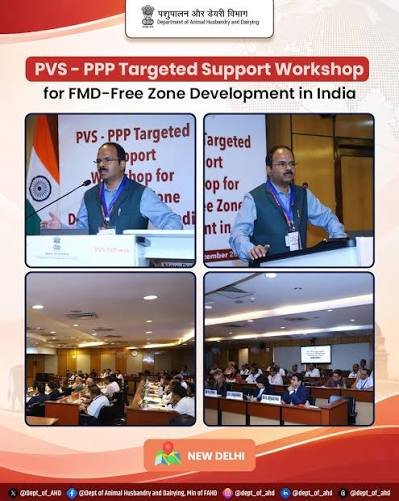
Government reporting states that group exercises involved stakeholders from nine priority States, with the objective of developing stronger ownership, accountability and sustainability around FMD-free-zone initiatives. The exercises focused on:
-
refining State-level action plans;
-
identifying technical gaps;
-
determining priority interventions;
-
defining roles for public and private stakeholders;
-
examining PPP opportunities;
-
improving sustainability of FMD-free-zone programmes.
The workshop therefore appears to have moved beyond a conventional policy conference toward implementation planning.
Why PPP is becoming strategically important
WOAH’s PVS–PPP framework is based on the principle that governments and private-sector participants can combine resources, capabilities and responsibilities to achieve veterinary-health objectives that may be difficult to deliver through either sector alone.
WOAH identifies potential PPP applications across the veterinary domain, including:
-
disease prevention and control;
-
large-scale vaccination;
-
diagnostic services;
-
surveillance;
-
laboratory networks;
-
veterinary infrastructure;
-
workforce development;
-
animal identification and traceability;
-
economic and legal assessments;
-
One Health activities.
For FMD-free zones, the potential partnership model is particularly relevant because the required infrastructure extends well beyond vaccine delivery.
A potentially important opportunity for India’s animal-health industry
The FMD-free-zone strategy could create a broader market opportunity than vaccination alone.
An effective disease-free-zone architecture requires an interconnected ecosystem:
Vaccines
↓
Cold chain & vaccination delivery
↓
Animal identification
↓
Digital traceability
↓
Veterinary surveillance
↓
Laboratory diagnostics
↓
Epidemiological analysis
↓
Movement control
↓
Biosecurity
↓
Certification & export assurance
This means the policy direction potentially expands the addressable opportunity for India’s animal-health sector from vaccines and medicines to veterinary infrastructure, diagnostics, digital platforms and disease-surveillance services.
For animal-health companies, the most interesting commercial question may therefore be not simply how many vaccine doses will India procure, but what infrastructure will be required to prove and maintain disease freedom within defined livestock populations.
India is also building the veterinary infrastructure required for the next phase
The FMD-free-zone initiative is being supported by broader veterinary-infrastructure reforms.
DAHD states that it introduced Minimum Standards of Veterinary Infrastructure in India in 2025 and is supporting States through the Support to States for Capital Investment (SASCI) framework to address infrastructure and system-readiness gaps identified by States.
This matters because FMD-free status is not simply a disease-control declaration. It requires veterinary systems capable of continuously demonstrating that disease surveillance, diagnosis, reporting and response are functioning effectively. The infrastructure agenda therefore supports the transition from:
campaign-based disease control
toward
permanent, evidence-based disease surveillance and veterinary-service capability.
Digital livestock identification is becoming part of the disease-control architecture
India’s disease-control system is also becoming increasingly digital. The government reports that more than 39 crore livestock have been registered on the Bharat Pashudhan Portal.
Animal identification and digital registration can become particularly important for FMD-free zones because traceability allows authorities and value-chain participants to establish:
-
where animals originate;
-
where they move;
-
which animals were vaccinated;
-
vaccination history;
-
herd-level disease status;
-
links between farms and markets;
-
potential disease contacts during an outbreak.
This creates an important intersection between animal health and livestock digitalisation.
Emerging SAT-serotype risk adds another layer
During the workshop, DAHD also highlighted the emerging threat from SAT serotypes of FMD and India’s preparedness for potentially exotic serotypes. This is strategically significant because India’s existing FMD-control architecture has historically focused on the serotypes circulating within the country.
An FMD-free-zone strategy must therefore incorporate exotic-disease preparedness and early detection, particularly where livestock movements and international trade could create pathways for introduction. The issue reinforces the importance of:
-
laboratory capability;
-
molecular surveillance;
-
rapid diagnostics;
-
vaccine preparedness;
-
border and movement controls;
-
epidemiological intelligence.
WOAH’s role: moving from technical advice toward implementation capability
WOAH’s PVS Pathway is designed as a country-driven, staged process for strengthening Veterinary Services in accordance with international standards. Its PPP component specifically helps veterinary authorities:
-
identify areas where private-sector participation is needed;
-
identify potential partners;
-
develop partnership opportunities;
-
construct business cases;
-
establish governance arrangements;
-
develop monitoring and evaluation mechanisms;
-
create an enabling environment for sustainable partnerships.

