


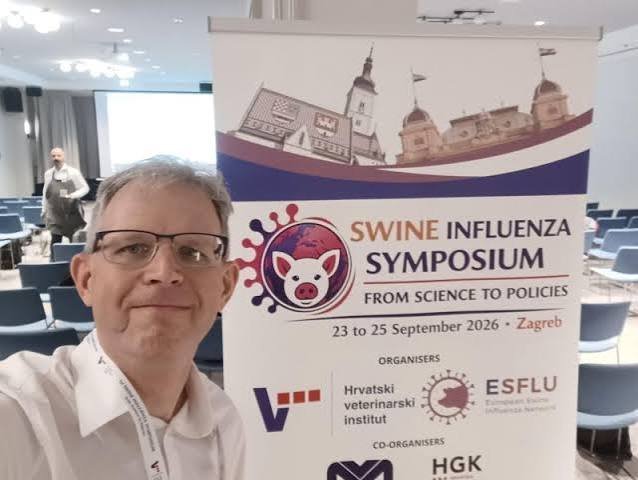
23–25 September 2026 | Zagreb, Croatia | Swine Health | One Health
The 1st International Symposium on Swine Influenza: From Science to Policies is bringing researchers, veterinarians, epidemiologists, policymakers and animal-health companies together in Zagreb from 23–25 September 2026.
Organised by the Croatian Veterinary Institute and European Swine Influenza Network (ESFLU), the symposium is focused on translating research into practical surveillance, prevention and policy. Organisers expect approximately 150–200 participants.
A three-day One Health agenda
The programme covers the full swine-influenza control chain:
Diagnostics → Surveillance → Virus evolution → Biosecurity → Vaccination → Economics → Zoonotic risk → Policy
The opening day focused on ESFLU’s collaborative work, including diagnostics, virus dynamics, surveillance, biosecurity and economics.
The scientific programme then moved into virus evolution, diagnostic methods, epidemiology and surveillance before concluding with prevention and control.
Genomic surveillance becomes central
One of the most important themes is the continuing genetic diversity and evolution of swine influenza A viruses. The programme includes presentations on:
-
Evolution of influenza surface proteins
-
Genetic diversity in Spanish pig farms
-
Human-derived H3N2 viruses in pigs
-
H3N2 detection in Great Britain
-
Eurasian avian-like swine influenza
-
Environmental and occupational surveillance
-
Genomic surveillance and sequencing
The agenda demonstrates that modern swine influenza control is increasingly dependent on continuous molecular surveillance rather than periodic outbreak investigation alone.
Non-invasive surveillance
The symposium also features research into alternative sampling approaches, including electrostatic dust collection and environmental/air sampling. This is strategically important because large-scale surveillance becomes easier when samples can be collected without repeatedly handling individual pigs.
Potentially, this could lower surveillance costs while increasing sampling frequency.
Vaccination and prevention
The final day focuses on prevention and control, including:
-
Swine influenza vaccine pipelines
-
Vaccine-induced immunity
-
Vaccination strategies in sow herds
-
Biosecurity
-
RNA-particle vaccines
-
Stakeholder perceptions
-
Economic impact
Ceva Animal Health is supporting the symposium as a Gold Sponsor, reflecting the commercial importance of influenza prevention and surveillance to the swine-health sector.
Strategic / Analyst View
The symposium reflects a broader transformation in livestock disease management. Swine influenza is increasingly being approached as a continuous population-management problem, not simply an acute respiratory disease.
The emerging model is:
Routine surveillance → genomic intelligence → strain tracking → risk assessment → targeted vaccination → biosecurity → economic measurement.
This has direct implications for animal-health companies. The future opportunity is likely to extend beyond vaccines into:
-
Molecular diagnostics
-
Environmental sampling
-
Genomic surveillance
-
Digital epidemiology
-
Biosecurity technologies
-
Farm-level analytics
-
Risk-management platforms

