


Biotech firm Pictor Holdings Inc. highlighted an independent peer-reviewed study conducted by researchers at Texas A&M University evaluating the Pictor PictVet® multiplex assay.
The study, published in Frontiers in Veterinary Science, evaluated the platform’s performance in detecting mucosal anti-Mycoplasma bovis IgG antibodies from bovine nasopharyngeal swab washes rather than traditional blood draws.
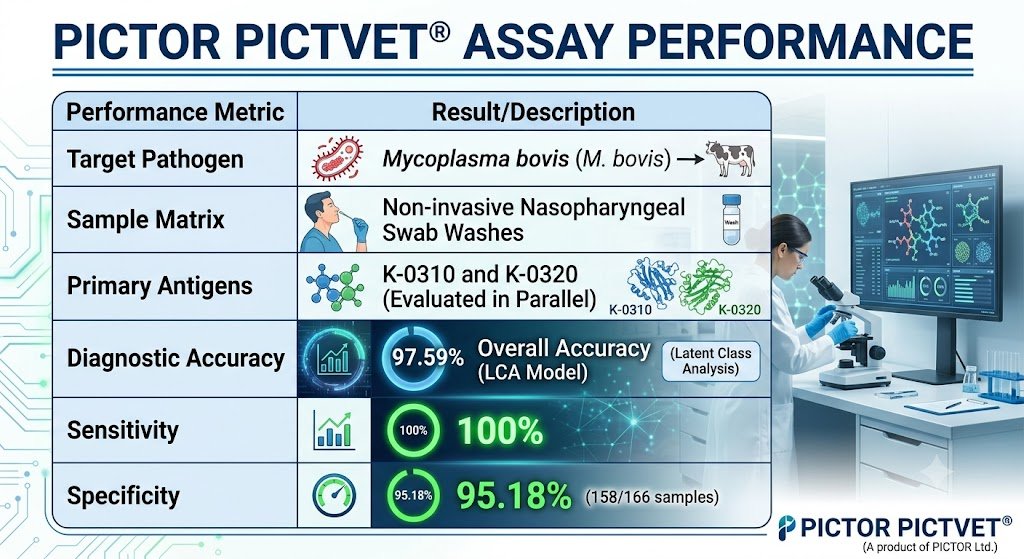
Using a Latent Class Analysis (LCA) model evaluating two target antigens (K-0310 and K-0320) in parallel, the Pictor platform demonstrated 97.59% accuracy, 100% sensitivity, and 95.18% specificity in identifying M. bovis immune responses.
Why M. bovis Surveillance Matters for Livestock Production
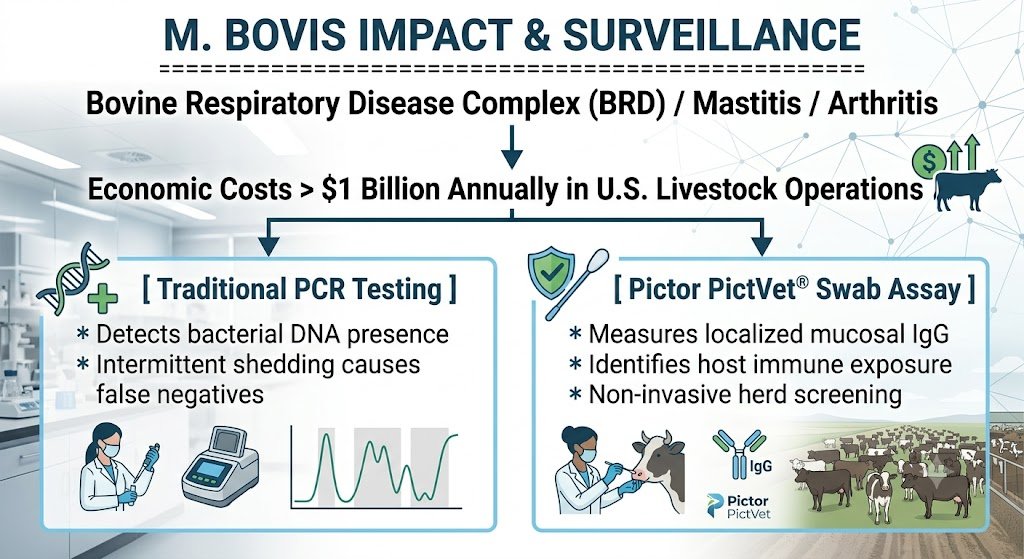
Mycoplasma bovis is a major bacterial pathogen implicated in Bovine Respiratory Disease (BRD)—the single most economically damaging health challenge in global beef and dairy production. Beyond respiratory distress, M. bovis causes severe mastitis, arthritis, and otitis in herds.
In the United States alone, BRD accounts for estimated economic losses exceeding $1 billion annually due to livestock mortality, reduced weight gain, treatment costs, and milk production drops.
Key Breakthroughs in the Texas A&M Study
-
Measuring Localized Mucosal Immunity: While molecular tools like Polymerase Chain Reaction (PCR) detect the presence of M. bovis DNA, they do not confirm whether the host animal has mounted an active immune response. Intermittent bacterial shedding in nasal secretions can also cause false-negative PCR readings. The Pictor assay directly measures localized mucosal antibody levels.
-
Non-Invasive Sampling Matrix: Testing nasal swab washes provides a practical, lower-stress alternative to blood sampling for herd surveillance.
-
High Analytical Reproducibility: The assay demonstrated strong inter-operator agreement ($\kappa = 0.894\text{ to }1.0$) and consistently detected positive samples even at $1:2$ dilutions.
Practical Considerations for Feedlot and Dairy Operations
While the trial results demonstrate strong analytical performance, adopting mucosal antibody testing across broader commercial livestock operations will depend on several real-world operational factors:
-
Herd-Type Variability: Performance metrics must be validated across diverse production environments, including high-density beef feedlots, cow-calf operations, and dairy facilities.
-
Disease Stage Differentiation: Because mucosal antibodies persist after exposure, herd health managers will need clear protocols to differentiate between active infection, historical clearance, and maternal antibody carriage.
-
Actionable Decision-Making: The economic value of the assay relies on integrating test results into culling, targeted antibiotic metaphylaxis, animal movement, and biosecurity protocols.
