


From January through September 2026, African Swine Fever (ASF)—caused by the double-stranded DNA virus Asfarviridae—remained the single most destructive transboundary animal disease affecting the global pork industry. According to field reporting surveillance consolidated from the World Organisation for Animal Health (WOAH) WAHIS platform, the Food and Agriculture Organization (FAO) EMPRES-i database, and the Swine Health Information Center (SHIC), the disease maintained an active footprint across four continent-level regions: Europe, Asia-Pacific, Africa, and the Caribbean (Americas).
Reporting period: 1 January–30 September 2026
Geographic scope: Africa, Europe, Asia-Pacific and the Americas
Primary sources: WOAH/WAHIS, FAO EMPRES-i+, FAO regional situation reports, SHIC/University of Minnesota Global Swine Disease Monitoring Reports, EFSA/ADIS, national veterinary authorities, USDA-APHIS and selected peer-reviewed 2026 research
2026 is becoming a disease of persistent circulation rather than isolated epidemics African swine fever remains one of the most consequential transboundary animal diseases in the world.
WOAH describes ASF as a highly contagious viral disease of domestic and wild pigs with mortality that can approach 100%, while emphasising that it is not a human disease. The virus can nevertheless survive for prolonged periods in pork, organic material, equipment and the environment, creating unusually persistent opportunities for human-mediated transmission.
The first nine months of 2026 show five important developments:
-
Europe remains the world’s largest ASF surveillance battlefield, with very substantial wild-boar infection and recurrent domestic-pig outbreaks.
-
Asia continues to experience endemic circulation, particularly in Vietnam, the Philippines, South Korea, India, Laos, Indonesia, Malaysia, Nepal and Bhutan.
-
Africa continues to generate major commercial losses, most visibly in South Africa, while new notifications in Kenya, Cabo Verde and South Sudan demonstrate continued geographic persistence.
-
The Americas remain geographically contained, with the active problem concentrated on Hispaniola—Dominican Republic and Haiti—but the risk to North, Central and South America remains significant.
-
2026 is increasingly a transition year from “emergency stamping-out” toward integrated management, combining biosecurity, zoning, surveillance, wildlife management, movement control and—in selected countries—vaccination.
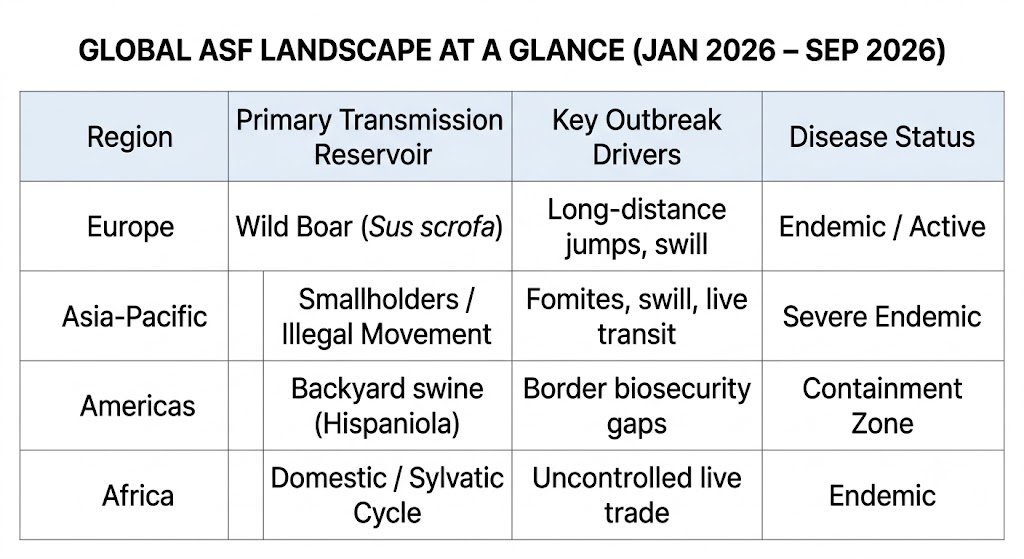
WOAH’s January 2026 situation report already showed the scale of the problem: 12 new domestic-pig outbreaks and approximately 724 wild-boar outbreaks were reported during January alone, with 353 domestic-pig animal losses. Importantly, 89 outbreaks occurred more than 10 km outside previously affected areas, demonstrating continued long-distance disease jumps.
Global 2026 Snapshot
A useful mid-year benchmark comes from a compilation based on Chinese Ministry of Agriculture and Rural Affairs data.
January–August 2026
Indicator |
Global reported/compiled total |
|---|---|
Countries reporting outbreaks |
28 |
ASF outbreaks |
7,180 |
Infected pigs |
~72,100 |
Pig deaths |
~21,700 |
Domestic pigs culled |
~265,000 |
Year-on-year change in outbreaks |
-5.5% |
Change in infections |
~ -50% |
Change in deaths |
~ -50% |
Change in domestic culling |
+121.7% |
The apparent contradiction—fewer infections and deaths but dramatically more animals culled—is important. It suggests that outbreak control is increasingly relying on pre-emptive or whole-herd depopulation, rather than waiting for every animal to become clinically infected.
August alone produced 598 outbreaks across 17 countries in Europe and Africa, including 201 domestic-pig outbreaks and 397 wild-boar outbreaks. Approximately 50,800 pigs were killed or culled during that month.
EUROPE — the world’s most intense wildlife-associated ASF ecosystem
Europe’s 2026 pattern is increasingly characterised by wild boar persistence + repeated spillover into domestic production.
A September 2026 European surveillance compilation based on ADIS data recorded the following wild-boar ASF outbreaks/cases from 1st of January to 9th of September 2026:
Country |
Wild-boar outbreaks/cases |
|---|---|
Poland |
1,661 |
Italy |
1,079 |
Lithuania |
856 |
Germany |
701 |
Hungary |
615 |
Latvia |
562 |
Romania |
296 |
Bulgaria |
282 |
Croatia |
106 |
Estonia |
82 |
Serbia |
65 |
Spain |
58 |
Slovakia |
131 |
Finland |
35 |
Moldova |
23 |
Bosnia & Herzegovina |
10 |
Ukraine |
7 |
Greece |
1 |
That is an extraordinarily broad European footprint.
Poland – Poland remained one of Europe’s most important ASF hotspots, with 1,661 wild-boar events through 9 September. Domestic outbreaks also continued, and August alone reportedly involved culling of more than 3,000 domestic pigs.
Germany – Germany illustrates the wildlife-management challenge. ASF had previously been concentrated in specific eastern regions, but in March 2026 the virus was detected in wild boar in Hochsauerland, North Rhine-Westphalia, demonstrating geographic expansion. More than 37,800 wild boar had tested negative, compared with 345 positives in the affected surveillance programme at the time. Germany deployed carcass searches, dogs, drones, fencing and restriction zones.
Spain – Spain continued managing the important Barcelona/Catalonia wild-boar outbreak. By 1 April, authorities had recorded 42 outbreaks and 241 ASF-positive wild boar across 10 municipalities, while no domestic-pig infections had been detected. Controls included trapping, hunting, night shooting, drone surveillance, fencing, carcass collection and restrictions on access to high-risk natural areas.
This is strategically important: Spain shows that controlling ASF in a major commercial pig-producing country increasingly requires wildlife population management as well as farm biosecurity.
Hungary – Hungary experienced an especially important commercial event in 2026: the first ASF outbreak in domestic pigs at a commercial facility housing 3,166 pigs, located less than one mile from Romania.
Romania – Romania remained Europe’s historically dominant domestic-pig ASF country. In August 2026 alone, 75 domestic-pig outbreaks were reported in the country.
Finland – Finland added an important northern dimension. ASF was detected in wild boar near the Russian border in July 2026, creating concern because the country had previously been outside the principal European ASF zone.
ASIA — endemic ASF, recombinant viruses and increasing vaccine deployment
Asia is arguably the most strategically important ASF region because of its enormous pig population. FAO’s September 2026 Asia-Pacific situation report identifies 20 countries that have reported ASF since the disease entered Asia in 2018:
China, Mongolia, Vietnam, Cambodia, DPR Korea, Laos, Myanmar, Philippines, Republic of Korea, Timor-Leste, Indonesia, Papua New Guinea, India, Malaysia, Bhutan, Thailand, Nepal, Singapore, Bangladesh and Sri Lanka. However, not all had confirmed new 2026 outbreaks.
Vietnam – Vietnam remains a major concern. By 10 August 2026, ASF had been reported in 28 provinces/municipalities, with more than 118,000 pigs destroyed. The pattern was strongly associated with small-scale farms with inadequate biosecurity. Vietnam’s 2026 control strategy is notable because it combines:
-
vaccination;
-
disease-free zones;
-
disease-free establishments;
-
stronger food-chain controls;
-
diagnostics;
-
rapid response;
-
improved farm biosecurity.
A particularly important virological development is that 83.6% (357/427) of representative 2026 Vietnamese ASF samples were reported as recombinant genotype I/II viruses. This is one of the most important developments globally because recombinant ASFV complicates assumptions that a vaccine or control strategy designed around one viral population will necessarily perform equally well against emerging strains.
South Korea – South Korea experienced an exceptional increase in domestic ASF activity. FAO reported 24 domestic outbreaks in 2026, more than three times the 2025 total, while wild-boar detections rose sharply early in the year:
-
January: 14
-
February: 63
-
March: 62
-
April: 30
-
May: 8
-
June: 10
-
July: 9
-
August: 1
Importantly, ASF genetic material was found in feed ingredients and farm-associated fomites, although a causal link between contaminated feed and infection was not established. More than 490 tonnes of potentially contaminated feed were recalled/destroyed as a precaution.
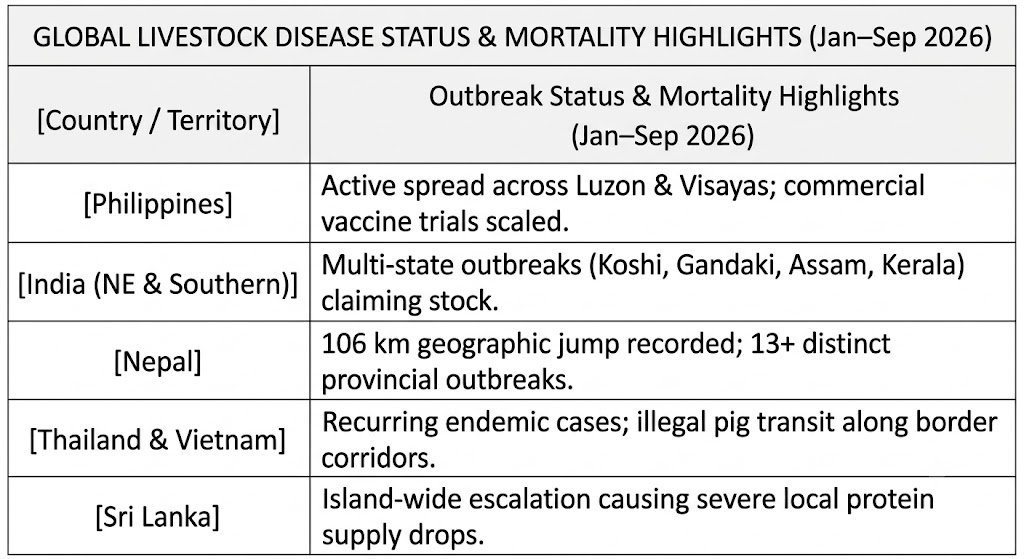
Philippines – The Philippines remains a major endemic ASF market. By 4 September 2026, FAO reported active ASF cases in: 154 barangays, 71 cities/municipalities and 29 provinces. The country has experienced ASF in 76 of 82 provinces since 2019. The Philippines has increasingly moved toward regionalisation and zoning, rather than treating the entire country as one infected epidemiological unit.
An important 2026 development was regulatory approval of AVAC ASF LIVE for commercial sale in September, with another Korean vaccine undergoing evaluation.
Laos – Laos provides an example of how ASF can re-emerge after apparently limited activity. The 2026 outbreak began in Sainyabouri Province in June and had expanded by 3 September to six districts. Reported losses reached: 3,134 pigs dead or culled plus 69 confirmed wild-boar deaths in Nam Phouy National Protected Area.
India — a particularly important smallholder and livelihood problem India officially reports ASF across 22 of 28 states plus the National Capital Territory. The 2026 situation was especially serious in: Nagaland; Assam; Mizoram; and other northeastern states. Nagaland reported continuing outbreaks through May–August, while Assam reported outbreaks in Tinsukia, Kamrup, Dibrugarh and Nagaon. Mizoram also reported continued spread.
India’s economic impact – The Indian government reported that the initial Assam outbreaks in 2020–21 produced approximately ₹276 crore in losses, while Mizoram had reportedly suffered approximately ₹982 crore in financial losses through 2025, affecting more than 11,382 households. A new 2026 Meghalaya study provides an important microeconomic perspective: 115 outbreak events involving 1,603 animals generated a conservative direct pork-production loss estimate of ₹2.74 crore (US$305,225) between 2020 and April 2025.
Major breakthrough: Indian ASF vaccine – On 4 August 2026, India dedicated an indigenous ASF vaccine developed by ICAR-NIHSAD. The government described the vaccine as a potentially important tool for strengthening India’s domestic ASF preparedness and reducing dependence on imported technologies. This could become strategically important for India’s pig-producing Northeast.
Indonesia – ASF has been reported in 32 of 34 Indonesian provinces. In 2026, new outbreaks were reported in East Kalimantan and West Sulawesi, followed by additional outbreaks in Central Sulawesi, East Nusa Tenggara and South Papua.
Malaysia – ASF returned to domestic pigs in Selangor and Sarawak in 2026. Malaysia also faces a wildlife dimension, including concern over ASF in vulnerable Bornean bearded pigs.
Nepal – Nepal reported 13 domestic-pig outbreaks during January–June, followed by new outbreaks in July, August and September. Wild-boar mortality was also reported.
Thailand – ASF reappeared in Ubon Ratchathani in August 2026. Authorities imposed movement restrictions and strengthened cleaning/disinfection requirements.
AFRICA — major losses despite lower reporting intensity
Africa remains the historical origin of ASF and continues to have major endemic risk. Confirmed/officially notified 2026 activity includes:
-
South Africa
-
Kenya
-
Cabo Verde
-
South Sudan
WOAH’s Africa notification system recorded ASF events in Kenya in July and South Sudan in September, while Cabo Verde reported a new ASF occurrence in February.
South Africa — South Africa experienced one of the most economically consequential ASF events of 2026. In Gauteng, seven outbreaks since November 2025 affected approximately 69,171 pigs, with roughly 60,000 culled. Reported industry costs exceeded R10 million, excluding losses borne directly by farmers.
August brought another severe event: two Gauteng outbreaks infected approximately 5,479 pigs, with 5,478 deaths and approximately 37,000 additional pigs culled. The affected commercial farms required extensive depopulation and were expected to take 12–18 months to return to full production.
South Sudan – In August, local authorities reported suspected ASF-associated mortality exceeding 8,000 pigs, including approximately 8,688 pigs in Yambio, although the distinction between suspected field mortality and internationally confirmed cases must be maintained. WOAH subsequently recorded a formal ASF notification in September.
This illustrates a major African surveillance problem: true losses may substantially exceed internationally notified figures.
AMERICAS — contained geographically, but strategically dangerous
As of the September 2026 evidence reviewed, the Americas had not experienced the feared continental spread into mainland North or South America. The active ASF problem remains concentrated in Dominican Republic and Haiti on Hispaniola. WOAH identifies the 2021 Dominican Republic introduction as the first Western Hemisphere detection in almost 40 years.
Dominican Republic – The Dominican Republic has >80% of its pigs raised by smallholders. FAO and USDA have implemented a national biosecurity programme covering: 637 farms, 80% of the national herd and 10,000 farmers trained. FAO estimates that the programme has already helped prevent potential losses of up to US$40 million over two years among participating farms—approximately ten times the initial investment.
A 2026 Frontiers study identified untreated organic waste/swill feeding as a major systemic vulnerability in the Dominican pig value chain. This is perhaps the most important Americas lesson: ASF control cannot stop at the farm gate.
ECONOMIC IMPACT ANALYSIS & GLOBAL SUPPLY CHAIN DISTORTIONS
The financial losses incurred by African Swine Fever between January and September 2026 extend beyond direct animal loss, touching trade, market valuations, and food security.
A. Direct Farm-Level & Indemnity Losses
-
Direct Culling Costs: Culling, safe deep-burial or incineration, and farm decontamination costs averaged $120–$280 per animal in Europe and Asia.
-
State Indemnity Pressures: Eastern European and Southeast Asian governments faced substantial financial strain providing indemnity payments to smallholders, leading to under-reporting in resource-limited rural zones.
B. Trade Restrictions & Export Losses
-
Non-Regionalized Trade Embargoes: Importing nations continued to enforce strict sanitary trade bans on ASF-positive countries. Non-regionalized export bans cost major European pork exporters millions in lost access to Asian markets.
-
Compliance & Zoning Costs: Exporters spent heavily on official freedom-from-disease certification, compartmentalization audits, and physical biosecurity barriers to maintain trade corridors under WOAH zoning guidelines.
C. Macroeconomic & Consumer Price Effects
-
Protein Substitution & Price Spikes: In heavily impacted regions such as Sri Lanka and parts of Southeast Asia, pork shortages drove up consumer prices for alternative animal proteins (broiler poultry and eggs).
-
Feed Industry Contraction: Soya and compound feed sales to the swine sector declined in localized outbreak zones, causing ripple effects throughout the agricultural supply chain.
Vaccines — the biggest change in the ASF landscape
Historically, ASF control was dominated by: detect → cull → disinfect → restrict movement.
That is changing. Vietnam has already licensed multiple vaccines, the Philippines approved AVAC ASF LIVE for commercial sale in 2026, South Korea authorised export-only vaccines, and India unveiled its indigenous ICAR-NIHSAD vaccine.
WOAH published dedicated 2026 guidelines for field evaluation and post-vaccination monitoring of ASF vaccines, an important indication that vaccination is transitioning from experimental science into a structured disease-control tool.
However, vaccination should not be viewed as a replacement for biosecurity. The most likely successful model is: Vaccination + surveillance + zoning + movement control + biosecurity + rapid response
Five major future ASF risks
1. Long-distance “disease jumps” – WOAH’s 2026 data show that ASF can appear far outside previously affected areas. Human-mediated movement of pigs, pork, feed, vehicles and equipment remains a major driver.
2. Recombinant viruses – Vietnam’s 83.6% recombinant genotype I/II finding deserves very close monitoring.
3. Wildlife reservoirs – Wild boar make eradication substantially harder because the virus can circulate outside farms.
4. Climate and land-use change – Changing landscapes, agricultural expansion, wildlife movement and altered human mobility can create new interfaces between wild and domestic pigs.
5. Global pork trade – The increasingly integrated global pork supply chain means an outbreak thousands of kilometres away can rapidly affect pork prices, ban on imports / exports and global trade supplies.
FUTURE OUTLOOK & STRATEGIC ROADMAP FOR ASF CONTROL
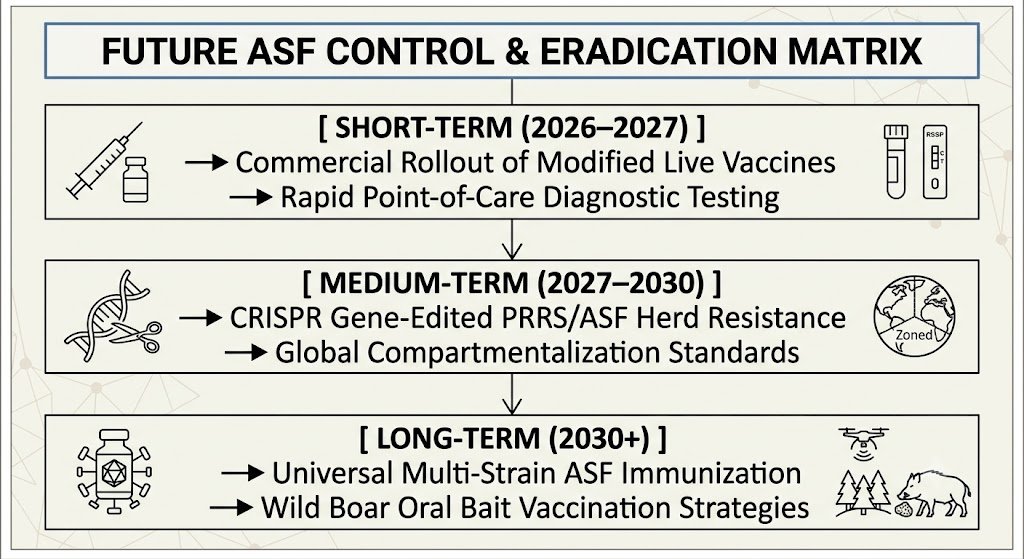
As the swine industry looks beyond late 2026, eradicating African Swine Fever will depend on advancing veterinary science, improving digital surveillance, and updating policy frameworks.
A. Next-Generation Vaccine Deployment
-
Modified Live Virus (MLV) Vaccines: The commercial approval of vaccines like AVAC ASF LIVE in the Philippines represents a significant milestone. However, safety monitoring remains crucial to prevent potential vaccine-strain reversion or recombination with field strains.
-
DIVA Capability: The next generation of ASF vaccines must incorporate Differentiating Infected from Vaccinated Animals (DIVA) markers to allow vaccinated regions to maintain international trade access without losing disease tracking capabilities.
B. Precision Genetics & Gene Editing
-
Host Resistance Research: CRISPR-Cas9 technologies targeting host factors essential for ASF replication (such as specific macrophage receptors) offer long-term promise for breeding inherently resistant commercial pig lines.
C. AI-Powered Early Warning Systems
-
Predictive Disease Analytics: Integrating internet-of-things (IoT) barn sensors, satellite land-use data, and wild boar movement models will enable veterinary authorities to issue predictive risk alerts, allowing farms to increase biosecurity protocols days before a regional outbreak occurs.
D. Global Policy Harmonization
-
WOAH and FAO continue to urge international trade partners to adopt formal compartmentalization agreements. By recognizing disease-free commercial sub-populations within an otherwise infected country, global pork supply chains can maintain stability while containing localized outbreaks.

