



US biotech start-up seeks to combine methane reduction with better cattle productivity
US livestock-biotechnology start-up Hoofprint Biome is developing a microbiome-based feed-additive platform designed to reduce methane emissions while improving digestive health and feed efficiency in cattle.
The company was co-founded by Kathryn Polkoff, an animal scientist and entrepreneur, and Scott Collins. The company’s central proposition is notable because it does not position methane reduction solely as an environmental objective.
Instead, Hoofprint is attempting to combine: methane reduction + improved rumen function + better feed efficiency + improved cattle productivity.
From microbiome research to commercial feed technology
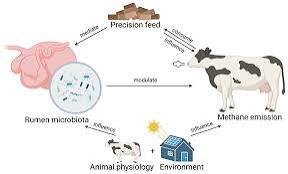
Hoofprint is developing natural enzymes and probiotics intended to alter the cattle gastrointestinal microbiome. The company’s approach is based on the observation that methane generation is strongly influenced by rumen microbial activity.
Its technology seeks to manipulate that microbial environment so that less feed energy is lost through methane production while improving nutrient utilisation.
Hoofprint reports that methane can account for a meaningful share of cattle feed energy, making methane reduction potentially relevant to animal productivity as well as sustainability.
The technology platform
The company’s technology combines:
-
microbiome engineering;
-
natural enzymes;
-
probiotic organisms;
-
fermentation;
-
feed-additive delivery.
A USDA-supported research programme involving Hoofprint has explored engineered Saccharomyces boulardii probiotic yeast capable of secreting anti-methane bioactive peptides.
The Phase I programme sought to identify peptides capable of substantially reducing methane production in artificial-rumen systems and develop a cost-effective probiotic-feed-additive platform.
That research is important because it provides a potential biological mechanism behind the company’s commercial proposition.
From climate technology to animal-health technology
The more interesting commercial question is whether methane reduction can be linked to measurable animal-performance benefits. A feed additive that only reduces emissions may face significant adoption barriers if farmers bear the cost while society captures most of the environmental benefit.
A product that simultaneously improves:
-
feed conversion;
-
digestive efficiency;
-
animal health;
-
growth;
-
milk production;
could have a much stronger commercial proposition. That is the strategic rationale behind Hoofprint’s positioning.
Current development stage
The company currently has approximately 12 employees and is scaling production of enzymes and probiotics using yeast fermentation.
The development remains a technology and product-development story rather than a mature commercial veterinary product. Large-scale commercial validation will be critical. The key questions for investors and producers will include:
-
Does the effect persist across different diets?
-
Does the technology work consistently across cattle populations?
-
What is the commercial dose?
-
What is the cost per animal?
-
Does methane reduction translate into better feed efficiency?
-
Can benefits be demonstrated under commercial farm conditions?
-
What regulatory pathway will apply across major dairy and beef markets?
Animal-health industry implications
The technology represents an important convergence between: animal health + animal nutrition + microbiome science + climate technology.
This convergence is likely to become increasingly important. Traditional categories are becoming less distinct. A product can simultaneously be:
-
a feed additive;
-
a microbiome intervention;
-
an animal-health product;
-
a productivity enhancer;
-
a carbon-reduction technology.

