

HomePoultryThailand Cuts Egg Exports Up to 50% After Floods Kill Millions of...

Thailand Cuts Egg Exports Up to 50% After Floods Kill Millions of Poultry Birds

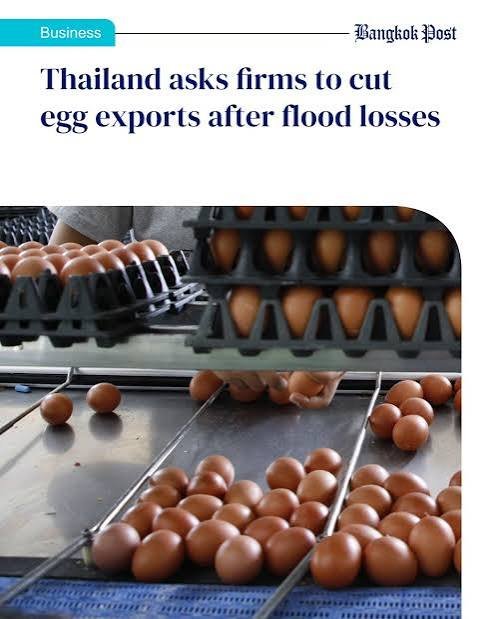
Thailand is tightening management of its egg supply chain after severe flooding disrupted major layer-producing areas and killed millions of poultry birds. The country’s Department of Internal Trade (DIT), under the Ministry of Commerce, has asked egg exporters to reduce shipments by 30–50% and, in some cases, postpone shipments through December 2026, with the objective of directing more eggs into the domestic market.

The intervention comes as flooding has caused substantial losses in eastern Thailand, particularly in Chachoengsao, one of the country’s important egg-producing areas. The latest assessment reported approximately 2.76 million dead laying hens, 483,228 dead pullets and 12,378 dead parent-stock birds in Chachoengsao, Chonburi, Prachinburi and Nakhon Nayok as of October 1.

The scale of mortality is significant because the impact is not limited to immediate egg output. The loss of productive hens reduces the national laying flock, while flooded roads, damaged farm infrastructure and disrupted logistics can prevent eggs from reaching wholesalers and retailers even where production capacity remains intact.

EXPORTS CUT TO PROTECT DOMESTIC SUPPLY

Thailand’s government has requested that exporters reduce egg shipments by 30–50% from normal levels. According to industry reporting, daily exports that normally run at approximately 800,000–900,000 eggs are expected to fall to around 600,000–700,000 eggs per day during the October–December intervention period.
Thailand egg exports 2026

Exporters have also been asked to submit their October and November export plans to the Department of Internal Trade so authorities can monitor supply conditions more closely.

The policy is primarily a domestic food-security and price-management intervention, rather than a formal export ban. Thailand remains an important regional supplier of fresh eggs, particularly to Singapore and Hong Kong.

Thailand exported approximately 518 million fresh eggs in 2025, worth about US$56.2 million, with Singapore accounting for approximately 74% of export value. Domestic consumption, however, dominates the sector: around 97% of Thailand’s egg production is consumed domestically, with exports accounting for only about 3%.

THE NUMBERS BEHIND THE SUPPLY SHOCK

Indicator
Latest position
Estimated dead laying hens
2.76 million
Dead pullets
483,228
Dead parent-stock birds
12,378
Normal national egg production
~42–43 million eggs/day
Normal daily exports
~800,000–900,000 eggs
Targeted export volume
~600,000–700,000 eggs/day
Export reduction requested
30–50%
Layer replacement age
80 → 85 weeks
Additional hens expected in system
~4.4 million
Additional eggs expected
~3 million/day
Target period
October–December 2026
Farm-gate price target
THB 4/egg

The government’s response is therefore broader than simply reducing exports. The DLD has asked layer farmers to extend the productive life of hens by approximately 3–5 weeks, moving the replacement age from 80 to 85 weeks. Officials estimate that this could add approximately 4.4 million laying hens to the production system and around 3 million eggs per day.

The government has also asked farmers to extend parent-stock replacement from 72 to 75 weeks, potentially supporting additional chick production.

PRICE PRESSURE IS ALREADY VISIBLE IN AFFECTED AREAS

The supply disruption has created localized price and availability pressure. Reports from affected areas have described shortages associated with transport disruption and higher prices for some egg sizes.

At the same time, Thailand’s authorities are attempting to prevent a nationwide price spike. The DIT has asked major producers to maintain the farm-gate price at approximately THB 4 per egg, while retailers and wholesalers have been asked to increase procurement and improve distribution.

This distinction is important: Thailand is experiencing a regional supply and logistics shock rather than a uniform national egg shortage. The Layer Farmers Association has indicated that national production remains substantial, at approximately 42–43 million eggs per day, but getting eggs from unaffected farms to consumers has become more difficult.

ANIMAL-HEALTH AND BIOSECURITY IMPLICATIONS

The event is also an animal-health warning.

Flooding can compromise poultry-house integrity, electrical systems, feed storage, drinking-water systems, manure management and farm access. Standing water and disrupted sanitation increase the importance of water quality, disinfection, pest control, carcass management and movement biosecurity.

The loss of millions of birds also creates a second-order challenge: farms attempting to rapidly rebuild production may increase stocking, extend flock age or move birds and equipment between locations. These actions require careful veterinary oversight because disease-control risks can increase when infrastructure and biosecurity systems are operating under stress.

For animal-health suppliers, the episode reinforces demand for farm biosecurity, water sanitation, vaccination support, diagnostic surveillance, feed additives, mycotoxin management, gut-health products and climate-resilient poultry housing.

REGIONAL TRADE IMPLICATIONS

Thailand’s intervention could temporarily tighten the regional egg market, particularly for buyers dependent on Thai supply.

Singapore is especially relevant because it has historically been Thailand’s dominant export destination. A sustained reduction in Thai shipments could encourage importers to seek alternative suppliers or adjust procurement schedules.

However, the scale of the impact should not be overstated. Because exports represent only around 3% of Thailand’s total egg production, the direct effect on total national production is relatively small. The more important issue is where the eggs are produced and whether they can be transported efficiently.

The event therefore demonstrates how a geographically concentrated climate shock can have consequences beyond farm mortality—affecting feed demand, flock replacement, logistics, trade flows, consumer prices and protein affordability.

ANALYST VIEW

Thailand’s egg-sector response is an increasingly relevant case study in climate-resilient animal agriculture.

The immediate policy—redirecting exports toward domestic consumers—is logical because eggs are a high-frequency, relatively affordable source of animal protein. But the longer-term lesson is more structural: poultry companies need to treat flood resilience as part of production economics rather than as a disaster-response issue.

The combination of 2.76 million dead laying hens, damaged production infrastructure, disrupted transport and a 30–50% export reduction demonstrates how quickly a regional climate event can translate into food-market intervention.

For Southeast Asia’s poultry industry, investment priorities are likely to increasingly include elevated housing, improved drainage, protected feed storage, emergency power and water systems, redundant logistics routes, stronger farm biosecurity and geographically diversified production.

For India and other Asian poultry markets, the Thailand event is a useful warning: climate resilience is becoming an animal-health, supply-chain and food-security investment—not simply an infrastructure issue.

Animal Health India Editorial Team
Animal Health India Editorial Teamhttps://animalhealthindia.com
Animal Health India (AHI) is an independent news and intelligence platform covering the global animal health, veterinary, livestock, poultry, companion animal and pet food sectors. Our editorial team comprises veterinary journalists, animal health professionals, regulatory affairs specialists and industry analysts with over 30 years of combined experience covering India, Asia, Europe and North America. AHI publishes news, regulatory updates, market intelligence and company news drawn from primary sources including DAHD, EMA, USDA, AVMA and leading veterinary publications worldwide.
RELATED ARTICLES