



Executive perspective: Pet Food is Becoming more than a Food Category
The global pet food industry is approaching a strategic inflection point. Its next phase of growth will not be determined solely by how many pets people own or how much food they buy. It will increasingly depend on what owners believe constitutes good nutrition, which health benefits they are willing to pay for, how credibly brands substantiate their claims, and whether manufacturers can deliver nutritional quality at a sustainable cost.
That is the central question behind food futurist Jack Bobo’s forthcoming keynote, Why the Future Belongs to Pet Food, at Petfood Forum 2027 in Kansas City, Missouri, scheduled for 26–28 April 2027. Bobo, executive director of UCLA’s Rothman Family Institute for Food Studies, argues that demographic change, premiumisation, protein economics and consumer trust could give pet food a different growth trajectory from human food.
His argument is provocative, but it is best understood as a strategic thesis rather than an established forecast. Pet food has structural advantages: owners often make purchasing decisions on behalf of dependent animals, and many are prepared to spend on products they believe support health and quality of life. Yet the category also faces inflation, affordability pressures, nutrition controversies, environmental scrutiny and rising expectations of scientific evidence.
The opportunity is therefore not simply to make pet food more expensive or more human-like. It is to create products whose nutritional value, safety, palatability, affordability and claimed benefits are demonstrably better aligned with the needs of pets and their owners.
The Market: Strong Growth, but Geography and Methodology Matter
The global pet food market is expanding, although estimates differ because researchers use different definitions of retail sales, manufacturer revenue, pet food products, treats and other categories.
Canada’s Agriculture and Agri-Food department, drawing on Euromonitor International data, estimates global pet food retail sales reached US$153.6 billion in 2025, up from US$98.8 billion in 2020. The same analysis forecasts sales of US$208.6 billion by 2030. These figures imply a projected compound annual growth rate (CAGR) of approximately 6.3% between 2025 and 2030.
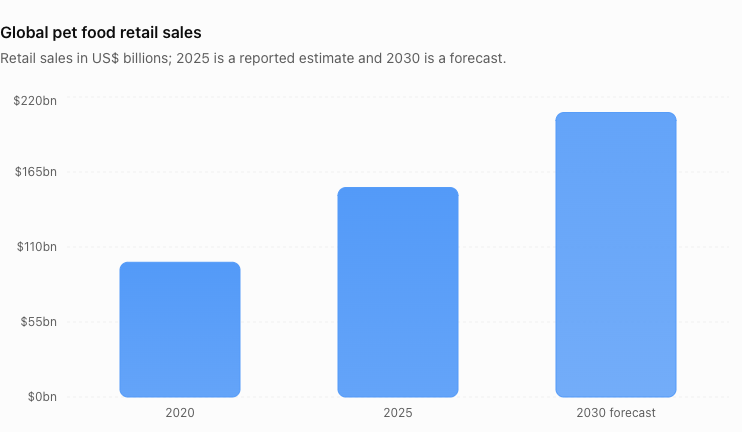
The scale is significant, but a global total can hide major differences between markets. The United States remains the largest market in the cited dataset, while China, Brazil and other large pet-owning countries have different growth drivers, price points, retail structures and feeding practices. Premium products may expand quickly in one market while value-oriented products dominate in another.
Europe also represents a large, mature market. FEDIAF’s 2026 facts and figures report, based on 2024 data, estimates that 140 million European households—49% of households in the covered countries—own at least one pet. It counts approximately 306 million pets and annual pet food sales of €29.4 billion, with volumes around 8.6 million tonnes. FEDIAF cautions that the geographical coverage has changed, so simple year-on-year comparisons require care.

The industry’s future should therefore be assessed across at least three dimensions:
-
Market expansion: more pet-owning households, greater formalisation of feeding and wider distribution.
-
Value growth: premium products, specialised diets and functional nutrition.
-
Productivity and affordability: formulation efficiency, manufacturing performance and accessible nutrition for price-sensitive consumers.
A rising sales value does not automatically mean that owners are buying more food, that pets are receiving better nutrition, or that manufacturers are achieving higher margins. Price inflation, product mix and changes in distribution can all influence market value.
Demographics may be a More Durable Growth Engine than Consumer Enthusiasm
Bobo’s demographic argument is important because pet food is purchased repeatedly. Once a household adopts a dog or cat, feeding becomes a recurring requirement. Changes in the number and type of pet-owning households can therefore influence category demand for years, even when consumers become more cautious about discretionary spending.
US industry data illustrate the demographic shift. The American Pet Products Association (APPA) reported that 94 million US households owned at least one pet in 2024. Its 2025 Dog & Cat Report also highlighted the rise in cat ownership, including strong adoption among younger owners. PetfoodIndustry’s summary of the APPA report said US cat ownership increased 23% in 2024 to 49 million households.
This matters for product development. Different household cohorts may seek different combinations of convenience, price, ingredient transparency, life-stage nutrition and perceived health benefits. But age alone is not a reliable predictor of what an individual owner will buy. Income, pet type, household size, veterinary advice and local availability also influence purchasing.
Three demographic changes deserve particular attention:
The ageing pet population. Longer lives increase the importance of weight management, digestibility, dental health, mobility and diets tailored to age or diagnosed conditions. These needs create opportunities for evidence-based products, but brands should not imply that ordinary foods treat diseases unless the claims and product category legally support that use.
Younger owners and changing household structures. Newer pet owners may be more comfortable with online discovery, subscriptions, product comparison and specialised formats. Their interest in pet wellbeing can support premium categories, but high price sensitivity may constrain repeat purchases.
Cats as a growth opportunity. Cats are becoming more commercially important in several markets. Their feeding needs, hydration patterns and product preferences differ from dogs’, making species-specific formulation and portfolio strategy essential.
The commercial implication is that premiumisation should not be modelled as a uniform increase in willingness to pay. It is more likely to be a segmented market, with premium products growing alongside value brands, mainstream complete diets and targeted nutrition products.

Premiumisation: the Next Premium will Need to Prove its Value
Premium pet food has historically relied on cues such as meat-first formulations, named animal proteins, grain-free positioning, natural ingredients, breed-specific recipes and human-grade language. Some of these cues may communicate product positioning, but none independently proves nutritional superiority.
The more durable premium proposition is likely to combine:
-
Nutritional adequacy for the intended species and life stage.
-
Consistent digestibility, palatability and manufacturing quality.
-
Ingredient traceability and credible sourcing.
-
Clear, appropriately supported functional claims.
-
Product safety and robust quality assurance.
-
Convenient formats and dependable availability.
The APPA-linked trend reporting points to continued interest in functional food toppers and mixers. In its summary of the 2025 Dog & Cat Report, PetfoodIndustry reported that use of these formats had risen 129% for dogs and 138% for cats since 2018. It also reported substantial increases in supplement use over the same period. These are category-specific US findings, not evidence that every premium segment is growing at the same rate.
The strategic test: can a brand explain what its product does, for which animal, under what conditions, and what evidence supports the claim? If the answer is unclear, the premium may be based primarily on marketing rather than a durable nutritional advantage.
Protein is not One Market: Low-Cost Supply and Premium Quality will Diverge
Protein will remain central to pet food, but the future will not be a simple contest between animal protein and alternatives. The real questions concern amino-acid profile, digestibility, palatability, ingredient functionality, supply reliability, cost and environmental impact.
The industry will continue to use conventional animal-derived proteins, rendered ingredients and by-products from human food systems. These materials can provide valuable nutrients and make use of resources that might otherwise be wasted. At the same time, manufacturers are evaluating plant proteins, insect ingredients, yeast, mycoprotein, bacterial proteins, algal ingredients and cultivated meat.
A 2025 peer-reviewed review in Foods examined alternative protein sources across plant, aquatic, insect-derived and cell-based categories, covering research publications, patents and product trends. It demonstrates that alternative proteins are a serious area of research and commercial development, but it does not establish that any single alternative is ready to replace conventional proteins at scale across all dog and cat diets.
Emerging ingredient options and their commercial readiness
Ingredient class |
Potential role |
Key challenges |
|---|---|---|
Conventional animal proteins and by-products |
Established sources of protein and other nutrients |
Price volatility, sourcing, traceability and environmental footprint |
Plant proteins |
Cost-effective protein and formulation flexibility |
Amino-acid balance, digestibility, palatability and antinutritional factors |
Insect proteins |
Diversified protein supply; potential use of selected side streams |
Scale, substrate controls, regulatory requirements, cost and acceptance |
Yeast and mycoprotein |
Fermentation-derived protein and functional ingredients |
Production economics, consistency, palatability and evidence for specific applications |
Algal proteins and oils |
Potential protein, lipid and specialised nutrient sources |
Cost, scale, formulation performance and species-specific suitability |
Bacterial proteins |
Potentially efficient production in controlled fermentation |
Regulatory status, manufacturing scale, safety validation and economics |
Cultivated meat |
Potential source of animal cells without conventional livestock production |
Cost, production scale, nutrient composition, regulation and consumer acceptance |
This is a qualitative industry assessment, not a ranking of approved ingredients or proof of nutritional equivalence. Ingredient suitability must be assessed for the specific species, product and inclusion level.
A useful recent example is the Centre for Feed Innovation’s Alternative Ingredients in Pet Food report, developed with the Pet Sustainability Coalition. Its assessment covers nine ingredients and 2,271 US dog and cat food products containing alternative ingredients. It estimates that the ingredient stage accounts for 42–80% of pet food’s overall environmental impact, depending on the assessment. The report recommends prioritising yeast protein and algal oil for certain applications, evaluating bacterial protein and mycoprotein selectively, and monitoring other categories where evidence, scale, cost or acceptance remain constraints.
This is a more nuanced framework than treating all alternatives as equally mature. Algal oil, for example, may replace or supplement conventional oils without serving as the main protein source. Yeast may have a credible role in specific formulations without being a universal substitute for meat. Cultivated meat may attract substantial attention while still facing significant cost and scale barriers.
What “quality over quantity” should mean
Quality should be measured by the nutritional and functional contribution of an ingredient in the finished diet, not by its prestige or novelty. The same ingredient can perform differently depending on processing, formulation and inclusion rate.
For product developers, the priority is to validate the finished food: nutrient adequacy, digestibility, palatability, stability, safety and consistency. For procurement teams, the challenge is to balance quality with supply resilience and cost. For marketing teams, the opportunity is to explain these trade-offs without implying that an expensive or unfamiliar protein is inherently superior.

Sustainability: Important for Strategy, Insufficient as a Standalone Sales Pitch
Pet food’s environmental footprint is materially influenced by its ingredients. Meat and fish inputs, land use, agricultural production, processing, packaging and transport all contribute, with relative impacts varying by ingredient and production system.
A 2024 life-cycle assessment of a wet vegan dog food reported a 37% lower climate-change impact than its meat-based comparator under the study’s assumptions. However, the same assessment found higher impacts in some other categories, including land use and freshwater eutrophication. The authors’ results demonstrate why a single carbon metric cannot establish that one diet is environmentally better across every dimension.
A separate 2024 life-cycle assessment of extruded dog food found that ingredient choice was a key determinant of environmental impact and highlighted the potential role of animal and vegetable by-products from the wider food system.
These findings support three principles for the future.
First, sustainability must be measured across multiple impact categories. Climate emissions, land use, water use, eutrophication, biodiversity and resource efficiency can move in different directions. A product with a lower carbon footprint is not automatically better across all environmental dimensions.
Second, alternatives must be nutritionally appropriate. Environmental benefits do not justify compromising the nutrient requirements of dogs or cats. Cats, in particular, have specific nutritional requirements that make formulation and validation essential.
Third, sustainability claims need transparent boundaries. Companies should disclose what is being compared, the life-cycle stages included, the functional unit used and the assumptions that materially affect the result.
Bobo’s behavioural point is equally important: a sustainability argument may matter to some owners, but it is unlikely to be sufficient for everyone. The more compelling commercial proposition may be one that combines credible environmental benefits with clear nutritional value, acceptable taste, safety and price.
Trust: the Foundation of the Next Pet-Food Business Model
Pet food is an unusually trust-sensitive category. Owners buy a product for an animal that cannot independently evaluate its ingredients, interpret its label or report subtle adverse effects. The brand must therefore earn trust from the person making the purchase while delivering appropriate nutrition to the animal consuming the product.
Trust can be damaged by exaggerated health claims, unclear ingredient descriptions, poorly explained recalls, inconsistent quality or marketing that overstates the evidence. It can also be weakened when different brands use scientific terminology to imply benefits that have not been established for the finished product.
The key question is not whether consumers trust science in the abstract. It is whether they believe a particular company is using science honestly, acknowledging uncertainty and placing animal wellbeing ahead of exaggerated commercial claims.
A 2025 survey of 2,639 dog guardians, published in Frontiers in Veterinary Science, offers a useful illustration of the gap between interest in sustainability and actual feeding behaviour. More than 84% of respondents reported feeding conventional or raw meat-based diets, while over 43% found at least one of the sustainable alternatives presented acceptable. Willingness to purchase alternatives most commonly depended on confidence in nutritional soundness; cultivated-meat-based dog food was the most popular of the alternative options in the survey.
What trust-building looks like in practice
-
Publish clear nutritional and ingredient information without implying that every novel ingredient is superior.
-
Substantiate functional claims with evidence relevant to the finished product and intended animal.
-
Maintain traceability and explain sourcing decisions.
-
Communicate product recalls, safety issues and corrective actions promptly.
-
Distinguish complete diets from complementary foods, toppers, treats and supplements.
-
Make it easy for veterinarians and owners to understand the intended use of a product.
-
Be transparent about what the evidence does not yet establish.
Bobo’s memorable formulation—“Without it, consumers won’t look at your science; with it, they won’t need to”—is best read as a statement about the role of credibility in communication, not as an argument that scientific evidence becomes unnecessary once a brand is trusted. In animal nutrition, trust and evidence must reinforce one another.
The Manufacturing Revolution: the Future is Also About Execution
Much of the public conversation about pet food focuses on ingredients, claims and consumer trends. Yet manufacturing capacity, process control, automation and cost efficiency will determine which innovations reach the market at a viable price.
Petfood Forum 2027 is introducing a pre-event seminar, The Operational Edge: Optimizing Your Pet Food Manufacturing Pipeline, scheduled for 26 April. The programme is intended to cover equipment integration, preventive maintenance, changeover efficiency, automation and data-driven decision-making.
These operational issues become more important as product portfolios diversify. A manufacturer may need to run more recipes, textures, pack sizes and ingredient systems while maintaining reliable throughput and strict quality controls. Frequent changeovers can reduce productive time; novel ingredients may introduce new handling or processing requirements; and a premium product can fail commercially if supply is inconsistent.
Future competitiveness will therefore depend on more than successful product development. Manufacturers need to integrate:
-
Ingredient qualification and supplier assurance
-
Process validation and finished-product quality testing
-
Predictive maintenance and reliable equipment performance
-
Flexible production lines and efficient changeovers
-
Traceability, batch-level records and recall readiness
-
Cost management that protects nutritional and safety standards
India: a High-Growth Opportunity, with Affordability and Trust at its Centre
India is an especially important market for assessing the future of pet food because it combines expanding pet ownership, a growing formal retail sector and a wide range of consumer purchasing power.
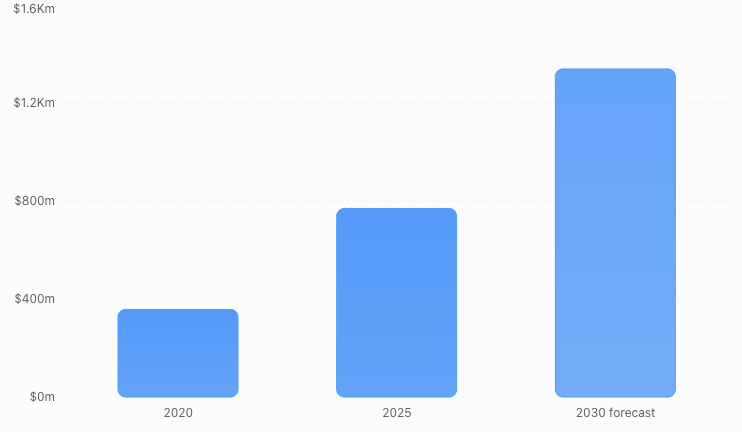
Agriculture and Agri-Food Canada’s sector analysis, using Euromonitor International data, estimates that Indian pet food retail sales reached US$769.7 million in 2025, up from US$357.5 million in 2020.
It forecasts sales of approximately US$1.34 billion by 2030, implying a projected CAGR of 11.7% between 2025 and 2030. These are market estimates and forecasts, not audited industry accounts.
The same source estimates that dogs accounted for US$540.1 million of Indian pet food retail sales in 2025, while cat food accounted for US$213.9 million. The report projects cat food to reach approximately US$439.6 million by 2030, compared with US$877.4 million for dog food. It also reports that India imported Can$192.9 million in pet food in 2025 and exported Can$110.2 million, indicating a trade deficit in the category.
These estimates suggest several strategic opportunities:
Local manufacturing and supply resilience – Import dependence creates an incentive to assess domestic production, ingredient sourcing, quality systems and distribution. However, local manufacturing is not automatically more competitive; costs, equipment, scale, quality assurance and access to suitable ingredients still matter.
Species-specific growth – Dog food remains the largest category, while cat food has grown rapidly from a smaller base. Companies should not treat the two categories as interchangeable. Nutritional requirements, feeding patterns, formats and purchasing behaviour differ.
A wider price ladder – India’s opportunity is unlikely to be served by premium-only strategies. Complete everyday nutrition, accessible value products, mid-market upgrades and carefully substantiated specialist products can serve different segments.
Digital and omnichannel distribution – E-commerce and quick commerce can improve convenience and product discovery, but repeat purchase will depend on price, availability, delivery economics, product acceptance and confidence in authenticity.
Education and veterinary engagement – As the market expands, clear communication about complete diets, life-stage needs, feeding quantities and the difference between evidence-based claims and marketing language can support better-informed purchasing.
For Indian manufacturers and international brands, the most durable opportunity is likely to combine reliable nutrition with local price points, credible quality systems and products tailored to the actual needs of Indian pet-owning households.
What Industry Leaders Should do Now
Strategic priority |
Recommended action |
Metrics to monitor |
|---|---|---|
Product and nutrition science |
Prioritise clear nutritional needs and validate the finished diet |
Nutritional adequacy, digestibility, palatability, safety and substantiated outcomes |
Premium portfolio |
Build products around demonstrable value, not ingredient prestige alone |
Repeat purchase, retention, price realisation and contribution margin |
Protein strategy |
Qualify a diversified portfolio of conventional and alternative ingredients |
Cost per usable nutrient, supply reliability, quality variation and environmental impact |
Sustainability |
Use comparable, transparent life-cycle assessments |
Climate impact, land and water use, sourcing traceability and waste reduction |
Consumer trust |
Improve label clarity, evidence communication and safety transparency |
Complaint rates, recall performance, customer retention and claim substantiation |
Manufacturing |
Improve line efficiency, quality control and production flexibility |
Overall equipment effectiveness, changeover time, yield, waste and cost per tonne |
India growth strategy |
Match products and channels to local affordability and species needs |
Household penetration, repeat purchase, cat-food growth, distribution and local production economics |
The key strategic questions for a board or leadership team
-
Which customer needs can we serve materially better than existing products?
-
Which premium claims can we substantiate for the finished food?
-
Where do alternative ingredients offer a genuine formulation or supply advantage?
-
Can we deliver the product at a price that supports repeat purchase?
-
How much of our growth comes from volume, price increases, acquisitions or product mix?
-
Can our manufacturing and quality systems support more complex formulations without undermining consistency?
-
What evidence would cause us to discontinue a product or revise its claims?
These questions turn the future-of-pet-food debate from a marketing narrative into a practical business strategy.
Petfood Forum 2027: Why the Keynote Matters
Jack Bobo’s keynote, Why the Future Belongs to Pet Food, is scheduled for the morning of 27 April 2027 at Petfood Forum in Kansas City. The event runs from 26–28 April, with a new pre-show manufacturing-efficiency seminar on 26 April. The full conference agenda is still being developed, according to the organiser’s published agenda. The keynote’s value is likely to lie in challenging three common assumptions:
-
That pet food will simply follow the same consumer and sustainability trends as human food.
-
That premiumisation is primarily a temporary mood rather than a result of structural demographic and household changes.
-
That scientific evidence alone can persuade customers without prior confidence in the company communicating it.
The strongest interpretation is not that pet food is guaranteed to outperform human food, or that sustainability and science matter less. Rather, pet food has a distinctive relationship between the purchaser, the animal and the product. That creates an opportunity for brands that can translate nutritional quality into credible, understandable and repeatable value.
Conclusion: Future Belongs to Products that Earn Their Premium
The pet food industry has a credible growth runway. Global retail sales were estimated at US$153.6 billion in 2025, Europe remains a substantial market, and India is projected to grow faster than the global average in the cited market analysis. Demographics, the development of specialised products and the emergence of new ingredient technologies create multiple routes to expansion.
But growth will not automatically reward every premium brand, novel protein or sustainability claim. The industry’s next phase will separate products that merely look innovative from those that deliver consistent nutritional quality, safety, palatability and value.
The most durable competitive advantage will come from combining four capabilities:
-
Nutrition: formulations that meet the needs of the intended animal.
-
Evidence: claims supported by appropriate data rather than marketing inference.
-
Trust: transparent communication and reliable quality.
-
Execution: manufacturing and distribution that make the product affordable and consistently available.
Bobo’s central proposition—that the pet food market may follow a different path from human food—is a useful lens for the coming decade. The opportunity is real, but it is conditional: the industry must earn consumer trust while proving that its products deliver on their promises.
References and further reading
-
Petfood Forum / PetfoodIndustry (21 October 2026). Food futurist Jack Bobo keynotes Petfood Forum 2027. Keynote thesis, speaker background and event details.
-
Petfood Forum. Official 2027 agenda. Event schedule and manufacturing seminar.
-
Agriculture and Agri-Food Canada (2026). Sector Trend Analysis — Pet food trends in India. Market estimates, forecasts, imports, exports and species categories, drawing on Euromonitor International.
-
FEDIAF (2026). European pet population and market data. European pet ownership and 2024 pet food sales and volume.
-
American Pet Products Association (2025). 2025 State of the Industry Report. US pet ownership and industry spending.
-
PetfoodIndustry (23 June 2025). Report: Four key trends shaping the pet food industry. Summary of APPA dog and cat trends.
-
Foods (2025). Comprehensive review of alternative proteins in pet food. Research, patents and product trends across plant, aquatic, insect and cell-based sources.
-
Centre for Feed Innovation / Pet Sustainability Coalition (2026). Alternative Ingredients in Pet Food. Ingredient readiness, supply, environmental impact and commercial considerations.
-
Frontiers in Veterinary Science (2025). Consumer acceptance of sustainable dog diets: a survey of 2,639 dog guardians. Consumer attitudes towards conventional and alternative diets.
-
Cleaner Environmental Systems (2024). A life-cycle assessment of vegan dog food. Environmental comparisons and trade-offs.
-
Journal of Cleaner Production (2024). Life-cycle assessment of extruded dog food in Brazil. Ingredient choice and environmental impact.

