


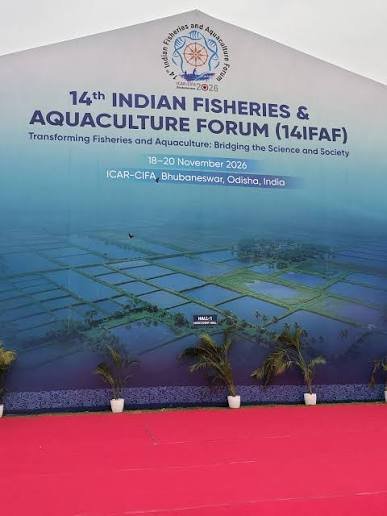
India’s fisheries and aquaculture research community is meeting in Bhubaneswar for the 14th Indian Fisheries and Aquaculture Forum (14IFAF), a three-day scientific conference running from 18 to 20 November 2026. Hosted at ICAR–Central Institute of Freshwater Aquaculture (ICAR-CIFA), the forum brings together researchers, policymakers, industry participants and farming communities to examine how scientific advances can translate into more productive, resilient and sustainable aquatic food systems.
The conference is jointly organised by the Asian Fisheries Society Indian Branch (AFSIB), ICAR-CIFA, the Department of Fisheries, Government of India, the National Fisheries Development Board (NFDB), Odisha’s Fisheries and Animal Resources Development Department and the Association of Aquaculturists. The theme, “Transforming Aquaculture and Fisheries: Bridging Science and Society,” reflects the need to connect research with practical challenges faced by fish farmers, hatcheries, feed manufacturers and aquatic-health professionals.
A Significant National Platform for Aquatic Animal Health
The forum’s relevance to the animal-health industry extends well beyond fish production. Aquaculture intensification, changes in water quality, high stocking densities, movement of seed and live aquatic animals, and climate variability all influence disease risk. Disease outbreaks can reduce survival, slow growth, increase feed-conversion ratios, raise treatment costs and undermine the economics of a production cycle.
For India’s aquaculture sector, the priorities include improving disease detection, strengthening hatchery biosecurity, developing reliable diagnostic capacity and translating research into farm-level health-management protocols. These are not isolated veterinary issues: they influence the performance of the entire value chain, from broodstock and seed production to grow-out farms, processing and export markets.
Why surveillance and biosecurity need to move closer to the farm
Disease management in aquatic systems presents specific challenges. Unlike terrestrial livestock, fish and shrimp are raised in environments where pathogens can move through shared water, equipment, carrier animals, untreated intake water and the movement of seed. A disease problem may therefore spread across multiple ponds or farms before clinical signs are recognised. A stronger surveillance system needs to combine:
-
Regular observation of mortality, feeding behaviour and growth performance.
-
Diagnostic testing of broodstock, hatchery seed and affected stocks.
-
Water-quality monitoring, including dissolved oxygen, temperature, pH and salinity.
-
Farm-level records of stocking, mortality, treatments and harvest.
-
Protocols for equipment disinfection, water treatment and movement control.
-
Rapid reporting and coordinated response when unusual mortality occurs.
The commercial opportunity is significant for aquatic animal-health businesses. Diagnostic laboratories, molecular testing providers, water-treatment companies, probiotics and functional-feed suppliers can all contribute to a more preventive model of aquaculture health.
Sustainable Aquaculture is also an animal-health strategy
Sustainability and disease prevention are closely connected. Poor water quality and excessive organic loading can create conditions that increase stress and disease susceptibility. Conversely, better pond preparation, appropriate stocking density, feed management and water exchange can reduce avoidable disease pressure.
The industry is increasingly interested in approaches that reduce dependence on indiscriminate antimicrobial use while improving farm productivity. These include pathogen screening, vaccination where suitable products and species-specific evidence exist, biosecurity protocols, selective breeding for disease resilience and improved nutrition.
For India, the challenge is to make these approaches practical for small and medium-sized producers, not just large integrated aquaculture businesses. Affordable diagnostics, accessible veterinary and aquatic-health extension services, and clear protocols in regional languages will be important to adoption.
What the Forum Means for India’s Animal-Health Industry
The 14IFAF offers a platform for researchers and commercial stakeholders to identify where scientific capability can be translated into products and services. The areas worth watching include aquatic vaccines, rapid diagnostics, hatchery health, probiotics, functional feeds, disease-resistant genetics and digital farm surveillance.
As the conference concludes on 20 November, the important measure of success will be whether the discussions lead to stronger collaboration between laboratories, farmers, policymakers and the private sector. India’s aquaculture expansion will depend not only on production technology, but also on its ability to prevent, detect and manage aquatic animal diseases.

