


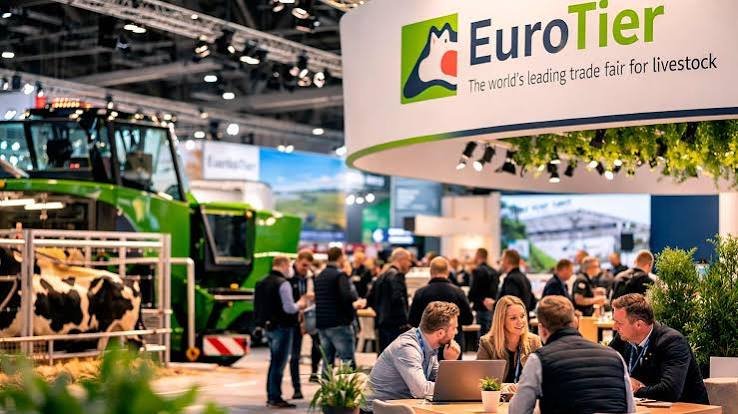
EuroTier 2026 is taking place in Hanover from 10 to 13 November under the theme “Intelligence in Animal Farming”. Its inaugural DLG-VetCon, held on 12–13 November, is providing a dedicated continuing-education and networking platform for livestock veterinarians, with sessions spanning herd health, fertility, probiotics, poultry biosecurity, animal nutrition, diagnostics and artificial intelligence.
EuroTier 2026, one of the world’s leading trade fairs for professional livestock farming and animal management, is entering its final days in Hanover, Germany.
The four-day exhibition, organised by the German Agricultural Society (DLG), runs from 10 to 13 November and brings together livestock producers, veterinarians, equipment manufacturers, feed companies, technology developers, researchers and animal-health businesses.
The guiding theme for this year’s event is “Intelligence in Animal Farming”, reflecting the growing importance of digitalisation, automation, data-driven management and artificial intelligence in commercial animal production.
A major addition to the 2026 programme is the inaugural DLG-VetCon, a two-day international continuing-education and networking event specifically designed for livestock and herd veterinarians.

DLG-VetCon: a dedicated veterinary platform within EuroTier
DLG-VetCon takes place on 12 and 13 November in the EuroTier conference area. The event is designed to connect veterinary professionals with developments in livestock production, scientific research, animal-health technology and practical farm management. Its programme covers four broad areas:
-
Animal health and prevention.
-
Herd management and productivity.
-
Animal nutrition and feed additives.
-
Technological innovation, diagnostics and early disease detection.
The event is recognised under Section 10 of the German Academy for Continuing Veterinary Education (ATF) statutes. Participants can receive up to 12 ATF continuing-education hours for the full programme, or six hours for a single day.
The format is significant because it places veterinary education directly alongside a major international livestock technology exhibition, enabling practitioners to connect scientific knowledge with equipment, products and commercial solutions.

Day 3: fertility, inflammation and species-specific workshops
The Thursday, 12 November programme opened with discussions on the future of livestock veterinary practice and the need to prepare the next generation of practitioners. A key scientific theme was the relationship between inflammation, metabolic stress and reproductive performance.
The programme included a presentation on infertility associated with inflammation and metabolic stress, followed by workshops across cattle, pigs, poultry and horses.
Cattle: transition-cow management
The cattle workshop examined the role of inflammation in successful transition-cow management. The transition period around calving is one of the most physiologically demanding stages in a dairy cow’s production cycle.
Metabolic stress, negative energy balance, immune dysfunction and inflammatory responses can influence:
-
Dry-matter intake.
-
Ketosis risk.
-
Metritis and uterine health.
-
Mastitis susceptibility.
-
Fertility and conception.
-
Early-lactation milk production.
The focus on inflammation reinforces the growing emphasis on integrating metabolic health, nutrition, reproduction and veterinary management.
Pigs: probiotics and production systems
The pig workshop addressed the use of probiotics in pig farming. Interest in microbiome management has increased as producers seek alternatives and complements to conventional approaches for improving gut health, feed efficiency and resilience.
The practical questions include strain selection, viable dose, administration timing, compatibility with feed processing and the ability to demonstrate consistent production benefits.
Poultry: vaccine application and botulism
The poultry sessions covered options for spray application of vaccines in rearing and laying houses, as well as a case report involving botulism in broiler chickens during summer 2026.
Vaccine delivery through spray systems can be useful in large flocks, but success depends on droplet characteristics, environmental conditions, bird distribution, vaccine handling and application technique.
The botulism case discussion provides a practical disease-management dimension, particularly around litter, carcass management and environmental contamination.
Equine medicine
The equine workshops addressed reproductive management, internal medicine, respiratory disease and colic. These sessions reflect the breadth of ambulatory veterinary practice, where clinical decision-making often has to be undertaken in field conditions with limited diagnostic infrastructure.
Day 4: biosecurity, probiotics and artificial intelligence
Friday, 13 November brings a further set of sessions focused on livestock health, production efficiency and digital technologies.
Probiotics and the physiology–immunology connection
A keynote session examines when probiotics should be administered and how they can be incorporated into animal husbandry. The physiology–immunology–probiotic relationship is particularly relevant to young animals, production stress and gastrointestinal health.
However, the practical value of probiotics depends on product-specific evidence, including strain identity, viable counts, stability and demonstrated outcomes in the target species.
Transport biosecurity
Another major session addresses how livestock transport management can influence biosecurity. Animal movement is a recognised pathway for disease transmission, particularly when transport vehicles, loading facilities and holding areas are inadequately cleaned and disinfected.
AI-supported veterinary practice
One of the programme’s technology-focused sessions is titled “More than just diagnoses: How vets can use AI to support farms more effectively”. The topic reflects the increasing role of artificial intelligence in veterinary workflows. Potential applications include:
-
Automated monitoring of animal behaviour.
-
Early detection of disease-related changes.
-
Milk-production and rumination analytics.
-
Reproductive monitoring.
-
Image-based disease screening.
-
Predictive herd-health alerts.
-
Decision-support tools for veterinary practitioners.
The commercial opportunity is considerable, but AI systems must be evaluated for diagnostic accuracy, false-alert rates, data quality, usability and integration with farm-management systems.
The event also includes a session on dry-off management, focusing on how metabolic and general health before dry-off can influence the subsequent lactation.
EuroTier’s wider technology and commercial programme
DLG-VetCon is part of a much larger exhibition covering the livestock value chain. EuroTier 2026 includes dedicated programmes for cattle, pigs, poultry, horses, feed and additives, research, start-ups and young professionals.
The new EuroTier Milky Way format brings together technologies and services across the dairy value chain, from genetics and animal identification to grazing, forage, milking, cooling and processing.
The exhibition also features innovation tours, expert stages and technology demonstrations focused on livestock production, energy and emission reduction.
For animal-health companies, the exhibition offers opportunities to engage with producers and veterinary professionals who influence product adoption and purchasing decisions.
What the event signals for the animal-health industry
The combination of EuroTier and DLG-VetCon highlights several structural changes in the livestock sector.
1. Veterinary practice is becoming increasingly data-driven. Digital monitoring, early-warning systems and AI-supported workflows are moving closer to routine herd management.
2. Preventive health is receiving greater emphasis. Biosecurity, vaccination, nutrition and early disease detection are central to productivity and resilience.
3. Gut health and microbiome management remain active innovation areas. Probiotics and other nutritional interventions are being evaluated as tools for animal health and production efficiency.
4. Veterinary and farm-management expertise are converging. The event’s design encourages direct exchange between veterinarians, farmers, researchers and technology providers.
5. Sustainability and productivity are increasingly interconnected. Feed efficiency, emissions reduction, reproductive performance and animal welfare are being addressed within integrated production systems.
Outlook
The inaugural DLG-VetCon represents a useful addition to the EuroTier programme by giving livestock veterinarians a dedicated platform for professional education and industry engagement.
Its emphasis on practical workshops, herd health, biosecurity, nutrition and AI reflects the changing requirements of modern livestock practice.
For the global animal-health industry, EuroTier 2026 is an important meeting point for the convergence of veterinary science, livestock technology and commercial innovation. The inaugural DLG-VetCon strengthens that connection by placing veterinary professionals at the centre of discussions about the future of intelligent animal farming.

