
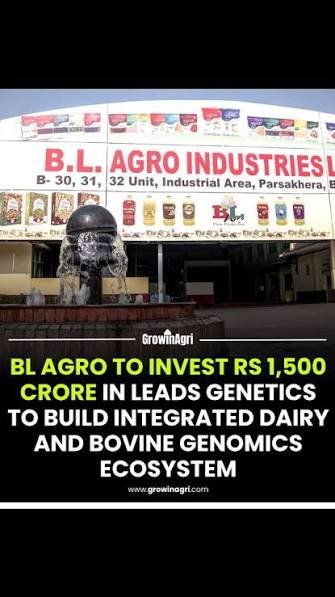
BL Agro Industries Ltd has committed ₹1,500 crore to its biotech subsidiary Leads Genetics to develop an integrated dairy and cattle-genetics ecosystem spanning genomics, reproductive technologies, animal health, nutrition, milk production and downstream processing.
The investment represents a significant move by an Indian agribusiness into a more vertically integrated genetics-to-milk value chain, with the company positioning its model as a “360-degree circular economy” for dairy.
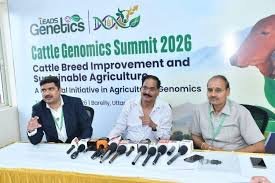
The programme was discussed around the Cattle Genomics Summit 2026 in Bareilly, Uttar Pradesh, where Leads Genetics showcased developments in genomic selection and advanced cattle-reproduction technologies.
From cattle genetics to the milk value chain
According to the company, the ₹1,500 crore investment will support an integrated platform bringing multiple components of dairy production under a coordinated system. These include:
-
Breed-improvement farms
-
Genomics laboratories
-
IVF and embryo-transfer facilities
-
Multiple Ovulation and Embryo Transfer (MOET)
-
Pathology laboratories
-
Elite-bull development
-
Embryo and sexed-semen production
-
Animal-health interventions
-
Nutrition and farmer-support programmes
-
Milk production and collection
-
Processing and market linkages
The objective is to shorten the genetic-improvement cycle and increase access to advanced reproductive technologies within India rather than relying predominantly on imported high-end germplasm.
15,000 embryos a month targeted by 2027
A key operational target is the development of Leads Genetics’ Centre of Excellence in Bareilly, with the company targeting production of approximately 15,000 embryos per month by the end of 2027.
The programme incorporates IVF, embryo transfer and genomic selection, while Leads Genetics is also working on elite bulls, embryos and sex-sorted semen.
The company has highlighted genomic selection as a mechanism for identifying desirable traits earlier in the breeding process, potentially accelerating genetic progress compared with conventional selection methods.
Zebu-optimised genomic technology
One of the developments showcased at the cattle-genomics event was a Zebu-optimised bovine SNP chip.
SNP-chip technology enables animals to be assessed across large numbers of genetic markers. In a breeding programme, such information can help identify animals carrying genetic characteristics associated with traits such as milk production, fertility, growth, health and environmental adaptation.
Leads Genetics also demonstrated next-generation sequencing using an Illumina NovaSeq X platform, reinforcing the company’s focus on genomics and data-driven livestock breeding.
Focus on Indian-adapted genetics
The strategy has an important India-specific dimension.
India is the world’s largest milk-producing country, but average productivity per animal remains an important industry challenge. Leads Genetics is positioning domestic genomic selection and reproductive technologies as tools for improving genetic performance while supporting indigenous breeds and cattle better adapted to Indian climatic conditions.
The company’s programme also seeks to reduce dependence on imported high-end germplasm.
The initiative is therefore broader than conventional dairy expansion: it represents an attempt to build domestic capabilities across the genetics–reproduction–animal health–nutrition–milk continuum.
Expansion beyond Uttar Pradesh
Leads Genetics is reportedly discussing replication of the integrated model with governments and stakeholders in Uttar Pradesh, Maharashtra, Bihar and Madhya Pradesh.
This could create a multi-state platform combining breeding infrastructure with farmer extension and access to reproductive technologies.
However, the publicly reported sources reviewed for this article do not substantiate the previously stated target of more than one million farmers and 10 million litres/day of milk procurement by 2030. Those figures should therefore not be presented as confirmed company targets without a primary BL Agro source.
Animal health becomes part of the genetics strategy
An important feature of the BL Agro model is that animal health is not being treated separately from breeding. The company describes the 360-degree model as spanning genetics, breeding, animal health, nutrition, milk production, processing and market linkages.
This is strategically relevant because genetic improvement alone does not necessarily translate into higher farm productivity. Expression of genetic potential depends on nutrition, reproductive management, disease control, housing, heat-stress management and overall herd health.
An integrated platform could therefore allow BL Agro to capture value across several layers of the dairy production chain rather than relying exclusively on genetics-related revenues.
What the investment means for India’s dairy industry
The investment represents a broader shift toward technology-led livestock productivity.
India’s dairy industry has historically been fragmented, with genetics, breeding services, veterinary care, feed, milk procurement and processing often operating through separate channels. BL Agro’s strategy attempts to connect these components.
From an animal-health industry perspective, the model creates potential demand for:
Genetics → Reproductive technology → Animal health → Nutrition → Higher productivity → Milk procurement → Processing → Consumer market
Such vertical integration can also create a larger dataset across individual animals, breeding histories, reproductive performance, health status and milk production—potentially supporting more data-driven livestock management.
Investor and industry perspective
The most important aspect of the ₹1,500 crore programme is not simply its size but its position in the dairy value chain. Rather than investing solely in a milk-processing plant or a breeding operation, BL Agro is attempting to build infrastructure across multiple stages of production.
If successfully executed, this could create several potential strategic advantages:
-
Greater control over genetic supply
-
Domestic production of advanced reproductive inputs
-
Integration of animal-health and nutrition interventions
-
Potential recurring relationships with dairy farmers
-
Greater visibility into herd and production data
-
Downstream access to milk procurement and processing
-
Potential scalability across multiple Indian states

