



Crushing Extended-Release Levetiracetam Alters Drug Exposure in Dogs, While Tablet Splitting Preserves Pharmacokinetic Profile, Study Finds
A new canine pharmacokinetic study published in the American Journal of Veterinary Research has highlighted an important medication-administration distinction for dogs receiving extended-release levetiracetam for seizure management: splitting an extended-release tablet did not significantly alter its measured pharmacokinetic profile, whereas crushing it increased peak drug concentrations and reduced late exposure.
The findings are clinically relevant for veterinary neurologists and general practitioners treating canine epilepsy, particularly smaller dogs for which commercially available extended-release tablet strengths may not provide convenient dose increments.
The study, conducted by researchers associated with North Carolina State University, evaluated intact, split and crushed extended-release levetiracetam tablets in seven healthy Beagles.
Why extended-release tablet modification matters
Levetiracetam is an antiseizure medication widely used in veterinary medicine for the management of canine epilepsy. It is available in immediate-release and extended-release formulations.
Extended-release formulations are intended to release medication gradually, helping maintain drug exposure over a longer period and reducing the frequency of administration. This can improve owner compliance, particularly in dogs requiring long-term treatment.
However, a practical challenge arises in smaller dogs. The lowest commercially available extended-release tablet strength may still exceed the desired individual dose, prompting owners or veterinary professionals to consider modifying tablets.
The critical question is whether changing the tablet’s physical structure compromises its extended-release characteristics.
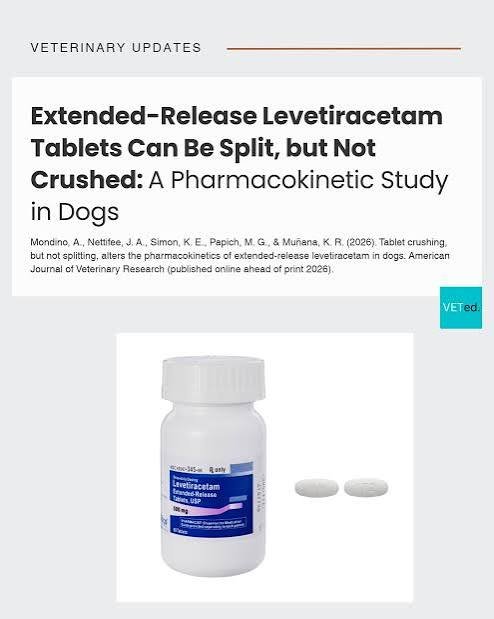
Study design: seven Beagles in a randomised crossover experiment
The study, titled Tablet crushing, but not splitting, alters the pharmacokinetics of extended-release levetiracetam in dogs, was published online on 23 October 2026.
Researchers evaluated the pharmacokinetics of 500 mg extended-release levetiracetam administered in three forms:
-
Intact extended-release tablet.
-
Split extended-release tablet.
-
Crushed extended-release tablet.
Seven healthy Beagles participated in a randomised crossover design. Plasma levetiracetam concentrations were measured over 12 hours using high-performance liquid chromatography.
The investigators assessed maximum plasma concentration (Cmax), drug exposure over time and the duration for which plasma concentrations remained above a target concentration of 10 µg/mL.
The crossover design allowed the different tablet preparations to be compared within the same animals, reducing the influence of between-dog pharmacokinetic variability.
Crushing increased peak concentrations and reduced late exposure
The principal finding was a clear difference between splitting and crushing.
Pharmacokinetic parameter |
Intact tablet |
Crushed tablet |
Interpretation |
|---|---|---|---|
Maximum plasma concentration (Cmax) |
46.0 µg/mL |
61.5 µg/mL |
Higher peak after crushing |
8–12-hour exposure |
49.8 µg·h/mL |
30.0 µg·h/mL |
Lower late exposure after crushing |
Duration above 10 µg/mL |
10.9 hours |
8.5 hours |
Shorter duration after crushing |
Crushing increased Cmax by approximately 34% compared with the intact formulation. The geometric mean ratio was 1.34, with a 95% confidence interval of 1.08–1.65.
Late exposure between eight and twelve hours was approximately 40% lower following administration of crushed tablets. The geometric mean ratio was 0.60, with a 95% confidence interval of 0.47–0.77.
The duration above the study’s target concentration was also shorter following crushing: 8.5 hours compared with 10.9 hours for intact tablets. The mean difference was 2.37 hours.
Exploratory compartmental modelling estimated an earlier time to maximum concentration after crushing, consistent with more rapid drug release.
These findings indicate that crushing compromises the intended extended-release exposure pattern, producing a higher early concentration followed by reduced late exposure.
Splitting did not significantly alter the evaluated pharmacokinetic parameters
In contrast, the researchers found no statistically significant differences between intact and split extended-release tablets across the pharmacokinetic parameters evaluated.
This is potentially useful for dose adjustment in smaller dogs, where the available tablet strength may be difficult to match to the prescribed dose.
The findings support the possibility that splitting an extended-release levetiracetam tablet can provide a practical dosing option without significantly changing the measured pharmacokinetic profile.
However, the study involved only seven healthy Beagles and a single-dose experimental design. It does not establish long-term clinical effectiveness, seizure control or equivalent safety in dogs with epilepsy receiving repeated treatment.
Implications for seizure management and clinical practice
The results are relevant to two distinct clinical situations.
Maintenance treatment: Splitting may offer a practical option when a smaller dose is needed, provided the specific tablet formulation is suitable for splitting and the treating veterinarian approves the approach.
Emergency or cluster-seizure situations: Crushing produced faster drug release in this study, but it also altered exposure and reduced late concentrations. The findings do not establish a clinical emergency dosing protocol or prove that crushed extended-release tablets are a safe substitute for immediate-release levetiracetam.
The authors identify further evaluation of crushed extended-release levetiracetam as an adjunct during cluster seizures as a potential research direction, particularly when immediate-release formulations are unavailable.
The study should not be interpreted as a general instruction for owners to modify tablets. Tablet design differs between manufacturers and formulations; the results cannot automatically be extrapolated to every extended-release levetiracetam product.
Earlier dissolution research supports the pharmacokinetic findings
A related 2025 study examined the dissolution characteristics of intact, split and crushed extended-release levetiracetam tablets in laboratory conditions.
That investigation found that splitting slightly increased drug release relative to intact tablets, while crushing eliminated the extended-release dissolution pattern, producing a profile resembling immediate-release levetiracetam.
The 2026 pharmacokinetic study provides important in-vivo evidence that the laboratory dissolution findings translate into measurable differences in plasma drug exposure in dogs.
Together, the studies reinforce the importance of formulation integrity in veterinary medication administration.
Research limitations and next steps
The principal limitations are the small sample size, use of healthy research dogs rather than epileptic patients, and single-dose pharmacokinetic evaluation.
Further research is needed to establish:
-
Whether splitting maintains comparable exposure during repeated dosing.
-
Whether altered exposure changes seizure control or adverse-event risk.
-
Whether results are consistent across different extended-release products.
-
Whether crushing has a defined role in veterinary emergency seizure protocols.
-
Whether the observed pharmacokinetic differences are clinically meaningful in dogs with naturally occurring epilepsy.
Bottom line: The study provides a practical clinical-pharmacology message: splitting and crushing extended-release levetiracetam are not interchangeable. Splitting did not significantly change the measured pharmacokinetic parameters in seven Beagles, while crushing increased peak concentrations and reduced late exposure. Veterinary professionals should consider the specific formulation and clinical objective before modifying tablets.

