


Two-Dose Melarsomine Protocol Shows 100% Survival in Randomised Canine Heartworm Trial, Offering Potential Advantages for Shelter Medicine
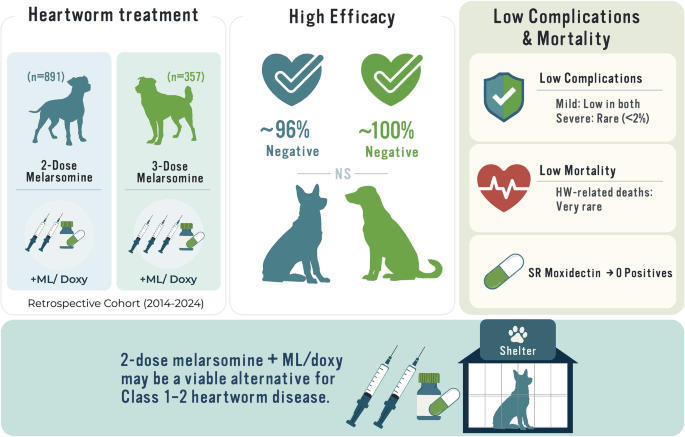
A randomised clinical trial published in the Journal of the American Veterinary Medical Association (JAVMA) has found that a compressed two-dose melarsomine protocol achieved 100% survival among 85 dogs completing the treatment regimen, with an adulticidal efficacy estimate of 95.3%.
The study compared the two-dose approach with the conventional three-dose melarsomine protocol in 168 dogs with Class 1 or Class 2 heartworm disease. Both treatment groups received a combination of sustained-release moxidectin, doxycycline and prednisone alongside melarsomine.
The findings are relevant to animal shelters, rescue organisations and veterinary practices managing heartworm-positive dogs, where treatment duration, staffing, cost and continuity of care can be significant operational constraints.
However, the study did not establish that the two-dose protocol was statistically non-inferior to the three-dose regimen under its predefined margin. Nor did it demonstrate 100% adulticidal clearance. These distinctions are important when translating the results into clinical practice.
Why alternative heartworm treatment protocols matter
Canine heartworm disease is caused by Dirofilaria immitis, a mosquito-transmitted parasitic nematode that primarily affects the pulmonary arteries and can cause serious cardiopulmonary complications.
The standard adulticide treatment recommended by the American Heartworm Society uses three melarsomine injections: an initial injection followed approximately one month later by two injections administered 24 hours apart.
Although effective, the conventional regimen requires a prolonged treatment period, multiple veterinary visits, exercise restriction and careful monitoring.
These requirements can create logistical difficulties for shelters and rescue organisations, particularly where dogs are awaiting adoption, have uncertain medical histories or require transfer between facilities.
A shorter treatment schedule could reduce the duration of treatment management and the resources required, provided safety and efficacy remain acceptable.
Randomised trial compared two-dose and three-dose regimens
The study, titled Comparing compressed 2-dose and 3-dose melarsomine protocols in the era of adjunctive therapy: a randomized clinical trial of 168 dogs with heartworm disease, was published online on 2 September 2026.
The trial was conducted between April 2024 and December 2025. A total of 168 dogs completed treatment:
-
Two-dose group: 85 dogs.
-
Three-dose group: 83 dogs.
The animals had Class 1 or Class 2 heartworm disease and received a common adjunctive treatment programme consisting of:
-
Sustained-release moxidectin.
-
Doxycycline.
-
Prednisone.
-
Melarsomine injections according to the assigned protocol.
The two-dose group received melarsomine on days 14 and 15. The three-dose group received melarsomine on days 14, 44 and 45. Dogs were placed under exercise restriction for four weeks following melarsomine administration. Clinical observations were recorded daily until the end of this restriction period.
Follow-up antigen testing was conducted six or nine months after melarsomine treatment.
Treatment outcomes: high efficacy in both groups
The study found no statistically significant difference in measured efficacy between the treatment groups.
Outcome |
Two-dose protocol |
Three-dose protocol |
|---|---|---|
Dogs completing treatment |
85 |
83 |
Dogs retested |
85 |
80 |
Adulticidal efficacy estimate |
95.3% |
98.8% |
95% confidence interval |
88.4–98.7% |
93.2–100.0% |
Survival |
100% |
100% |
The two-dose protocol achieved an efficacy estimate of 95.3%, compared with 98.8% for the three-dose protocol. Importantly, the study’s sample size was insufficient to establish conclusive non-inferiority against the predefined 4% margin.
Therefore, while the observed outcomes were encouraging and the difference between groups was not statistically significant, the findings should not be reported as proof that the two-dose protocol is equivalent to the three-dose regimen.
Both groups recorded 100% survival among the dogs completing the trial.
Complications were uncommon
The researchers reported that complications were rare. Seven dogs required thoracic radiographs, with or without additional treatment. None required intensive management. There were no statistically significant differences between the treatment groups in the reported incidence of:
-
Post-melarsomine coughing.
-
Increased respiratory effort.
-
Weakness.
These findings suggest that, within the selected study population and treatment framework, the compressed protocol was associated with a favourable short-term clinical safety profile.
However, the results should not be extrapolated automatically to dogs with more advanced heartworm disease, substantial cardiopulmonary complications or other conditions outside the trial’s eligibility criteria.
Why the findings matter for shelters and rescue organisations
The practical significance of a shorter melarsomine schedule extends beyond the number of injections.
For animal shelters, treatment duration can affect kennel occupancy, veterinary staffing, exercise management, monitoring requirements and the timing of adoption or transfer.
A compressed protocol may offer several operational advantages:
1. Shorter treatment schedule: Two injections administered on consecutive days may simplify coordination compared with a regimen involving injections separated by approximately one month.
2. Potentially lower treatment-management costs: Fewer injections and veterinary visits may reduce some direct and indirect costs, although the study did not provide a formal economic evaluation.
3. Improved operational flexibility: A shorter injection schedule could make treatment planning easier in rescue environments where animals are moved between facilities or where long-term care capacity is limited.
4. Continued adjunctive therapy: The results apply to the complete treatment combination, not to two melarsomine injections in isolation. Moxidectin, doxycycline and prednisone were integral components of both protocols.
The trial’s relevance to shelter medicine is particularly important because several investigators were affiliated with shelter medicine and animal welfare organisations.
Clinical implications: the full protocol matters
The study should not be interpreted as support for independently shortening heartworm treatment without veterinary oversight.
The outcomes were obtained using a defined protocol involving adjunctive medication, exercise restriction, follow-up testing and clinical monitoring.
The American Heartworm Society’s established treatment recommendations remain the reference framework for routine clinical management. Any alternative regimen should be assessed by a veterinarian in light of disease severity, individual patient risk, local guidance and the available evidence.
The trial also does not establish that the two-dose approach is appropriate for Class 3 disease, caval syndrome or dogs with significant cardiopulmonary complications.
Research implications and next steps
The study provides valuable prospective comparative evidence, but larger trials would help clarify the relative efficacy of the compressed protocol. Future work should address:
-
Larger sample sizes to assess non-inferiority more conclusively.
-
Longer-term outcomes and repeat testing.
-
Performance in dogs with more advanced heartworm disease.
-
Adverse events and complications across different clinical settings.
-
Comparative cost-effectiveness for shelters and rescue organisations.
-
Real-world treatment completion and adoption outcomes.
Bottom line: The randomised trial provides encouraging evidence that a compressed two-dose melarsomine protocol, when combined with moxidectin, doxycycline and prednisone, can achieve high adulticidal efficacy and 100% survival in selected dogs with Class 1 or Class 2 heartworm disease. It may offer practical advantages for shelters and rescue organisations, but it has not yet been proven statistically non-inferior to the standard three-dose protocol.

