



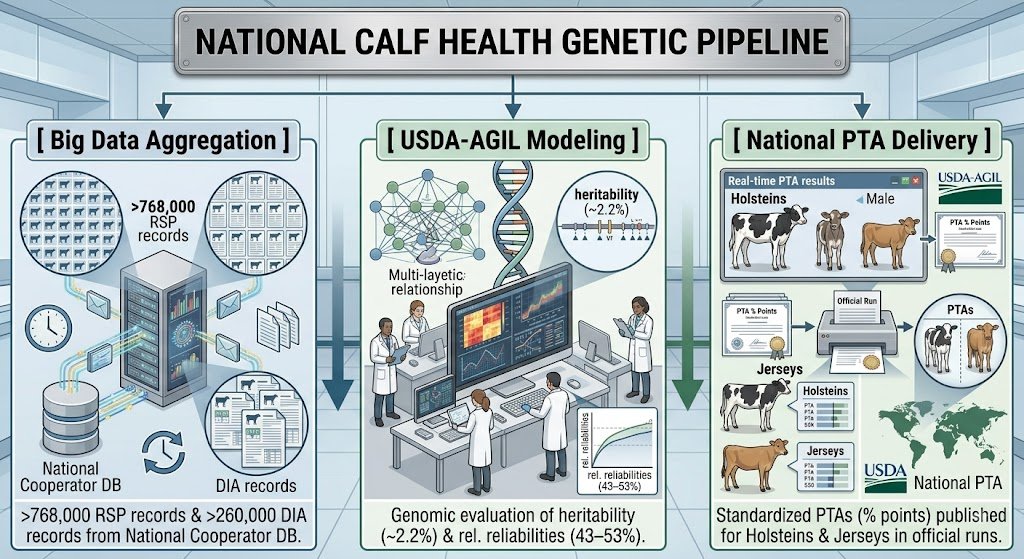
Council on Dairy Cattle Breeding (CDCB), in collaboration with the USDA Animal Genomics and Improvement Laboratory (AGIL), has officially launched the U.S. dairy industry’s first national genetic evaluations specifically targeting early-life calf health.
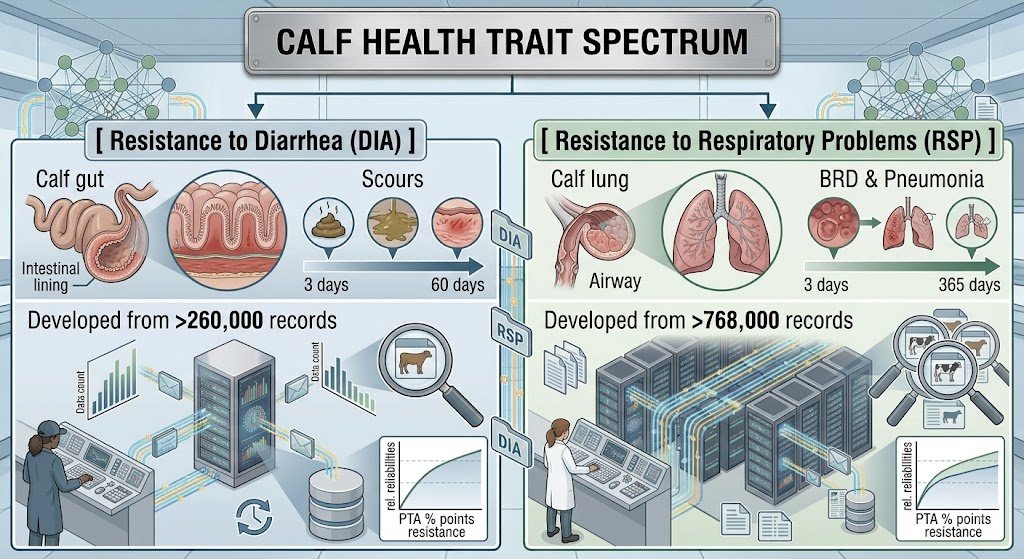
Beginning with the August 2026 official genetic evaluation release, dairy producers gain access to standardized Predicted Transmitting Abilities (PTAs) for two critical health traits: Resistance to Diarrhea (DIA) and Resistance to Respiratory Problems (RSP).
These evaluations empower breeders to select for genetic disease resistance against the two primary drivers of calfhood morbidity and mortality, transitioning youngstock management from purely reactive treatment to proactive genetic selection.
Economic Necessity: Mitigating High Replacement Costs
Raising replacement heifers represents the second-highest operating cost on commercial dairy farms, superseded only by feed expenses. Bovine Respiratory Disease (BRD) and scours (diarrhea) account for the vast majority of heifer losses and veterinary interventions before first calving.
Beyond immediate mortality, severe calfhood sickness inflicts permanent developmental damage—reducing average daily gain (ADG), delaying age at first calving, and impairing first-lactation milk yield.
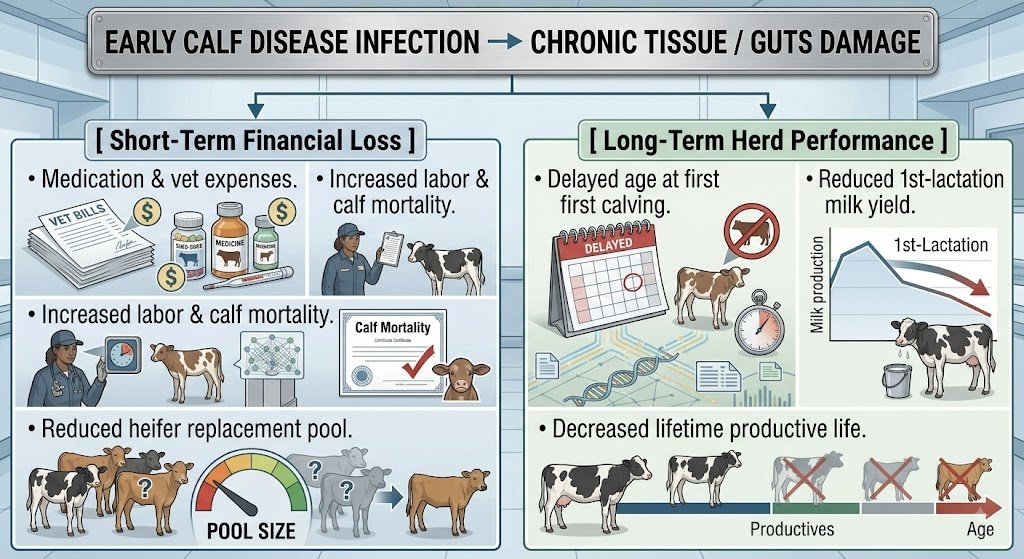
With current replacement heifer inventories at historically tight levels and high market valuations, preserving calf health from birth is essential for farm solvency and long-term herd productivity.
Technical Specifications: RSP and DIA Evaluated
Built upon hundreds of thousands of producer-recorded health events stored within the National Cooperator Database, the new evaluations undergo rigorous quality control modeling to isolate genetic influence from environmental management effects.
Key Technical Parameters
Trait Parameter |
Resistance to Diarrhea (DIA) |
Resistance to Respiratory Problems (RSP) |
Evaluated Target Age |
Calves aged 3 to 60 days |
Animals aged 3 to 365 days |
Research Dataset Base |
>260,000 on-farm records |
>768,000 on-farm records |
Unit of Measurement |
Percentage points of resistance (PTA %) relative to breed base. |
Percentage points of resistance (PTA %) relative to breed base. |
Heritability ($h^2$) |
~2.0% – 2.2% (observed scale) |
~2.2% (observed scale) |
Holstein Genomic Reliability |
43% (young sires) / 48% (progeny tested) |
45% (young sires) / 53% (progeny tested) |
Jersey Genomic Reliability |
~35% (young sires) / 39% (progeny tested) |
~35% (young sires) / 39% (progeny tested) |
Initial Available Breeds |
Holstein and Jersey |
Holstein and Jersey |
How to Interpret and Apply DIA & RSP on Farm
Like the national cow health traits introduced in 2018 (e.g., Mastitis, Ketosis, Metritis), DIA and RSP are expressed as Predicted Transmitting Abilities (PTAs) in percentage points.
-
Larger, Positive Values Are Favorable: A bull with an RSP PTA of +3.0% is expected to sire daughters that have 3 percentage points fewer respiratory events than offspring from an average sire (0.0%) when managed in the same environment.
-
Population Variation: In Holsteins, active A.I. sires span a range from roughly -6.9% to +3.5% for RSP, demonstrating significant room for genetic selection despite low heritability.
-
Favorable Genetic Correlations: Research confirms that RSP has a strong favorable correlation with Heifer Livability (+0.38) and a positive correlation with DIA (+0.34), as well as minor positive correlations with adult Cow Livability and Productive Life.

 and Respiratory Problems (RSP) to boost calf survival)