


PetMed Express, Inc. (NASDAQ: PETS), doing business as PetMeds and parent company of PetCareRx, officially released its financial results for the first quarter ended June 30, 2026.
The online pet pharmacy reported sequential revenue stabilization alongside a sharp reduction in net loss, driven by aggressive expense management, improved marketing acquisition efficiency, and the complete absence of prior-year impairment non-cash charges.
Executive Commentary & Key Financial Highlights
“Our first quarter results reflect continued progress toward our goal of establishing a direct, clear path back to sustainable profitability,” stated Leslie Campbell, Chairman, Interim CEO, and President of PetMeds. “We are pleased that net sales have stabilized sequentially over the past several quarters, and we continued to make our marketing spend more efficient…”
-
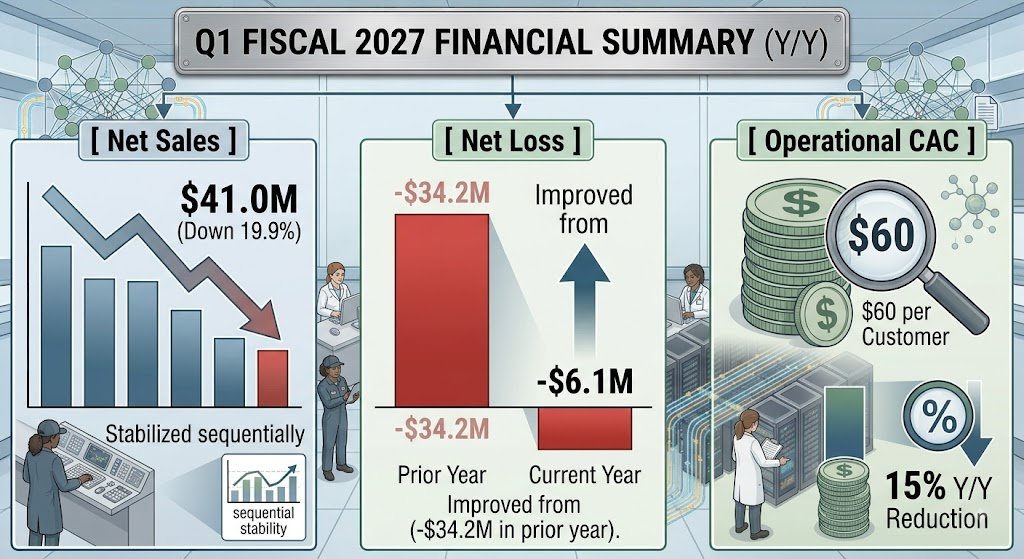
Net Sales: Totaled $41.0 million compared to $51.2 million in the prior-year period, representing a $19.9% year-over-year decline. Management noted that lower consumer promotional usage was more than offset by ongoing declines in prescription medication sales.
-
Net Loss Improvement: Net loss narrowed to $6.1 million (or (0.28) per diluted share), compared to a net loss of $34.2 million (or (1.65) per diluted share) in Q1 of the previous year. The narrowing loss was primarily driven by the absence of $27.3 million in prior-year goodwill and trade-name impairment charges, alongside reduced operating expenses.
-
Adjusted EBITDA: Reported at $(3.4) million, compared to $(2.7) million in the prior-year quarter.
-
Gross Profit Dynamics: Gross profit settled at $11.3 million. Favorable net freight costs per order were offset by reduced manufacturer rebates as a percentage of sales.
Year-Over-Year Financial Comparison
Financial Metric |
Q1 Ended June 30, 2026 |
Q1 Ended June 30, 2025 |
YoY Change (%) |
Net Sales |
$41.0M |
51.2M |
-19.9% |
Net Loss |
$(6.1M) |
$(34.2M) |
+82.2% (Favorable) |
Diluted Loss Per Share (EPS) |
$(0.28) |
$(1.65) |
+83.0 (Favorable) |
Adjusted EBITDA |
$(3.4M) |
(2.7M) |
-25.9% |
General & Administrative (G&A) |
$11.2M |
12.9M |
-13.5% |
Advertising Expense |
$4.2M |
$ 6.4M |
-30.2% |
Strategic Initiatives & Operational Transformation
-
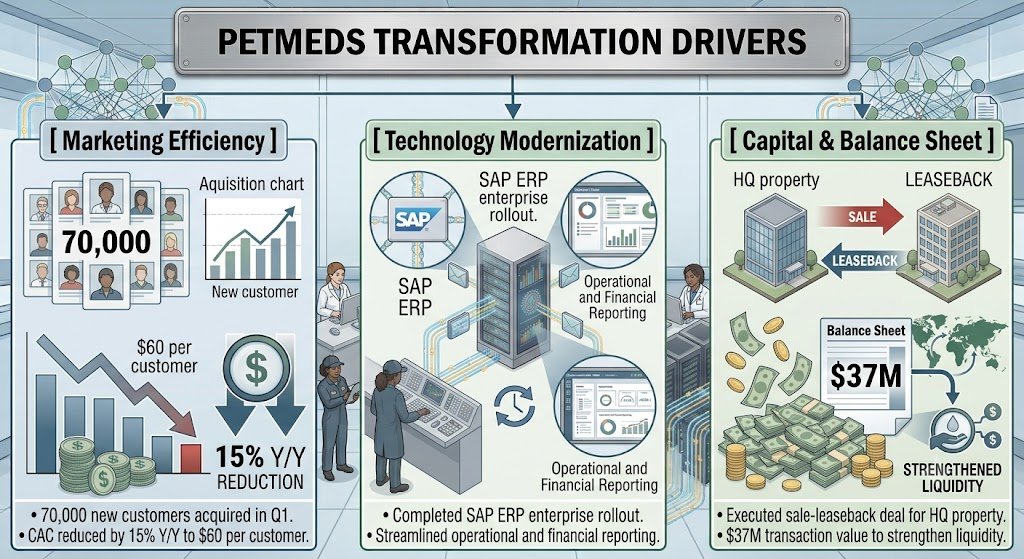
Customer Acquisition Efficiency: PetMeds acquired 70,000 new customers during the quarter. Targeted optimization of media spending reduced Customer Acquisition Costs (CAC) by 15% year-over-year down to $60 per customer.
-
Disciplined Cost Control: Operational discipline led to a 13.5% reduction in G&A expenses (falling to $11.2 million) and a 30.2% drop in advertising spend through the elimination of unproductive promotional channels.
-
Enterprise ERP Integration: The company completed an enterprise-wide rollout of its new SAP ERP system, modernizing backend financials, inventory management, and operational reporting.
-
Balance Sheet Optimization: PetMeds announced a sale-leaseback transaction valued at $37 million for its Delray Beach headquarters and distribution center. The capital execution enhances liquidity and grants flexibility to fund strategic growth drivers while leasing back operational facilities under a 10-year agreement.

