Elanco’s October 2026 consumer research points to resilient pet-health demand, growing omnichannel medication purchasing and the continuing influence of veterinary recommendations—even as US households navigate cost-of-living pressures.
Pet owners in the United States continue to prioritise animal health despite pressure on household budgets. A new consumer survey released by Elanco Animal Health (NYSE: ELAN) on 6 November 2026 found that 93% of surveyed pet owners maintained or increased their pet-related spending over the preceding three months.
The findings come from an online omnibus survey of 2,018 US adults, including 1,495 dog and cat owners, conducted between 16 and 21 October 2026. Among pet owners, 32% reported increasing their pet expenditure during the previous three months. Looking ahead, 93% expected to maintain or increase spending over the following year.
The survey also identifies a significant change in how consumers purchase pet medications. Veterinary clinics remain an important channel, but online pharmacies, pet-specialty retailers, mass retail and general e-commerce have become substantial points of access. Importantly, veterinary recommendations remain the leading stated reason for changing medication, while one-time discounts and rebates were cited by only 3%.
For the animal-health industry, the message is broader than consumer resilience: the market is becoming increasingly omnichannel, while veterinary trust continues to influence product choice.

Pet-health spending remains resilient despite economic pressure
The headline finding is that 93% of surveyed pet owners maintained or increased spending on their pets during the three months preceding the survey.
The breakdown provides additional context:
-
93% maintained or increased pet spending.
-
32% increased their expenditure.
-
93% expected to maintain or increase spending during the following year.
-
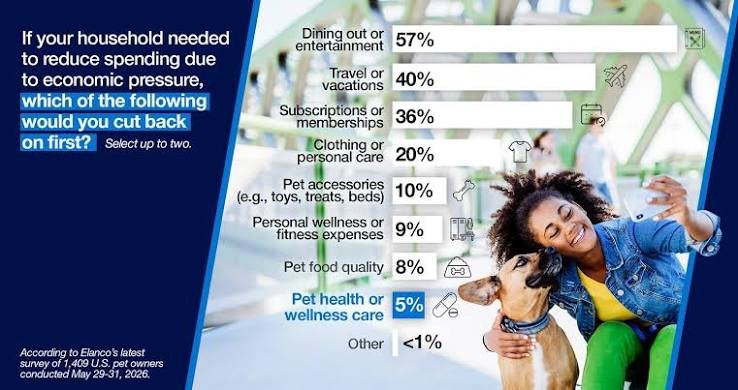
Only 7% said they would cut pet-health spending under economic pressure.
The company also compared the latest forward-looking spending figure with its previous surveys: 93% in February 2026 and 91% in May 2026. This suggests consistency across Elanco’s successive survey waves, although it should not be interpreted as a continuous panel tracking the same households.
The survey’s comparative findings are particularly interesting. Under economic pressure, respondents were much more likely to identify discretionary lifestyle categories for cuts:
Spending category
|
Respondents identifying it for cuts under economic pressure
|
Dining out and entertainment
|
54%
|
Travel
|
44%
|
Digital subscriptions
|
33%
|
Pet-health spending
|
7%
|
The figures suggest that pet health occupies a protected position in household spending priorities. However, they measure stated consumer intentions, not audited household expenditure or actual purchasing behaviour during a recession.
Why this matters
For animal-health businesses, consumer resilience can support demand for preventive healthcare, parasiticides, vaccines, dermatology treatments, chronic disease management and other veterinary medicines.
But the 93% figure should not be mistaken for evidence that every category is equally insulated. A household may preserve essential veterinary treatment while delaying routine visits, choosing a lower-priced product, switching purchase channels or postponing elective procedures.
The commercial opportunity is therefore not simply to increase prices. It is to demonstrate clinical value, convenience, accessibility and continuity of care.
Pet humanisation is evolving into a healthspan-driven purchasing mindset
The survey provides further evidence of the emotional relationship between US pet owners and their animals.
-
87% said their pet’s happiness and wellbeing were as important as their own.
-
63% said their pet’s happiness and wellbeing were more important than their own.
The principal motivations behind pet-related spending were:
Motivation
|
Percentage
|
Keeping pets healthy and helping them live longer
|
65%
|
Ensuring pets are happy and comfortable
|
59%
|
Treating pets as family members
|
54%
|
These findings point to a consumer mindset increasingly centred on longevity, comfort and quality of life.
For manufacturers, this creates an opportunity to position products around meaningful health outcomes rather than relying exclusively on product specifications or price competition.
However, consumer willingness to spend should not be confused with clinical evidence of product effectiveness. Veterinary recommendations and substantiated product claims remain essential.
Veterinary medication purchasing is moving beyond the clinic
One of the most commercially important findings is the changing distribution of pet-medication purchases. According to Elanco, 38% of pet owners said they had shifted their pet-medication purchasing outside the veterinary clinic during the preceding one or two years.
The survey reported the following purchase channels:
Medication purchasing channel
|
Percentage reported
|
In-person veterinary clinics
|
37%
|
Online pet-specialty pharmacies
|
31%
|
Mass retail and grocery
|
28%
|
Physical pet-specialty retail
|
27%
|
General e-commerce
|
25%
|
Home delivery through a veterinarian’s online pharmacy
|
17%
|
These percentages should not be added together to estimate market share. The release does not establish that respondents selected only one channel; consumers may use multiple purchasing routes. Nevertheless, the pattern highlights a structural change in the pet-health value chain.
The emerging omnichannel model
Historically, veterinary clinics played a central role in both clinical consultation and medicine dispensing. The newer purchasing environment separates these activities more frequently. A pet owner may:
-
Visit a veterinarian for diagnosis and treatment advice.
-
Receive a product recommendation or prescription.
-
Compare prices and availability online.
-
Purchase through a veterinary-operated online pharmacy or an external retailer.
-
Arrange home delivery or collect the product from a retail outlet.
This does not necessarily mean that veterinary influence is declining. It may mean that the veterinarian’s role is shifting increasingly towards diagnosis, clinical decision-making and treatment recommendation, while fulfilment is distributed across a wider retail network.
For manufacturers and distributors, the implication is significant: product availability, digital discoverability, pharmacy relationships, inventory visibility and fulfilment capabilities are becoming increasingly important components of commercial execution.
Veterinary recommendation outweighs one-time discounts
Perhaps the most strategically valuable finding for pharmaceutical manufacturers is that a doctor’s recommendation was the leading stated reason for a pet owner to switch medications. Elanco reported that one-time discounts or rebates were cited by only 3% as a reason for switching.
This suggests that price promotions alone may have limited influence when compared with the confidence generated by a veterinary recommendation. For companies competing in parasiticides, dermatology, pain management, vaccines and chronic disease treatments, the result reinforces the importance of:
-
Strong clinical evidence and product differentiation.
-
Veterinary education and continuing professional development.
-
Trustworthy safety and efficacy information.
-
Practical administration and adherence.
-
Reliable product supply and availability.
-
Digital tools that help veterinarians and pet owners manage treatment.
The survey does not establish that discounts never influence purchasing. Nor does it quantify the relative importance of clinical efficacy, safety, price, convenience and availability across every product category. Its findings are best interpreted as evidence of the continuing importance of veterinary endorsement.
Pet adoption expectations point to a potential demand pipeline
The survey also explored future pet ownership.
-
21% of all surveyed consumers expected to add a pet during the following year
-
Among current pet owners, 25% expected to adopt another pet during that period
If these intentions translate into actual adoptions, they could contribute to future demand for veterinary consultations, vaccinations, parasite prevention, diagnostics, nutrition and other companion-animal services.
However, these are stated intentions, not a forecast of actual adoption numbers. Economic conditions, housing, household circumstances and pet availability can influence whether intended adoptions occur.
What this means for the global animal-health industry
Although this is a US consumer survey, several of its findings have wider strategic relevance for animal-health companies operating in developed and emerging markets.
A. Preventive healthcare may be more resilient than discretionary pet spending
The survey suggests that consumers distinguish between pet health and other discretionary household expenses. This supports continued investment in preventive healthcare categories, although individual product markets may behave differently.
B. Distribution is becoming a competitive differentiator
Manufacturers can no longer rely exclusively on clinic-based dispensing. The growing importance of online pharmacies and retail channels creates a need for coordinated omnichannel strategies.
C. Veterinary influence remains commercially important
The finding on medication switching suggests that digital commerce does not automatically eliminate the veterinarian’s influence. Clinical recommendation and convenient fulfilment can coexist.
D. Pet healthspan is an important consumer proposition
Longer, healthier and more comfortable lives are central motivations behind spending. This creates opportunities for evidence-based products addressing ageing, mobility, chronic disease and preventive care.
E. Consumer demand and veterinary visit volumes may increasingly diverge
Elanco specifically highlighted that veterinary visits may no longer be a leading economic indicator for pet spending. Medication purchases can occur through channels outside the clinic, making traditional clinic-visit metrics less comprehensive as a measure of market demand.
This is an important hypothesis for market analysts to monitor, not proof that veterinary visit trends have become irrelevant.
Commercial implications and strategic watchpoints
Industry segment
|
Potential implication
|
Veterinary pharmaceuticals
|
Demand resilience may support established and innovative therapies, but product-level performance will vary
|
Parasiticides
|
Omnichannel availability and brand recommendation can influence repeat purchasing
|
Online veterinary pharmacies
|
Opportunity to capture medication fulfilment beyond physical clinics
|
Pet-specialty retail
|
Potential to expand access to preventive and non-prescription pet-health products
|
Veterinary clinics
|
Greater emphasis on diagnosis, treatment planning, adherence and customer relationships
|
Diagnostics
|
Earlier identification of disease can support preventive and chronic-care pathways
|
Pet nutrition
|
Healthspan, comfort and life-stage positioning may influence consumer preferences
|
Manufacturers
|
Digital distribution, channel coordination and veterinary engagement become increasingly important
|
What the industry should monitor next
The survey raises several questions that warrant further investigation:
-
Are pet owners maintaining spending because they are purchasing more products, paying higher prices or shifting purchases between channels?
-
Which therapeutic categories are most resilient under cost-of-living pressure?
-
Are online pharmacies expanding market access or primarily redistributing sales from veterinary clinics?
-
How does veterinary recommendation influence brand selection and repeat purchasing?
-
Will stated adoption intentions translate into higher pet ownership and veterinary demand in 2027?
The answers will help distinguish genuine market expansion from channel migration and price-driven revenue growth.
Conclusion: pet-health demand is resilient, but the route to the consumer is changing
Elanco’s October 2026 survey offers a useful snapshot of US pet-owner behaviour. The finding that 93% maintained or increased pet spending is encouraging for the animal-health sector, particularly in an environment of household budget pressure.
But the more important strategic signal may be the changing route through which pet owners access medicines. Veterinary clinics remain central to clinical recommendations, while online pharmacies, mass retail and e-commerce increasingly participate in fulfilment.
For animal-health companies, the competitive equation is evolving. Clinical credibility, veterinary confidence, product innovation, digital accessibility and omnichannel distribution must work together.
The future pet-health market may not be defined only by how much owners spend, but by where they buy, who influences their decisions and how effectively companies connect veterinary care with convenient access to treatment.