


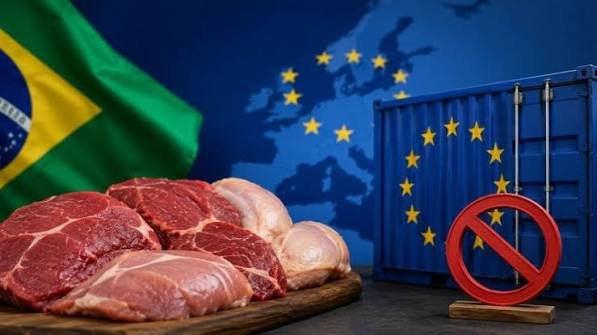
The European Union has today, September 3, 2026, suspended imports of Brazilian beef, poultry and a range of other animal-origin products after Brazil failed to provide sufficient guarantees that its production controls meet EU requirements on antimicrobial use. Audits of poultry and honey chains could determine whether some trade resumes within weeks, while the beef market may remain closed considerably longer.
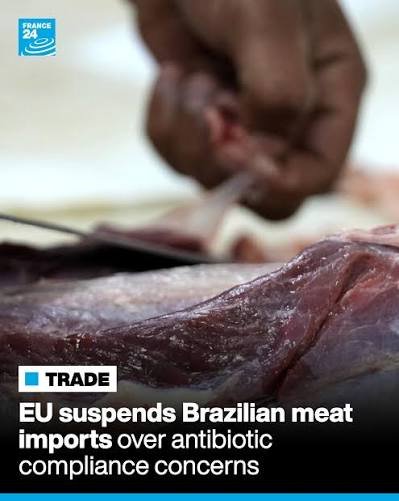
EU–Brazil Meat Trade Disrupted
The suspension applies across all 27 EU member states and follows Brazil’s removal in May from the EU list of third countries considered compliant with the bloc’s rules governing antimicrobial use in food-producing animals.
The affected categories reported by the European Commission and current industry coverage include beef, poultry, eggs, honey, aquaculture products and certain other animal-origin products. Reports have differed on the precise product scope, so pork should not currently be treated as a confirmed headline category without checking the applicable EU tariff/product listing.
Importantly, the EU action is a regulatory-compliance measure rather than a declaration that Brazilian meat shipments are contaminated. The central issue is whether Brazil can demonstrate controls equivalent to EU requirements governing antimicrobial use and the ability to verify those controls through the production chain.
Poultry and Honey Could Return First
The immediate outlook is not uniform across commodities. European officials have indicated that audits involving poultry and honey are already underway, with findings expected shortly. A favourable assessment could create a pathway for some exports to resume in the coming weeks, although reinstatement still requires the appropriate regulatory steps.
Beef faces a more uncertain timeline. Brazil was the EU’s second-largest beef supplier in 2025, exporting more than 92,000 tonnes worth over €713 million to the bloc.
Brazilian industry sources are warning that restoration of beef access could take substantially longer, potentially extending into 2027 or beyond, depending on the regulatory process and the EU’s assessment of Brazil’s corrective measures.
Why Antimicrobial Use Has Become a Trade Issue
The dispute reflects a wider change in international food regulation.
The EU has progressively tightened restrictions on antimicrobial use in food-producing animals, including controls designed to prevent antimicrobial resistance and restrict the use of certain substances. For third-country exporters, market access increasingly depends not only on meeting residue limits but also on demonstrating that production systems themselves provide verifiable guarantees on antimicrobial use. For Brazil, this raises the importance of:
-
veterinary antimicrobial-use records;
-
traceability across the animal-production chain;
-
controls on restricted antimicrobials;
-
producer and veterinary oversight;
-
documentation supporting export certification; and
-
evidence that production practices meet EU-equivalent requirements.
Brazil Faces a High-Value Market Disruption
The EU is not Brazil’s largest meat market, but it is strategically important because of the value attached to particular beef and poultry products. Brazilian exporters now face the need to redirect affected volumes toward alternative markets while attempting to restore EU eligibility.
For beef, the economic impact could be particularly significant because the EU market contains higher-value segments for Brazilian exporters. In January–July 2026 alone, Brazil reportedly exported 63.7 thousand tonnes of beef to the EU, generating US$562.2 million.
The disruption therefore extends beyond lost volume: exporters may face market reallocation, price pressure, inventory adjustments and lower returns if displaced products move into markets with different price structures.
EU Buyers Will Look for Alternative Suppliers
The suspension also creates an opening for competing exporters able to demonstrate full compliance with EU requirements. Potential beneficiaries include established South American suppliers such as Uruguay and Argentina, as well as other approved international suppliers. However, replacing Brazilian supply will not necessarily be immediate because suppliers must meet EU veterinary, traceability and antimicrobial requirements and have sufficient export capacity.
The poultry market could experience the most immediate sourcing pressure because Brazil is a major global poultry exporter and European buyers have developed established Brazilian supply relationships.
A Bigger Signal for Global Animal Health
The strategic importance of the decision extends beyond the EU–Brazil trade relationship. Antimicrobial stewardship is increasingly becoming a condition of international market access.
For livestock producers and exporters, demonstrating that antibiotics and other antimicrobials are used responsibly is becoming part of the commercial value proposition, alongside disease control, traceability, food safety and animal welfare.
This could accelerate investment in: Veterinary diagnostics → antimicrobial stewardship → farm-level records → traceability → residue monitoring → export certification
For the global animal-health industry, that creates opportunities for diagnostic companies, veterinary-service providers, digital traceability platforms and technologies that help producers reduce unnecessary antimicrobial use without compromising animal health or productivity.
AHI View
The September 3 suspension should therefore be viewed as more than a temporary trade restriction. It represents a regulatory shift in which antimicrobial-use controls are becoming embedded in international market-access rules.
The near-term test will be the poultry and honey audits. A positive outcome could allow parts of the Brazilian export complex to reopen relatively quickly. Beef is the bigger strategic question. Brazil’s ability to regain EU access will depend on whether it can provide credible, auditable and EU-acceptable guarantees covering antimicrobial use throughout the relevant production chain.
For exporters globally, the message is clear: food safety compliance is increasingly moving upstream—from testing the final product to proving how animals were raised and treated.
Key Numbers
Indicator |
Current position |
|---|---|
EU market affected |
27 member states |
Suspension begins |
3 September 2026 |
Brazilian beef exports to EU, 2025 |
>92,000 tonnes |
Value of 2025 Brazilian beef exports to EU |
>€713 million |
Brazilian beef exports to EU, Jan–Jul 2026 |
63.7 thousand tonnes |
Value Jan–Jul 2026 |
US$562.2 million |
Main regulatory issue |
Antimicrobial-use compliance |
Poultry/honey review |
Underway |
Beef reinstatement outlook |
Potentially substantially longer |

