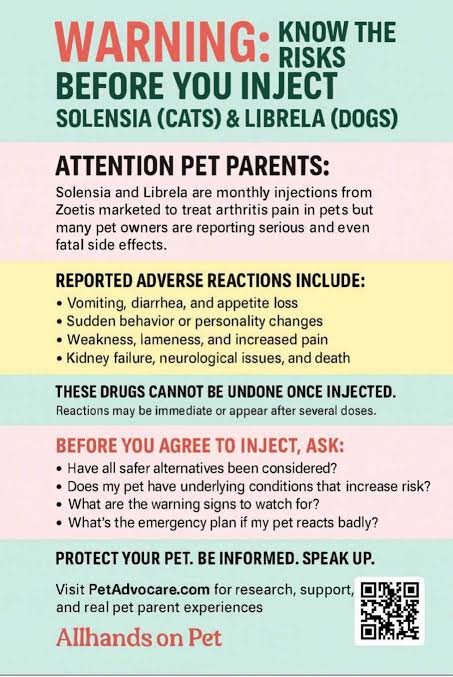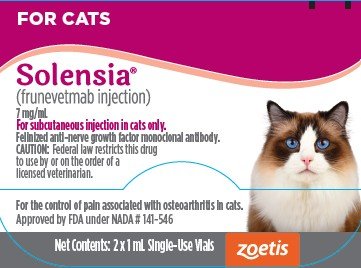
US Food and Drug Administration (FDA) has updated the safety-related labelling for Solensia (frunevetmab injection), a monoclonal antibody used to control pain associated with osteoarthritis in cats. The update, recorded last week in the FDA’s Animal Drug Safety-Related Labeling Changes database, adds a post-approval adverse-event section, strengthens instructions for discussing risks with cat owners, and introduces a dedicated Client Information Sheet.
The change is significant for veterinary practice because it formalises how safety information should be communicated before each injection. It is not, on its own, an announcement that Solensia has been withdrawn, that its approved indication has changed, or that the FDA has established a definitive causal relationship between the medicine and every event reported after marketing.
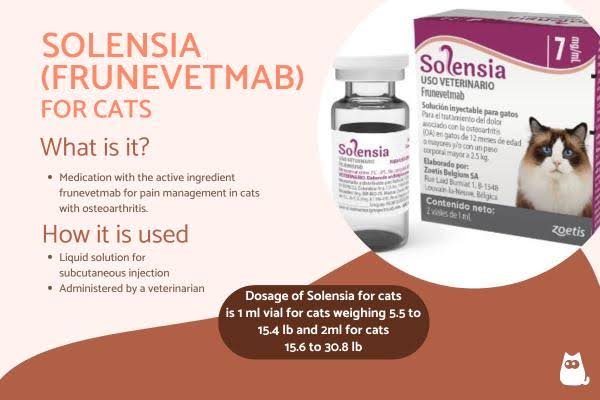
What is Solensia?
Solensia contains frunevetmab, a feline monoclonal antibody that binds to nerve growth factor (NGF), a protein involved in transmitting pain signals. The treatment is indicated for control of pain associated with osteoarthritis in cats and is administered by a veterinarian as a subcutaneous injection, generally once a month. It is intended to relieve pain; it does not reverse or cure the underlying progression of osteoarthritis.
Osteoarthritis can impair a cat’s mobility and daily activities, while behavioural changes may make chronic pain difficult for owners to recognise. A treatment administered at monthly veterinary visits also places particular importance on ongoing review: clinicians need to assess the animal’s response, discuss new symptoms and reconsider the benefit-risk balance before continuing therapy.
What changed in the FDA label?
The FDA lists four main changes:
-
Updated dosage and administration instructions: veterinarians are directed to provide the Client Information Sheet and discuss potential adverse drug events with the owner before each injection.
-
A new “Post-Approval Experience” subsection: adverse events reported after marketing are described in the Adverse Reactions section.
-
A new “Information for Cat Owners” section: the label directs veterinarians to discuss the information sheet and relevant potential reactions before administration.
- A dedicated Client Information Sheet: owners receive written information about potential adverse reactions, risk considerations and when to contact their veterinarian.
These changes place greater emphasis on documented owner communication, rather than relying solely on the veterinarian’s knowledge of the package insert or on informal counselling.
Adverse events listed in post-approval reporting
The FDA’s revised label groups reported events by body system. The listed categories include:
Body system |
Events listed in the updated label |
|---|---|
Skin and dermatological |
Generalised or facial itching, which may be severe; scabs; hair loss; dermatitis; skin ulceration and crusting |
General |
Reduced appetite, lethargy, weight loss and anaemia |
Gastrointestinal |
Vomiting, diarrhoea and pancreatitis |
Neurological |
Ataxia, seizures, paresis, paralysis and knuckling |
Behavioural |
Unusual behaviour, vocalisation and hiding |
Musculoskeletal |
Muscle weakness, lameness, joint swelling, abnormal gait, difficulty jumping and plantigrade stance |
Urinary/renal indicators |
Increased blood urea nitrogen (BUN) and/or creatinine, increased thirst and increased urination |
Immune |
Anaphylaxis |
The FDA also states that deaths, including euthanasia, have been reported as outcomes in some cases involving the listed adverse events.
These reports require careful interpretation. The FDA explicitly cautions that not all adverse events are reported to the agency and that post-approval reports do not necessarily allow reliable calculation of event frequency or confirmation of a causal relationship to exposure.
Spontaneous adverse-event reporting is an important pharmacovigilance tool because it can identify patterns that merit further investigation after a product enters wider clinical use. However, reports alone do not establish incidence: the number of treated animals, completeness of reporting, underlying illnesses, concurrent treatments and other factors affect interpretation.