


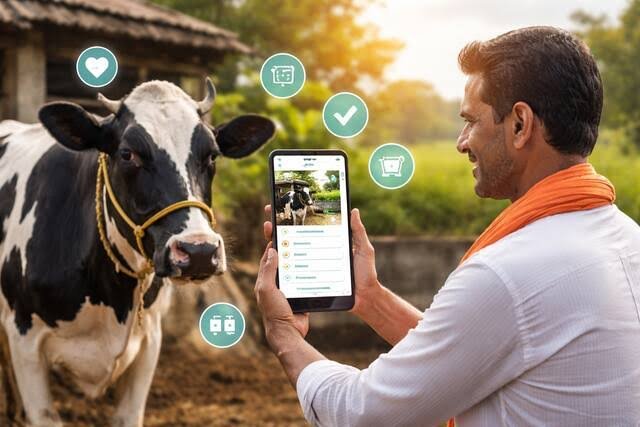
India’s Gau Swastha platform is demonstrating how image-based artificial intelligence could extend livestock-health assessment to farmers who have limited access to advanced veterinary diagnostic infrastructure.
The platform has been reported as operating across 26 Karnataka Veterinary Department polyclinics, with more than 50,000 farmers benefiting from its deployment. Using a single side-angle photograph of a cow, the system is designed to generate a health, nutrition and productivity assessment in under 30 seconds.
Its reported capabilities include screening for 33 cattle diseases, breed identification, assessment of breeding potential, estimated animal value and tailored nutrition and fodder recommendations.
The technology combines computer vision, vision-language models and other AI capabilities to convert an ordinary smartphone image into a structured livestock assessment. It is designed to reduce dependence on expensive hardware and make digital animal-health support more accessible to farmers.
One photograph, multiple livestock-health assessments
Gau Swastha’s central proposition is simplicity of access. Instead of requiring a farmer to purchase specialist imaging equipment or install multiple sensors, the platform uses a photograph captured through a smartphone. According to published descriptions of the platform, a single side-angle image can be used to generate a range of assessments:
| Platform capability | Reported function |
|---|---|
| Disease screening | Screens for 33 cattle diseases |
| Breed identification | Identifies the animal’s breed |
| Health assessment | Generates a structured animal-health assessment |
| Body-weight estimation | Estimates weight to support selected recommendations |
| Breeding assessment | Evaluates breeding potential |
| Nutrition guidance | Provides tailored nutrition and fodder suggestions |
| Market intelligence | Generates estimated market value and buy/sell recommendations |
| Delivery time | Under 30 seconds |
These are platform-reported capabilities. The system’s output should be treated as an AI-generated assessment rather than a confirmed veterinary diagnosis. Clinical examination and appropriate testing remain necessary where disease is suspected or treatment is required.
Deployment across 26 government veterinary polyclinics
The reported deployment across 26 Karnataka Veterinary Department polyclinics is an important aspect of the platform’s development.
The involvement of government veterinary facilities creates a potential route for combining digital screening with professional veterinary services. Farmers can use the platform to obtain an initial assessment, while veterinary professionals can provide clinical review and decide whether additional examination, testing or treatment is necessary.
The reported reach of more than 50,000 farmers indicates a potentially meaningful level of field engagement. The platform has also reportedly been validated on more than 7,000 cattle in field settings. These figures are based on published platform-related reporting and should not be interpreted as independently audited national adoption statistics.
India-specific datasets underpin the platform
One of the platform’s notable features is its use of datasets designed around Indian cattle and local veterinary conditions. Published descriptions report that the system has been trained using:
-
40,000 annotated cattle-health images.
-
1,000 symptom-to-disease mappings.
-
More than 30 veterinary treatment protocols.
The importance of local datasets is substantial. Livestock populations differ by breed, body condition, management system, climate, disease prevalence and production environment. AI systems trained on datasets from other countries may not perform equally well across India’s diverse cattle populations.
India-specific images and veterinary information could improve the relevance of automated assessments, provided that the datasets are sufficiently representative and the system is validated across different breeds, regions, disease presentations and farm conditions.
Veterinary oversight remains central to safe deployment
A major consideration in AI-based livestock health platforms is the distinction between screening and diagnosis. An image-based model may identify visible features or patterns associated with disease, but many veterinary conditions require information that cannot reliably be obtained from a photograph alone. Clinical history, physical examination, laboratory testing and other diagnostic procedures may be necessary.
Published reporting indicates that licensed veterinary professionals review AI-generated assessments and recommendations, providing a feedback mechanism to identify errors and improve the platform. This human-in-the-loop approach is important for several reasons:
-
Clinical verification: Veterinarians can assess whether an AI-generated result is consistent with the animal’s actual clinical condition.
-
Treatment safety: Medication and dosage decisions require professional judgement, particularly where disease severity, body weight and contraindications matter.
-
Model improvement: Expert feedback can help identify incorrect classifications and areas where the system needs further training.
-
Farmer confidence: Veterinary involvement can improve trust and encourage appropriate use of digital tools.
AI-generated treatment recommendations should not be treated as a substitute for a veterinarian’s prescription or clinical assessment.
Potential impact on rural veterinary access
India’s livestock sector is characterised by a large number of small and marginal producers, many of whom manage relatively small herds. For these farmers, access to timely veterinary advice can be constrained by distance, cost, limited availability of professionals and delays in recognising disease.
A smartphone-based screening platform could help address some of these barriers. Potential benefits include:
-
Earlier identification of animals that may require veterinary attention.
-
Better access to structured health and nutrition information.
-
Improved farmer awareness of body condition and productivity.
-
Support for preliminary disease-risk assessment.
-
More efficient prioritisation of cases at veterinary facilities.
-
Potentially better integration of animal-health information into government and cooperative systems.
However, the platform’s ability to deliver these benefits at scale will depend on smartphone access, language support, connectivity, farmer training, the quality of AI outputs and the availability of veterinary professionals to follow up on flagged cases.
Implications for India’s animal-health industry
Gau Swastha represents a broader shift towards low-cost, software-led animal-health services.
Traditional livestock monitoring systems often rely on physical devices, sensors, cameras installed at farm level or specialist diagnostic equipment. Smartphone-based AI platforms may offer a lower-cost entry point, particularly in regions where investment in farm automation remains limited. The model could create opportunities across several areas:
| Industry segment | Potential opportunity |
|---|---|
| Veterinary pharmaceuticals | Better identification of animals that may need treatment, subject to veterinary confirmation |
| Diagnostics | Referral of suspected cases for laboratory testing |
| Nutrition companies | More targeted fodder and nutritional recommendations |
| Breeding services | Improved access to animal identification and breeding-related information |
| Veterinary service providers | Digital triage and case prioritisation |
| Government departments | Potential integration with disease surveillance and livestock development programmes |
| Cooperatives and FPOs | Digital services for member farmers and livestock records |
For veterinary pharmaceutical companies, the important opportunity is not simply access to more farmers. It is the possibility of improving disease awareness and connecting farmers with appropriate veterinary services and validated treatment pathways.
The next challenge: independent validation and measurable field outcomes
The platform’s reported scale and capabilities are encouraging, but several questions will determine its long-term credibility and commercial potential:
-
How accurately does it identify each of the 33 reported diseases?
-
How does performance vary across indigenous and crossbred cattle?
-
What are the false-positive and false-negative rates?
-
How consistently does it perform under different lighting, image angles and field conditions?
-
What proportion of AI-flagged cases receive veterinary confirmation?
-
Does the platform reduce time to diagnosis, disease-related losses or treatment delays?
-
Can its recommendations improve measurable farm-level productivity?

