


The National Poultry Transformation Programme will integrate feed, breeding, hatcheries, broiler production, processing, cold chain and distribution, with first-phase output targeted at 20,000 tonnes of processed chicken annually and eventual capacity of 50,000 tonnes.
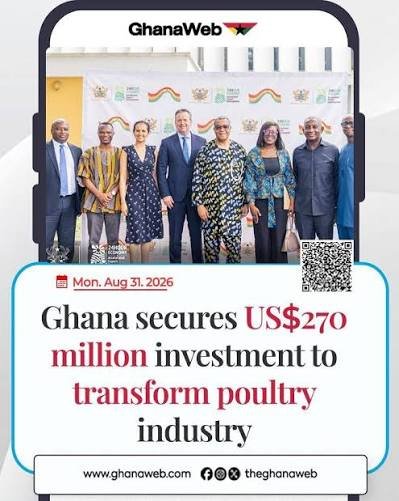
Ghana has secured a proposed US$270 million investment programme to transform its domestic poultry industry, strengthen local processing capacity and reduce the country’s heavy dependence on imported chicken.
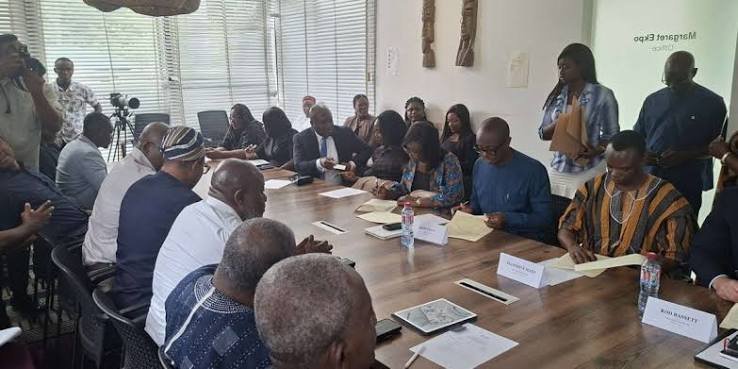
The 24-Hour Economy and Accelerated Export Development Secretariat (24H+) and four investment partners signed Heads of Terms for the National Poultry Transformation Programme. The agreement brings together UK-based agrifood investment company Agrium Capital, Ghanaian institutional investors Petra Trust and Axis Pension Trust, and Ghana EXIM Bank. The signing was held in Accra and was reported by Ghanaian media on September 1, although the official 24H+ release dates the signing to August 28.
The programme is being described by Ghanaian authorities as the largest UK agrifood investment in Ghana’s history. It is designed as an integrated poultry platform covering the value chain from feed production and breeding through hatcheries, broiler production, processing, cold-chain infrastructure, logistics and market access.
Key numbers
Indicator |
Programme target / current position |
|---|---|
Proposed investment |
US$270 million |
Direct jobs expected |
12,000 |
Current annual broiler output referenced |
~20,000 tonnes |
First-phase processed output |
20,000 tonnes/year |
Longer-term target |
50,000 tonnes/year |
Ghana chicken & poultry imports |
~270,000 tonnes/year |
Annual import expenditure |
~US$400 million |
Estimated domestic chicken consumption |
~340,000 tonnes/year |
Value-chain coverage |
Feed → breeding → hatchery → farms → processing → cold chain → distribution |
The scale of the import gap explains the investment rationale. Ghanaian sources estimate annual chicken consumption at approximately 340,000 tonnes, while imports account for roughly 270,000 tonnes, leaving domestic production to supply only a relatively small share of the market. The associated import bill is estimated at about US$400 million annually.
From poultry farming to integrated processing
The proposed programme is significant because it does not focus only on increasing the number of broilers produced. The investment model covers the entire poultry value chain, including:
-
feed manufacturing;
-
breeding stock;
-
hatchery capacity;
-
commercial broiler production;
-
slaughtering and processing;
-
cold-chain infrastructure;
-
logistics;
-
distribution and market access.
That structure is important because Ghana’s poultry competitiveness is constrained not only by farm output but also by the availability and cost of feed, chicks, processing infrastructure, financing, logistics and reliable market channels.
The first phase is expected to produce approximately 20,000 tonnes of dressed and processed broiler products annually, with the programme designed to scale that figure to 50,000 tonnes.
At the 50,000-tonne target, the programme would represent roughly 18.5% of the 270,000 tonnes of annual poultry imports cited in the investment announcement, assuming those import volumes remain unchanged. This is an analytical comparison rather than a stated government target.
Import substitution is the central economic objective
Ghana’s poultry sector has struggled to compete with imported frozen chicken, creating a persistent foreign-exchange outflow. The proposed US$270 million programme is therefore designed around import substitution rather than simply expanding poultry production.
If domestic processors can produce competitively priced, consistently available chicken, the programme could progressively replace part of the imported volume while retaining more value within Ghana.
The government also sees potential for the integrated system to support regional exports, meaning the investment is intended to move beyond import replacement toward building a commercially scalable West African poultry platform.
UK-Ghana investment dimension
Although the programme is Ghana-specific, it has a clear UK-Ghana commercial investment component. Agrium Capital is identified by the Ghanaian government as a UK-based agrifood investment company and subsidiary of Asset Green Ltd. British High Commission representatives welcomed the project as an opportunity to deepen UK-Ghana commercial ties, particularly in agriculture and agrifood.
The investment therefore combines foreign private capital, Ghanaian institutional capital and development-oriented financing rather than representing a UK government-funded poultry project.
That distinction is important: the US$270 million should not be described as a direct UK government grant or sovereign investment.
12,000-job target
The programme is expected to generate approximately 12,000 direct jobs across the integrated value chain. Additional indirect employment could emerge through feed ingredients, poultry farming, veterinary services, transport, equipment maintenance, packaging, cold storage and retail distribution.
For Ghana’s poultry industry, the integrated structure could also create opportunities for domestic farmers to participate as growers or suppliers rather than relying entirely on vertically owned production.
However, the ultimate economic impact will depend on how the programme structures farmer participation, procurement, pricing, access to finance and technology transfer.
Why processing capacity matters
Increasing broiler production without adequate processing and cold-chain capacity can create a major bottleneck.
Modern processing infrastructure can provide: Farm → slaughter → portioning → packaging → cold storage → distribution
rather than leaving producers dependent on live-bird markets.
This can improve product consistency, food safety, shelf life and access to supermarkets, institutional buyers and food-service channels. For Ghana, therefore, the processing component could be as strategically important as the additional poultry farms.
What remains to be delivered
The announcement should not be interpreted as US$270 million of capital already deployed. The parties have signed Heads of Terms, described by Ghanaian reporting as the first formal step toward implementation. The agreement is expected to be developed into a Shareholders’ Agreement for execution in the coming weeks.
This creates several execution milestones to watch:
-
Finalisation of the shareholders’ agreement.
-
Financial close and capital deployment.
-
Site and infrastructure development.
-
Feed and hatchery capacity expansion.
-
Construction or acquisition of processing facilities.
-
Farmer integration and broiler production expansion.
-
Cold-chain and distribution rollout.
-
Ramp-up from 20,000 to 50,000 tonnes of processed output.

