



The rapid global expansion and industrialization of the poultry farming sector have played a decisive role in shaping the genomic evolution, global dissemination, and antimicrobial resistance profiles of Campylobacter, according to new research led by scientists at the Ineos Oxford Institute for Antimicrobial Research at the University of Oxford.
Campylobacter species—primarily Campylobacter jejuni and Campylobacter coli—represent the leading cause of bacterial foodborne gastroenteritis worldwide. While the association between poultry consumption and human campylobacteriosis has long been established, the Oxford investigation provides critical population-genomic evidence mapping how modern agricultural practices actively drive the genetic lineages and adaptation strategies of the pathogen.
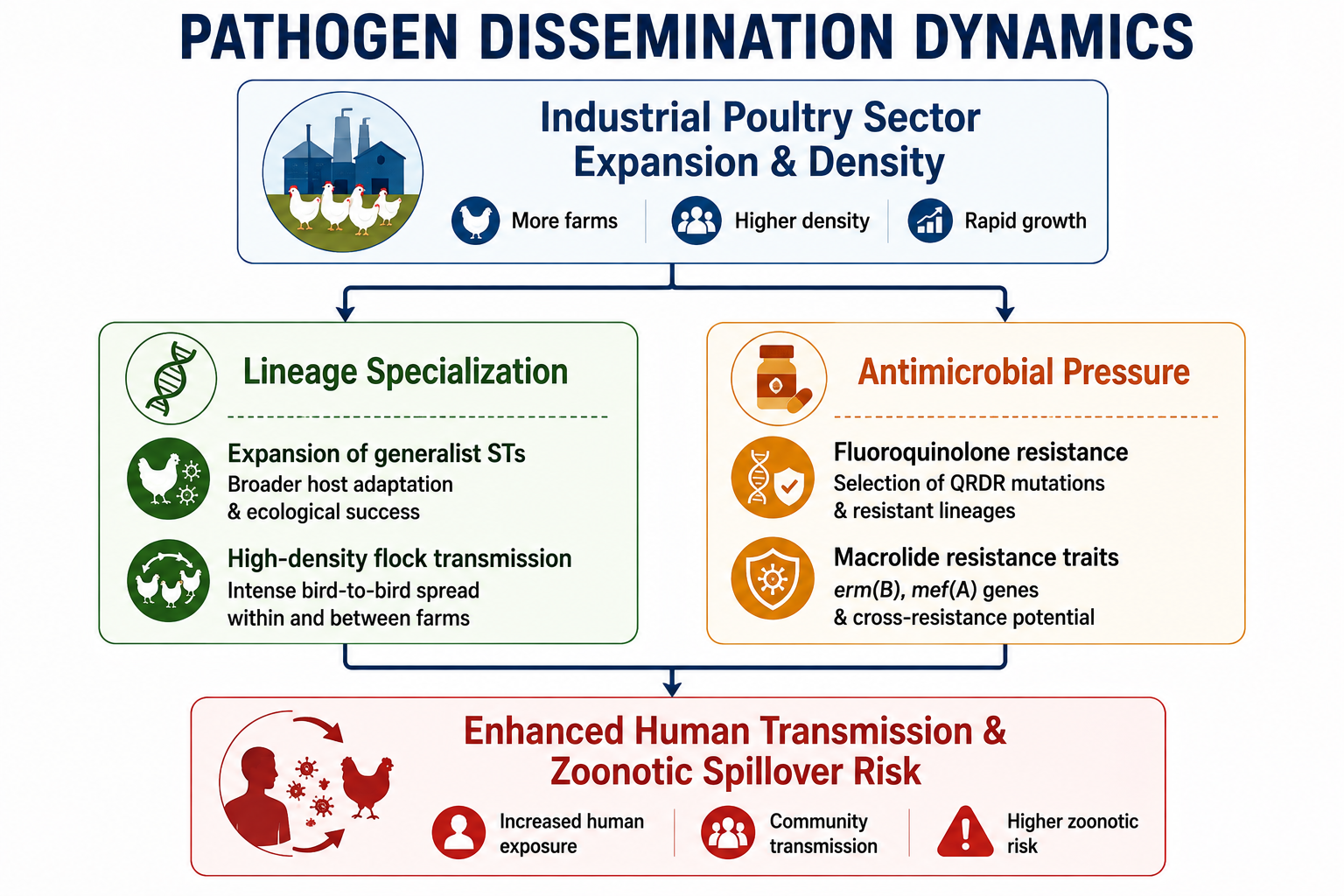
Genomic Insights into Poultry-Driven Evolution
Utilizing broad whole-genome sequencing datasets alongside phylodynamic modeling, researchers traced the evolutionary trajectory of major Campylobacter sequence types. The findings confirm that the rapid scaling of high-density poultry production over recent decades created an ideal biological niche for specific pathogenic lineages to multiply and diversify.
-
Lineage Specialization: High-density broiler operations select for specialized Campylobacter lineages capable of colonizing avian intestinal tracts efficiently while maintaining high environmental stability during slaughter and processing.
-
Global Lineage Homogenization: International trade of breeding stock, poultry meat, and feed supplies has facilitated the rapid cross-border distribution of dominant clone complexes, overriding localized genetic variation in farm environments.
-
Cross-Species Transmission: Industrial poultry reservoirs act as primary amplifiers, increasing pathogen spillover into secondary animal reservoirs and human food supply chains.
Implications for Antimicrobial Resistance (AMR)
Beyond pathogen transmission, the study emphasizes the critical intersection between agricultural management and Antimicrobial Resistance (AMR). The historical and ongoing routine use of critically important antimicrobials—specifically fluoroquinolones (such as ciprofloxacin) and macrolides (such as erythromycin)—in veterinary settings has selected for resistant strains.
Clinical & Agricultural Factor |
Epidemiological & Genomic Impact |
Flock Density & Turn-over |
Accelerates horizontal gene transfer (HGT) and intra-flock transmission rates |
Fluoroquinolone Exposure |
Drives point mutations in the gyrA gene, leading to widespread therapeutic failure in severe human clinical infections |
Supply Chain Globalisation |
Enables rapid geographical spread of multidrug-resistant (MDR) Campylobacter clones across national borders |
One Health Imperatives & Policy Action
The research team at the Ineos Oxford Institute emphasizes that addressing Campylobacter transmission requires a unified One Health framework connecting veterinary medicine, agricultural policy, and public health surveillance.
“Understanding how industrial agricultural systems alter pathogen genetics is essential for safeguarding essential human therapeutics,” the report underscores. “Mitigating the burden of foodborne disease demands biosecurity interventions at the farm level rather than relying solely on downstream processing controls.”
Priority Interventions
-
Targeted Farm Biosecurity: Implementing enhanced hygiene barriers, water treatment systems, and strict flock management to interrupt transmission cycles.
-
Antimicrobial Stewardship: Phasing out medically critical antibiotics in poultry husbandry to protect first-line treatments for severe gastroenteritis.
-
Genomic Surveillance Integration: Routine whole-genome sequencing at slaughter plants to monitor emerging hypervirulent or resistant Campylobacter lineages in real time.
References
-
Ineos Oxford Institute for Antimicrobial Research, University of Oxford. (2026). Genomic epidemiology and evolutionary dynamics of Campylobacter across global livestock production systems.
-
World Health Organization (WHO). Campylobacter: Fact Sheet and Global Burden of Foodborne Diseases.
-
European Centre for Disease Prevention and Control (ECDC) / European Food Safety Authority (EFSA). The European Union Summary Report on Antimicrobial Resistance in zoonotic and indicator bacteria from humans, animals and food.

