


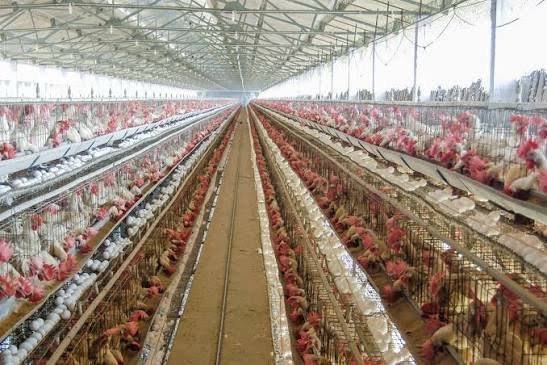
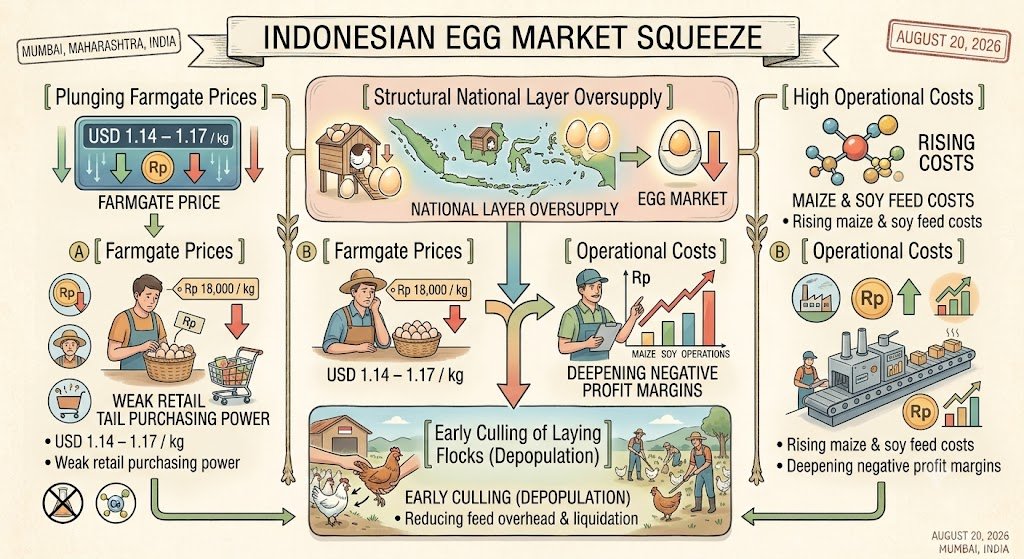
Egg prices at the farmgate level across Indonesia have plummeted to USD 1.14 to 1.17 per kilogram (approx. IDR 18,000–18,500/kg), driven down by an intense structural oversupply and sluggish household purchasing power. The prolonged price depression has forced small- and medium-scale poultry farmers to cull laying hens prematurely to cap unsustainable feed bills and mitigate compounding operational losses.
In key egg-producing regions across Central Java, East Java, and Sumatra, producers report that current market realizations fail to cover the basic cost of production (CoP), which has risen significantly due to elevated raw material prices for maize and imported soybean meal.
Magelang Farmers Face Severe Margin Compression
In Magelang, Central Java—a critical egg production cluster—producers are taking aggressive measures to survive the market downturn. Local independent farmers are liquidating productive layer birds well before their standard 80-to-90-week culling cycle.
“Selling eggs below the cost of production for several consecutive weeks leaves us with no liquidity,” noted an independent layer farmer in Magelang. “By culling our older layers early, we immediately lower our daily feed overhead and generate emergency cash flow from spent fowl sales to keep the remaining flock alive.”
Key Market Factors Driving the Downturn
-
Compounding Supply Glut: Expansion of commercial day-old chick (DOC) layer placements over preceding cycles has resulted in a surplus of active laying birds coming into peak production simultaneously.
-
Eroded Consumer Purchasing Power: Weakened macroeconomic conditions and high general food inflation have dampened domestic household egg consumption, preventing retail markets from absorbing farmgate surpluses.
-
Elevated Feed Costs: Despite declining egg values, finished commercial feed prices remain high due to sustained prices for domestic corn and imported protein meal, preventing farmers from breaking even.
Market Dynamics & Regional Price Comparison
Region / Hub |
Average Farmgate Price |
Estimated Cost of Production (CoP) |
Primary Industry Action |
Magelang (Central Java) |
USD 1.14 – 1.16 / kg |
USD 1.35 – 1.40 / kg |
Accelerated early layer culling & flock reduction. |
Blitar (East Java) |
USD 1.15 – 1.17 / kg |
USD 1.35 – 1.38 / kg |
Voluntary depopulation & reduced DOC intake. |
Medan (North Sumatra) |
USD 1.17 – 1.20 / kg |
USD 1.40 – 1.42 / kg |
Culling older age cohorts to manage feed stock. |
Industry Outlook & Regulatory Interventions
Poultry producer associations across Indonesia, including the Pinsar Petelur Nasional (PPN), are calling on the Ministry of Agriculture to intervene with coordinated national flock reduction programs. Industry leaders emphasize that without government-backed supply adjustments or temporary feed subsidies, smallholder layer farms risk bankruptcy, which could lead to extreme price volatility once supply clears.
Until national supply balances normalize, Indonesian layer farmers are expected to continue depopulating flocks to survive the prolonged price floor.
References
-
National Poultry Farmer Associations (Pinsar Petelur Nasional – PPN). Internal Livestock & Farmgate Price Bulletin, August 2026.
-
Ministry of Agriculture, Republic of Indonesia. Directorate General of Livestock and Animal Health Supply & Demand Projections.
-
Food and Agriculture Organization (FAO). Global Animal Protein & Feed Market Monitoring.

