


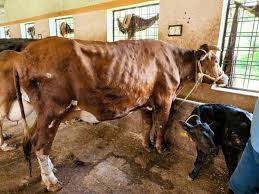
India’s largest province / state – Uttar Pradesh has intensified preventive action against Lumpy Skin Disease (LSD) in cattle as the monsoon season increases concern over vector-borne disease transmission.
Prayagraj has received 48,000 doses of LSD vaccine, while authorities have strengthened surveillance, introduced restrictions on interstate cattle movement and temporarily suspended animal fairs as a precautionary measure.
The latest intervention follows suspected LSD cases in Jhansi, where blood samples from affected cattle have been sent for laboratory testing after the death of one bovine. Importantly, no LSD case has been confirmed in Prayagraj in the latest report. The district administration has nevertheless placed its animal-health system on heightened alert, particularly in areas bordering Madhya Pradesh.
The response illustrates an increasingly important shift in India’s livestock-health strategy: prevent disease introduction and transmission before an outbreak becomes established, using vaccination, surveillance, movement control, vector management and rapid veterinary response.
Prayagraj builds a vaccination and surveillance buffer
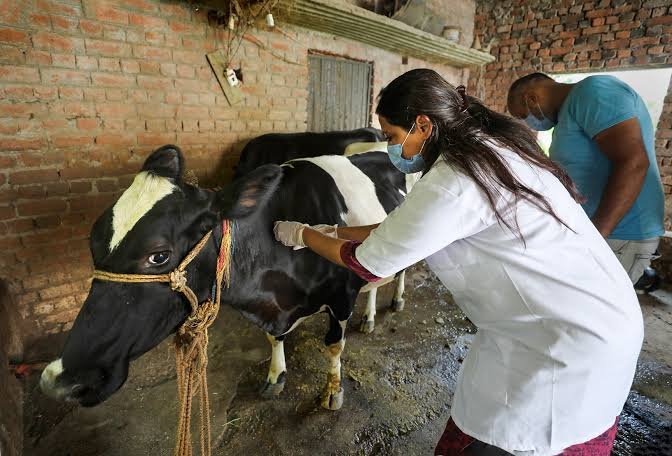
The immediate response in Prayagraj is substantial. Authorities have deployed 37 teams comprising 32 veterinarians and 292 support staff, while mobile veterinary units are visiting villages to monitor animal health. More than 23,000 cattle housed in shelters are being vaccinated, and ring vaccination is being conducted in vulnerable areas to establish a protective buffer.
The Koraon area has been identified as particularly vulnerable because of its location close to Madhya Pradesh. Surveillance has therefore been strengthened along the interstate border. The intervention is occurring alongside the district’s broader monsoon livestock-vaccination programme.
Officials report that approximately:
-
7.36 lakh animals have already been vaccinated against haemorrhagic septicaemia;
-
9.2 lakh FMD vaccine doses were received;
-
5.38 lakh FMD doses have already been administered.
These figures demonstrate that the current response is not an isolated LSD programme. It is part of a broader seasonal livestock disease-prevention campaign covering multiple economically important infections.
Why LSD matters to India’s dairy economy
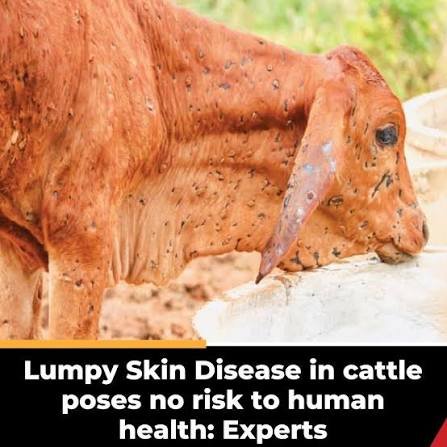
Lumpy Skin Disease is caused by lumpy skin disease virus (LSDV), a capripoxvirus affecting cattle and water buffalo. The disease is not considered a human-health threat, but its economic consequences for livestock producers can be substantial.
According to the World Organisation for Animal Health (WOAH), LSD can cause:
-
reduced milk production;
-
weight loss;
-
impaired fertility;
-
damage to hides;
-
animal mortality in some cases;
-
restrictions on animal movement and trade.
Transmission is predominantly associated with blood-feeding arthropods, including mosquitoes, biting flies and ticks. Movement of infected livestock is also an important mechanism for longer-distance spread.
This makes monsoon conditions particularly relevant to control programmes because vector populations and activity can increase under favourable environmental conditions. The disease therefore cannot be managed effectively through vaccination alone. Vector control, animal movement management, early detection and farm-level biosecurity must operate alongside immunisation.
India’s dairy exposure makes disease prevention economically important
The scale of India’s dairy economy gives livestock disease prevention an importance that extends well beyond veterinary medicine. India produced 247.87 million tonnes of milk in 2024–25, up from 239.30 million tonnes in 2023–24, representing annual growth of approximately 3.58%. India remains the world’s largest milk-producing country.
DAHD reports that the livestock and dairy sector provides livelihoods to approximately 8.5 crore rural households, while milk production had a reported output value of about ₹12.21 lakh crore in 2024–25.
The composition of India’s milk supply also underlines the importance of bovine health. In 2024–25:
Animal category |
Share of India’s milk production |
|---|---|
Indigenous buffalo |
31.18% |
Crossbred cattle |
30.80% |
Indigenous cattle |
11.20% |
Non-descript cattle |
9.64% |
Non-descript buffalo |
11.97% |
Goat |
3.32% |
Exotic cattle |
1.89% |
Together, cattle and buffalo therefore account for the overwhelming majority of India’s milk production. Consequently, an infectious disease that reduces milk yield, affects fertility or increases mortality can have effects at several levels:
animal health → farm productivity → household income → milk supply → dairy economics.
LSD is already an established Indian livestock-health concern
The current Uttar Pradesh response should not be interpreted as evidence that LSD is a new disease threat in India. India first confirmed LSD in West Bengal and Odisha in September 2019, according to DAHD. The disease subsequently spread to other states.
The Department’s 2025–26 Annual Report states that India has developed advisories covering biosecurity, treatment, surveillance, diagnosis and vaccination, including recommendations for annual vaccination programmes. The scale of disease reporting also demonstrates why continued surveillance remains necessary.
India’s Basic Animal Husbandry Statistics 2025 recorded:
167 LSD outbreaks → 4,049 bovines affected → 222 deaths.
These figures relate to reported outbreaks rather than the entire burden of disease in India’s cattle and buffalo population, but they demonstrate that LSD remains an active livestock-health issue requiring continuing control measures.
The science behind the prevention strategy
The current Uttar Pradesh response can be understood as a five-layer disease-control model.
1. Vaccination – Vaccination reduces the probability that susceptible cattle will develop disease following exposure.
Prayagraj’s deployment of 48,000 doses and ring vaccination in vulnerable locations represents a classic risk-based vaccination strategy, rather than waiting for widespread clinical disease.
2. Vector management – LSD transmission is strongly associated with blood-feeding insects. This means that vaccination should be accompanied by:
-
fly control;
-
mosquito management;
-
tick control;
-
sanitation;
-
removal of breeding sites;
-
improved housing hygiene.
WOAH identifies arthropod vectors as the predominant transmission pathway.
3. Movement control – Restrictions on interstate livestock movement are particularly important because infected animals can introduce the virus into previously unaffected populations.
The combination of movement restriction + surveillance at borders + vaccination is therefore designed to reduce the probability of a disease entering a high-risk area and then spreading through cattle movements.
4. Surveillance and diagnostics – The suspected Jhansi cases have been sent for laboratory testing. That distinction matters. Suspected clinical disease is not equivalent to laboratory confirmation.
Modern disease control depends on identifying cases quickly and accurately enough to trigger appropriate containment measures without unnecessarily disrupting livestock trade or farmer activity.
5. Rapid field response – The deployment of veterinarians and mobile veterinary units provides the final layer. The objective is to detect abnormal illness early, investigate suspected cases, vaccinate at-risk animals and provide farmers with practical disease-control advice.
India’s LHDCP is moving toward prevention-first animal health
The Uttar Pradesh response is consistent with the broader architecture of India’s Livestock Health & Disease Control Programme (LHDCP). DAHD describes LHDCP as a programme focused on disease prevention, control and management, with vaccination, improved veterinary services, disease surveillance and strengthened veterinary infrastructure as central components.
The programme also seeks to improve access to veterinary services through Mobile Veterinary Units (MVUs), which are designed to provide diagnosis, treatment and basic veterinary procedures closer to farmers.
This is an important structural change in India’s animal-health system. The emphasis is increasingly moving from: treating individual sick animals
toward: managing disease risk across populations.
That distinction is particularly important for diseases such as LSD, FMD, PPR, brucellosis and swine diseases, where population-level prevention can have much greater economic impact than treating animals after infection.
India’s domestic LSD vaccine ecosystem is also expanding
The preventive response is occurring alongside expansion of India’s indigenous LSD vaccine manufacturing base.
In April 2026, ICAR announced the commercialisation of an indigenous homologous live-attenuated LSD vaccine technology developed by ICAR-National Research Centre on Equines and ICAR-Indian Veterinary Research Institute. The technology was transferred to Brilliant Bio Pharma Pvt. Ltd., Hyderabad, making it the sixth company to receive the LSD vaccine technology.
The agreement included a ₹75 lakh technology-licensing fee plus GST and a 5% royalty on sales. The commercialisation is significant because disease-control programmes require not simply a scientifically effective vaccine, but also:
-
manufacturing capacity;
-
reliable supply;
-
cold-chain infrastructure;
-
field distribution;
-
veterinary administration capacity;
-
surveillance of vaccine coverage and effectiveness.
Earlier ICAR technology transfers had already supported commercial production of Lumpi-ProVacInd, including transfers to Biovet, Indian Immunologicals and Hester Biosciences, among others. This creates an increasingly domestic vaccine ecosystem around LSD.
Why the 48,000-dose deployment matters commercially
The immediate number — 48,000 doses — is relatively small compared with India’s enormous cattle and buffalo population. Its importance lies elsewhere.
It represents a targeted deployment of vaccine capacity around a geographic disease-risk zone. That model can create demand across a much broader animal-health value chain:
Animal-health segment |
Potential role in LSD control |
|---|---|
Vaccines |
Preventive immunisation |
Diagnostics |
Confirmation of suspected cases |
Vector control |
Mosquito, fly and tick management |
Veterinary services |
Field examination and treatment |
Mobile veterinary units |
Rural surveillance and response |
Biosecurity |
Reduce transmission opportunities |
Animal identification |
Traceability and movement management |
Disease surveillance |
Early-warning systems |
Data platforms |
Mapping outbreaks and vaccination |
Farmer education |
Early recognition and reporting |
The commercial opportunity therefore extends beyond vaccine manufacturers.
Diagnostics, veterinary services, vector management and livestock-health data are becoming increasingly important components of India’s animal-health market.
The dairy-sector risk is primarily economic, not zoonotic
One point deserves particular emphasis for consumers and policymakers. LSD is not regarded as a human-health threat.
WOAH explicitly states that LSD is not a threat to human health. Its importance is primarily associated with animal welfare, productivity, farmer economics and livestock trade. For dairy farmers, the concern is the potential combination of:
illness + lower milk production + fertility problems + treatment costs + animal losses + movement restrictions.
At national scale, those effects can accumulate into significant economic losses. Therefore, the objective of preventive vaccination is not simply to reduce mortality. It is to protect the productive capacity of the dairy animal.

