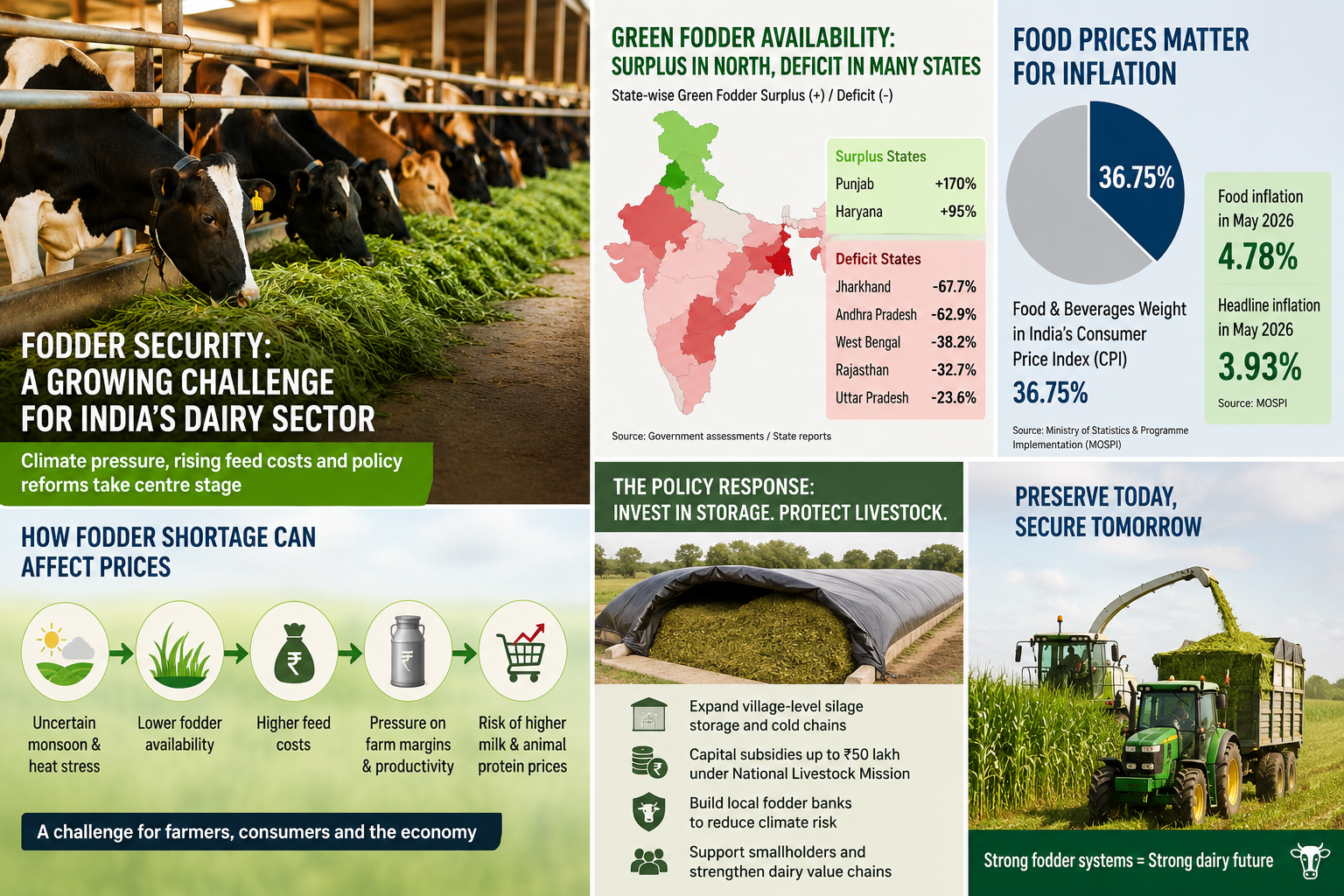


India’s livestock sector is facing a renewed feed security challenge as an uncertain monsoon and the risk of El Niño put pressure on fodder availability. Recent government data and dairy industry warnings suggest that a prolonged shortage of green fodder could raise farm costs and eventually affect milk and other animal protein prices.
The concern has become more immediate after the Centre stepped up weekly reviews of the 2026 kharif season. On July 8, the Ministry of Agriculture said it was increasing preparedness because of uncertainty surrounding the southwest monsoon and the possible impact of El Niño.
India already has a serious fodder gap
The feed problem did not begin with the 2026 monsoon but looks like getting accentuated due to potential El Nino led weak monsson rains.
Government assessments have repeatedly identified large differences between fodder demand and availability across India. Recent state-level figures show green fodder deficits of 67.7% in Jharkhand, 62.9% in Andhra Pradesh, 38.2% in West Bengal, 32.7% in Rajasthan and 23.6% in Uttar Pradesh.
In contrast, Punjab has reported a green fodder surplus of about 170%, while Haryana has a surplus of nearly 95%. The sharp regional imbalance shows that India’s fodder challenge is not simply about total production. Storage and movement of fodder from surplus to deficit areas are also major problems.