


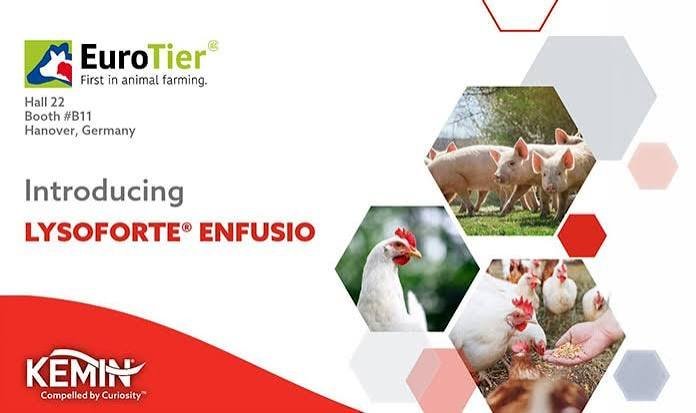
Kemin Industries has launched LYSOFORTE® ENFUSIO at EuroTier 2026, introducing a new nutrient-absorption technology designed to improve the utilisation of dietary lipids and amino acids in monogastric animal production.
The product was introduced by Kemin Animal Nutrition and Health EMENA at the international livestock production exhibition in Hanover, Germany, which runs from 10 to 13 November.
LYSOFORTE ENFUSIO is the latest addition to Kemin’s LYSOFORTE portfolio, which focuses on improving nutrient digestion and absorption in animal diets.
The launch comes as feed manufacturers increasingly seek to optimise nutrient utilisation, reduce formulation costs and maintain animal performance while moving towards leaner and more precisely formulated diets.
A self-regulating matrix designed to improve nutrient utilisation
According to Kemin, LYSOFORTE ENFUSIO uses a self-regulating matrix concept intended to support both lipid absorption and amino acid digestion and absorption.
Traditional feed formulations often focus on the energy contribution of dietary fats and oils. However, Kemin argues that improving lipid digestion alone may not be sufficient to maximise overall nutrient utilisation, particularly as feed formulations become more constrained.
The company positions ENFUSIO as a technology that complements lipid absorption with improved amino acid utilisation. Its formulation approach is intended to provide nutritionists with greater flexibility when designing poultry and swine diets.
Why lipid and amino acid digestibility matter
Lipids provide a concentrated source of energy in poultry and pig diets. Efficient lipid digestion and absorption are important for:
-
Energy availability.
-
Growth performance.
-
Feed conversion efficiency.
-
Dietary energy formulation.
-
Overall nutrient utilisation.
Amino acids are equally important because they provide the building blocks required for protein synthesis, tissue development, muscle growth and productive performance.
In commercial poultry and swine production, the objective is not simply to increase nutrient inclusion but to improve the proportion of nutrients that animals can actually digest and utilise. This is particularly relevant when formulating diets using alternative ingredients or lower-cost raw materials.
Flexibility in feed formulation
One of the product’s stated features is the flexibility to use the technology through:
-
On-top application.
-
Diet reformulation using the product’s matrix values.
This could be commercially relevant for feed manufacturers seeking to improve nutrient utilisation while adjusting ingredient inclusion and formulation costs. The company is positioning this flexibility as an important feature for poultry and swine nutritionists working with increasingly complex feed formulations.
However, actual economic benefits will depend on the validated matrix values, inclusion rates, ingredient composition, animal species, production stage and feed formulation conditions.
Implications for poultry nutrition
The poultry sector is particularly sensitive to feed costs because feed represents a substantial proportion of total production expenditure. Improving nutrient digestibility can potentially support:
-
Better utilisation of dietary energy.
-
Improved amino acid availability.
-
More precise feed formulation.
-
Better performance consistency.
-
Reduced nutrient wastage.
For broiler producers, the commercial relevance would ultimately need to be demonstrated through measurable improvements in growth, feed conversion ratio and production economics.
For layers, the key outcomes would include egg production, egg mass, feed efficiency and shell quality where supported by relevant evidence.
Implications for swine nutrition
In pigs, nutrient digestibility is influenced by age, intestinal development, dietary ingredients and physiological conditions. Young pigs in particular can experience limitations in nutrient digestion during the transition from milk to solid feed.
A technology targeting improved lipid and amino acid utilisation could therefore be relevant across different pig-production stages, although its benefits must be validated separately for nursery, grower and finisher diets.
EuroTier 2026: Kemin highlights its nutrition technology portfolio
Kemin is showcasing LYSOFORTE ENFUSIO at Hall 22, Booth B11 during EuroTier 2026. The company’s technical and commercial teams are available to discuss:
-
Product matrix values.
-
Supporting trial data.
-
Feed reformulation.
-
Inclusion recommendations.
-
Practical application in poultry and swine diets.
What the animal nutrition industry should evaluate
The commercial potential of LYSOFORTE ENFUSIO should be assessed using independent and replicated feeding trials. Important evaluation parameters include:
| Parameter | Why it matters |
|---|---|
| Apparent ileal digestibility | Measures nutrient absorption before hindgut fermentation |
| Amino acid digestibility | Evaluates availability of essential amino acids |
| Fat digestibility | Assesses lipid utilisation |
| Feed conversion ratio | Measures production efficiency |
| Average daily gain | Measures growth performance |
| Feed cost per kg gain | Determines economic return |
| Nutrient excretion | Evaluates environmental implications |

