



A research-led assessment of methionine sources, broiler performance, feed-conversion efficiency and procurement economics – This is the most definitive guide for choosing best L-Methionine / DL -Methionine Brand for usage in Poultry Feeds
India’s poultry-feed industry faces a familiar procurement challenge: should feed manufacturers continue using established DL-methionine, consider fermentation-produced L-methionine, or evaluate a lower-cost alternative supplier? The comparison between MetAMINO, L-Met 100 and PRO-AMINO M highlights why the decision cannot be made on price per kilogram alone.
The commercially relevant question is which source delivers the lowest cost per kilogram of saleable broiler meat—or per unit of egg output—while maintaining growth, feed conversion ratio (FCR), flock health, carcass yield and production consistency.
Published poultry research provides a credible basis for investigating potential performance differences between L-methionine and DL-methionine. However, the evidence does not establish a universal performance advantage for every L-methionine product, nor does it identify a definitive commercial winner among these three brands. For Indian feed mills and poultry integrators, the decision must combine scientific evidence, verified product quality, delivered prices and controlled farm-level performance data.
The three products: What is being compared?
The products represent two nutritional approaches: conventional DL-methionine and L-methionine.
Product |
Product identity in the reviewed sources |
Principal comparison |
|---|---|---|
MetAMINO |
Evonik feed-grade DL-methionine; stated purity above 99% |
Established reference product for evaluating DL-methionine quality and supply |
L-Met 100 |
CJ BIO/BESTAMINO range; stated assay of at least 99% L-methionine |
Potential performance challenger, particularly for early broiler growth and feed efficiency |
PRO-AMINO M |
Listed as feed-grade DL-methionine, 99%, in a Sri Lankan government feed-product register |
Alternative DL-methionine candidate for quality qualification and landed-cost comparison |
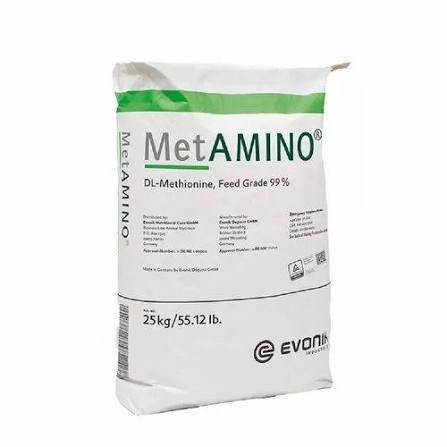
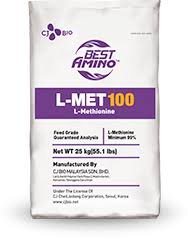
These specifications describe the products as identified in the sources reviewed. Buyers should obtain current manufacturer documentation, product identity confirmation and batch-specific certificates of analysis before procurement. The cited registration listing for PRO-AMINO M establishes its listed identity and declared grade; it does not independently verify every commercial batch or establish its manufacturing origin.
Why methionine source matters in poultry nutrition
Methionine is an essential amino acid and is commonly the first limiting amino acid in maize–soybean poultry diets. It supports protein synthesis, muscle development, feather growth, methyl-group metabolism and the synthesis of compounds including glutathione. Feed formulations therefore consider methionine alongside cysteine when meeting digestible sulphur amino-acid requirements.
DL-methionine versus L-methionine
DL-methionine contains approximately equal proportions of D- and L-isomers. Poultry can utilise the D-isomer after metabolic conversion into the L-form used in protein synthesis.
L-methionine supplies the L-isomer directly. This difference provides a biological rationale for testing whether L-methionine can improve nutrient utilisation under particular conditions, especially during early growth. However, three concepts must remain separate:
-
Chemical assay: how much of the declared substance the product contains.
-
Biological efficacy: how effectively the nutrient supports the relevant production response.
-
Economic value: whether any performance benefit offsets the ingredient’s delivered cost.
A product with a 99% assay does not automatically deliver identical biological or commercial outcomes to another product with a similar assay. Conversely, a theoretical biochemical advantage does not guarantee a measurable improvement in every commercial flock.
What does the published research show?
Study 1: Meta-analysis of L-methionine and DL-methionine
Ahmadi et al., 2023 — Poultry Science
The study, Assessing the nutritional equivalency of DL-methionine and L-methionine in broiler chickens: a meta-analytical study, evaluated published dose-response experiments in young broilers and used linear and nonlinear models to estimate relative biological efficacy.
The reported DL-methionine efficacy estimates, expressed relative to L-methionine, were:
Outcome |
Linear-model estimate |
Nonlinear-model estimate |
|---|---|---|
Average daily gain (ADG) |
94.97% |
91.33% |
Feed conversion ratio (FCR) response |
95.63% |
76.57% |
The linear-model findings were statistically significant at P<0.01. In the nonlinear model, the ADG difference was significant at P=0.01, while the FCR result was not conventionally statistically significant (P=0.09).
The analysis suggests that L-methionine may have a biological advantage in certain young-broiler growth and feed-efficiency responses. However, the estimates vary substantially by model, and the largest estimated FCR difference was statistically uncertain.
Commercial interpretation: The research supports evaluating L-methionine, but the estimates should not be converted into a guaranteed percentage improvement in commercial FCR. The study compared methionine sources—not MetAMINO, L-Met 100 and PRO-AMINO M in a single, direct, brand-to-brand trial. Source: Ahmadi et al., Poultry Science (2023)
Study 2: Controlled broiler experiment involving 720 chicks
Shen et al., 2023 — Poultry Science
Researchers allocated 720 one-day-old male Cobb 500 broilers to ten treatment groups, with six replicates of 12 birds per group. The experiment compared diets supplying different proportions of sulphur amino-acid requirements using DL-methionine or L-methionine. Some birds were also challenged with Eimeria species to investigate responses under coccidiosis-related conditions.
The pooled results for days 1–14 reported:
Performance measure |
DL-methionine |
L-methionine |
|---|---|---|
Body-weight gain |
310 g |
325 g |
FCR |
1.52 |
1.45 |
Feed intake |
No significant difference between isomers |
No significant difference between isomers |
The reported differences in body-weight gain (P=0.015) and FCR (P=0.010) favoured L-methionine. The study therefore provides a relevant signal that methionine source can influence early growth and feed efficiency under the experimental conditions.
Nevertheless, this was a controlled research experiment, not a full-cycle Indian commercial validation of the three named brands. Its findings should not be interpreted as proof that L-Met 100 will improve FCR by the same amount in every diet, strain, farm or production cycle. Source: Shen et al., Poultry Science (2023)
Study 3: Methionine hydroxy analogue research—an important distinction
Lemme, Li and Dorigam, 2024 — Animals
A separate meta-analysis examined 25 publications containing 95 datasets on DL-methionine versus methionine hydroxy analogue (MHA) in broilers. It reported no significant performance difference when DL-methionine was supplied at 65% of the MHA inclusion rate under the studied conditions.
This study is relevant to feed economics because it demonstrates why methionine products must be compared using the correct nutritional equivalence framework. However, MHA is a different product category from the crystalline DL-methionine and L-methionine products considered here.
The 65:100 substitution relationship must not be applied directly to MetAMINO, PRO-AMINO M and L-Met 100 as though they were interchangeable products. Source: Lemme, Li and Dorigam, Animals (2024)
What about layer birds?
The reviewed material also describes a layer-chick experiment in which utilisation was broadly similar across DL-methionine and L-methionine treatments for body weight, weight gain and feather growth over the study period.
This is a useful qualification: findings in young broilers cannot automatically be generalised to layers. A commercial layer decision requires evidence on egg production, egg mass, feed intake, egg weight, shell quality, mortality and feed conversion per kilogram of egg mass over an appropriate laying period.
Overall scientific assessment
The available research supports three conclusions:
-
L-methionine is a credible candidate for improving certain early-broiler growth and FCR outcomes.
-
The magnitude and consistency of any advantage remain dependent on the experimental conditions and production system.
-
The comparison between MetAMINO and PRO-AMINO M is primarily a question of verified DL-methionine quality, batch consistency, supplier reliability and delivered cost—not an established difference in methionine-isomer type.
Indian feed-mill economics: Price per kilogram is not enough
Publicly verifiable, comparable Indian bulk quotations for all three products were not established in the reviewed material. Accordingly, no current market price or definitive cost winner should be inferred from the examples below.
The first step is to compare the landed cost per unit of verified active methionine.
A simplified screening formula is:
Effective methionine cost per kg = Landed price per kg ÷ (assay fraction × assumed relative efficacy)
For illustration, assume a 99% assay for each product and use L-methionine as the reference with relative efficacy of 1.00. If DL-methionine is assigned a relative-efficacy assumption of 0.95, the calculation becomes:
Product |
Illustrative assay |
Relative-efficacy assumption |
Effective-cost expression |
|---|---|---|---|
MetAMINO |
Use actual batch assay; stated purity above 99% |
0.95 |
Price ÷ (assay fraction × 0.95) |
PRO-AMINO M |
99% listed grade |
0.95 |
Price ÷ (0.99 × 0.95) |
L-Met 100 |
At least 99% stated assay |
1.00 reference |
Price ÷ (assay fraction × 1.00) |
The 0.95 figure is an illustrative scenario informed by the linear-model evidence; it is not a validated, universal formulation coefficient. The actual calculation should use the batch assay and a defensible nutritional-efficacy basis agreed with the feed formulator.
At what premium does L-Met 100 stop being economical?
Under the simplified 95% relative-efficacy scenario, the break-even condition is:
L-Met 100 price ≤ DL-methionine price ÷ 0.95
On this basis, L-Met 100 could cost approximately 5.3% more per kilogram than a comparable 99%-assay DL-methionine product and still break even on the simplified effective-nutrient-cost calculation.
This is a scenario result—not a claim that L-methionine delivers a universal 5% performance advantage. The nonlinear meta-analysis generated a larger estimated FCR difference, but that result was statistically uncertain and should not be used as a default commercial pricing assumption.
The prudent approach is to begin with a transparent, conservative scenario and test any larger premium through a controlled feeding trial.
MetAMINO versus PRO-AMINO M: What should procurement teams verify?
Where both products are declared to be approximately 99% DL-methionine, the initial hypothesis should be that verified, nutritionally equivalent quantities may deliver similar performance when other relevant factors are equivalent. That hypothesis must be tested through supplier qualification and, where warranted, a production trial. Procurement teams should compare:
-
Batch-specific assay and product identity.
-
Impurity profile and moisture.
-
Particle size, handling and flowability.
-
Mixing uniformity and risk of segregation.
-
Manufacturing traceability and quality-management documentation.
-
Packaging, shelf life and storage performance under Indian logistics conditions.
-
Certificate of analysis for the actual supplied batch.
-
Delivered price, including applicable freight, handling, taxes and financing costs.
-
Supplier technical support, lead times and continuity of supply.
If both products meet the same agreed specification and supplier-qualification requirements, the lower landed cost per verified kilogram of DL-methionine is a rational starting choice. Any price premium should be justified by measurable quality, consistency, supply or production benefits—not brand recognition alone.
How much FCR improvement is needed to justify a higher price?
For a broiler integrator, the key metric is not merely ingredient cost. It is feed cost per kilogram of live-weight gain. The formula is:
Feed cost per kg of gain = Feed cost per kg × FCR
Consider a purely illustrative example:
-
Baseline feed cost: ₹40,000 per tonne.
-
Baseline FCR: 1.60.
-
Additional cost of the alternative diet: ₹100 per tonne of feed.
The baseline feed cost per kilogram of live-weight gain is ₹64.00. The alternative diet costs ₹40.10 per kilogram of feed, so its break-even FCR is approximately:
1.60 × (₹40,000 ÷ ₹40,100) = 1.596
The alternative diet would therefore need to improve FCR by approximately 0.004 points, or 0.25%, to offset the additional feed cost under these assumptions.
This calculation is an economic illustration, not a forecast of Indian methionine prices or the performance response to L-methionine.
For an actual feed-mill decision, calculate the break-even FCR using the baseline and alternative diet costs, then compare the threshold with replicated, mortality-adjusted farm results. Account separately for any changes in carcass yield, saleable output, mortality, processing losses or other operating costs.
At commercial scale, a small but repeatable FCR improvement can have material financial value. Conversely, an ingredient that improves early growth but does not improve full-cycle efficiency or saleable output may fail to deliver an adequate return.
How Indian poultry producers should validate the products
Supplier claims and individual published studies should not replace local validation. A well-designed broiler trial should assess biological performance and economics together. A practical comparison should include:
-
Treatment groups: the current MetAMINO-based standard, an equivalent diet using PRO-AMINO M, a diet using L-Met 100 and an appropriate reference or basal treatment where scientifically justified.
-
Nutritional equivalence: formulate against digestible sulphur amino-acid requirements, accounting for methionine and cysteine. Clearly state whether products are compared at equal product weight, equal analysed methionine or another independently justified nutritional target.
-
Replication: randomise and replicate pens. Determine bird numbers through a prospective power calculation using historical FCR variability and the minimum economically meaningful difference.
-
Full-cycle assessment: follow the commercial programme, such as day 0 to day 35–42, as appropriate to the operation. Report starter, grower and finisher results separately and cumulatively.
-
Controlled conditions: maintain comparable energy, amino-acid balance, protein, electrolytes, premix, coccidiosis control, feed form, stocking density, temperature and management.
-
Transparent analysis: use a prespecified statistical plan, report confidence intervals and disclose mortality, exclusions and protocol deviations.
Performance indicators to measure
Parameter |
Commercial relevance |
|---|---|
Body weight at days 7, 14, 28, 35 and 42, as appropriate |
Identifies when growth differences emerge |
Average daily gain |
Measures growth rate |
Average daily feed intake |
Helps distinguish improved efficiency from increased consumption |
FCR by phase and cumulatively |
Primary feed-efficiency measure |
Mortality-adjusted FCR |
Helps avoid misleading comparisons where mortality differs |
Livability and health events |
Captures production outcomes beyond growth |
Breast and carcass yield |
Relevant where returns depend on saleable meat |
Flock uniformity and coefficient of variation |
Measures consistency |
Feed-manufacturing and mixing variation |
Identifies dosing or segregation problems |
Feed cost per kilogram of live-weight gain |
Connects biological performance to cost |
Contribution margin per bird or tonne of feed |
Supports the final commercial decision |
For layers, use a separate and sufficiently long trial that measures egg production per hen-day, egg mass, egg weight, feed intake, feed conversion per kilogram of egg mass, shell quality, mortality and economic return. Broiler evidence alone is insufficient to select a methionine source for commercial layer production.
Two comparisons are particularly useful. An equal analysed-methionine comparison helps investigate source-related biological differences. A commercially optimised diet comparison identifies the lowest-cost formulation that meets the same nutritional and performance objectives. Together, these provide a stronger basis for procurement than either comparison alone.
Product-by-product assessment
MetAMINO: The reference benchmark
MetAMINO is a suitable reference product for a DL-methionine supplier-validation programme. Evonik states a purity above 99% and identifies the product for balancing methionine and total sulphur amino-acid requirements.
Its commercial value should be assessed against verified quality, supplier reliability, technical support and the competing delivered quotation. Any price premium should be linked to demonstrable operational benefits.
L-Met 100: The performance challenger
L-Met 100 is the most scientifically interesting candidate where early broiler growth and feed efficiency are important. Published research provides a credible rationale for evaluating L-methionine, but it does not justify assuming a fixed FCR advantage across commercial cycles.
An L-methionine premium is justified only when the effective nutrient cost and measured production response support it. The decision should be based on the feed mill’s own diet formulation, flock conditions and replicated performance data.
PRO-AMINO M: The alternative DL-methionine candidate
The reviewed Sri Lankan government listing identifies PRO-AMINO M as feed-grade DL-methionine at 99%. This makes it a logical candidate for evaluation against an established DL-methionine reference.
The listing does not, by itself, establish equivalence in impurities, batch consistency, mixing behaviour or commercial performance. If PRO-AMINO M satisfies the same supplier-qualification requirements and delivers equivalent results at a lower landed cost, it may offer a strong procurement case.
Final verdict: Which methionine product is best?
The answer depends on the commercial objective.
Objective |
Recommended starting point |
Why |
|---|---|---|
Establish a DL-methionine reference for supplier trials |
MetAMINO |
Established benchmark for evaluating an alternative source |
Reduce cost while maintaining equivalent DL-methionine quality |
Compare MetAMINO and PRO-AMINO M |
Select on verified quality, delivered cost and performance |
Investigate potential starter-phase broiler performance benefits |
L-Met 100 |
Published research supports further evaluation of L-methionine |
Minimise cost per kilogram of live-weight gain |
Not yet determined |
Requires actual quotations and full-cycle performance data |
Select a product for commercial layers |
Not yet determined |
Requires layer-specific production and egg-mass evidence |
Recommendation for Indian poultry integrators: Obtain comparable delivered quotations for all three products, qualify MetAMINO and PRO-AMINO M against the same documented quality specification, and validate L-Met 100 against the selected DL-methionine benchmark in a controlled feeding trial.
Do not pay a substantial L-methionine premium based solely on the largest published efficacy estimate. Equally, do not dismiss a premium if replicated farm data demonstrate that the higher-priced option reduces total production cost or improves saleable output.
The strongest conclusion supported by the reviewed evidence is that L-methionine is a credible performance challenger, while the choice between MetAMINO and PRO-AMINO M should initially be driven by verified product quality, landed cost and demonstrated consistency. A definitive commercial winner cannot be named without comparable Indian quotations and controlled, nutritionally appropriate performance data.
References and source documentation
-
Ahmadi et al. (2023). “Assessing the nutritional equivalency of DL-methionine and L-methionine in broiler chickens: a meta-analytical study.” Poultry Science. https://doi.org/10.1016/j.psj.2023.103143
-
Shen et al. (2023). “Effects of levels of methionine supplementations in forms of L- or DL-methionine on the performance, intestinal development, immune response, and antioxidant system in broilers challenged with Eimeria spp.” Poultry Science. https://doi.org/10.1016/j.psj.2023.102586
-
Lemme, Li and Dorigam (2024). “Meta-Analyses of Methionine Source Concept Validation Trials in Broilers.” Animals. https://doi.org/10.3390/ani14121771
-
Evonik. MetAMINO product information. Official product page
-
CJ BIO. BESTAMINO L-methionine product information. Official product page
-
Department of Animal Production and Health, Sri Lanka. Feed-product registration listing for PRO AMINO-M. Registration document

