


In a major milestone for India’s $150+ billion dairy sector, the National Dairy Development Board (NDDB) is aggressively scaling its indigenous, low-cost sex-sorted semen technology, GauSort.
Achieving a validated 85% to 90% female calf birth rate, GauSort is transforming smallholder dairy economics across northern and western dairy belts while addressing one of Indian agriculture’s most complex challenges: the stray cattle crisis.
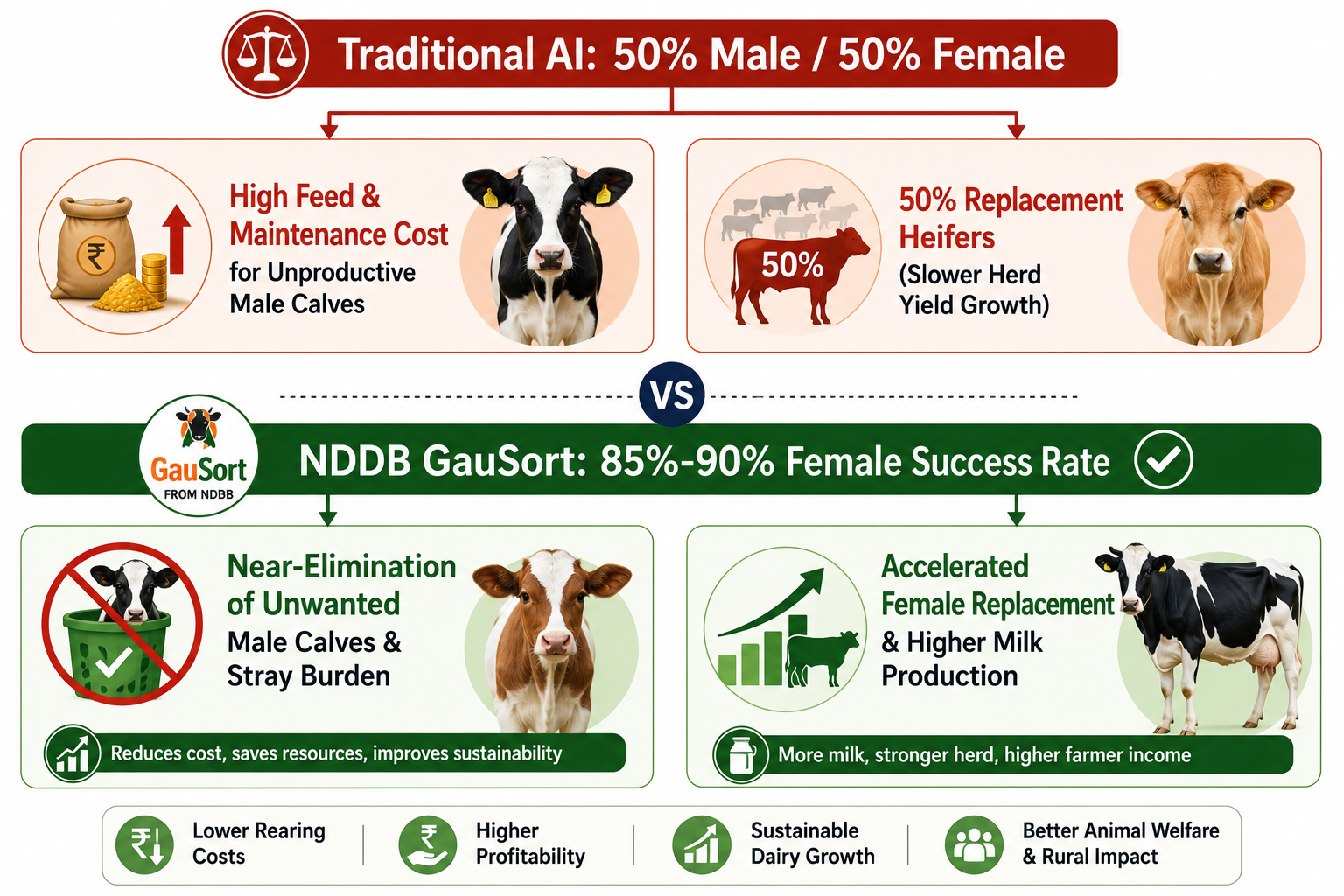
GauSort Impact Metrics & Dairy Sector Comparison
Performance Metric |
Traditional Artificial Insemination (AI) |
NDDB GauSort Sex-Sorted Semen |
Female Calf Probability |
~50% |
85% – 90%+ |
Cost per Dose to Farmer |
₹50 – ₹100 |
Subsidized Low-Cost (3x–5x cheaper than foreign tech) |
Unproductive Male Offspring Rate |
~50% (Drives stray cattle burden) |
Reduced by 80%–90% |
Herd Milk Yield Acceleration |
Baseline Genetic Progress |
Accelerated 2x–3x via female elite genetics |
Technology Origin |
Imported Flow Cytometry Equipment |
Indigenous Proprietary Sorting Platform |
1. The Economics of Dairy Transformation: Why GauSort Matters
For millions of Indian smallholder farmers owning 2 to 5 cows or buffaloes, raising a male calf represents a severe financial drain. With the mechanization of agriculture reducing the demand for draft bullocks, male calves often become economically unviable, contributing to widespread stray cattle issues across rural and urban landscapes.
Key Economic Drivers:
-
Cost Efficiency for Farmers: Imported sexed semen historically cost between ₹1,500 and ₹2,500 per dose—putting it out of reach for resource-poor farmers. NDDB’s indigenous technology drastically lowers production costs, making sex-sorted semen affordable at the village cooperative level.
-
Maximizing Milk Yield: By ensuring almost every successful insemination produces a female calf (heifer), farmers can double their replacement heifer rate, rapidly multiplying genetically superior milk-producing stock.
-
Resource Optimization: Farmers save thousands of rupees annually on feed, fodder, and healthcare that would otherwise be spent on non-remunerative male stock.
2. Indigenous Technology & High-Conception Accuracy
Developed at NDDB’s state-of-the-art research facilities in Anand, Gujarat, GauSort utilizes advanced microfluidics and specialized fluorescence-based cell sorting tailored specifically to indigenous Indian cattle breeds (Gir, Sahiwal, Red Sindhi, Tharparkar) and high-yielding Murrah and Mehsana buffaloes, alongside crossbred stock.
-
Precision Sperm Cell Sorting: The system differentiates between X-chromosome (female-determining) and Y-chromosome (male-determining) sperm cells based on minute DNA content differences.
-
Cryopreservation Membrane Protection: GauSort incorporates specialized extenders that preserve sperm membrane integrity during freeze-thaw cycles, solving the historical issue of low conception rates linked to early-generation sexed semen.
-
Field-Validated Results: Field trials across thousands of inseminations in Gujarat, Punjab, Haryana, and Uttar Pradesh consistently verify female calf birth success rates exceeding 85% to 90%.
3. Policy Alignment: Supporting Rashtriya Gokul Mission
The nationwide expansion of GauSort directly supports the Government of India’s Rashtriya Gokul Mission (RGM), which aims to enhance bovine productivity, conserve indigenous breeds, and double farmers’ income.
“Indigenous innovations like GauSort prove that cutting-edge biotechnology can be democratized for smallholders. By replacing imported proprietary tech with domestic capability, NDDB is securing both animal welfare and rural financial resilience,” noted industry analysts.

