


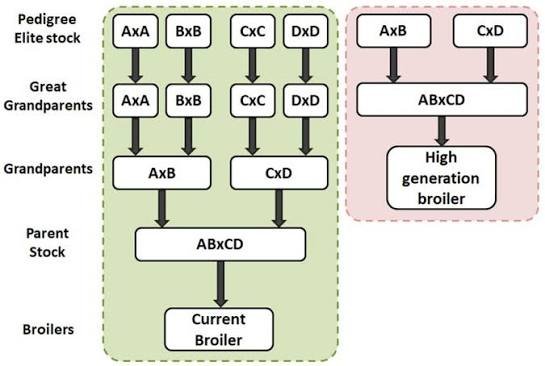
The modern industrial poultry ecosystem represents one of the most consolidated, technologically controlled, and high-margin segments in global agribusiness. At the root of this $500+ billion animal protein market sits a highly specialized niche: Grandparent Stock (GPS) genetics.
Market Landscape
While billions of commercial broilers are slaughtered annually for human consumption, the foundational genetics driving virtually all global poultry meat production are controlled by a tight oligopoly. Two primary conglomerates—Aviagen and Cobb-Vantress—control an estimated 80% to 85% of the worldwide market for white-feathered broiler breeding stock.
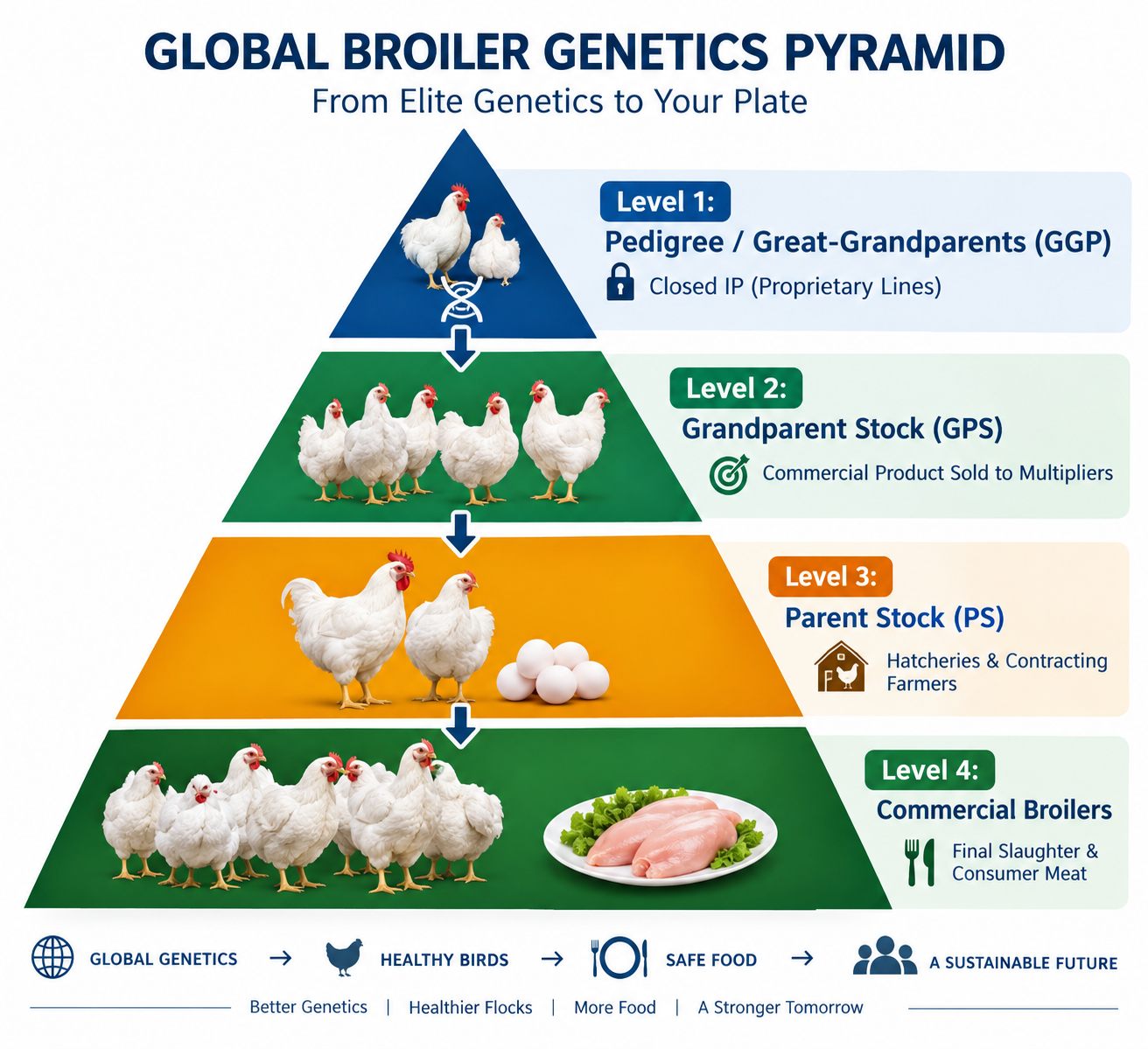
This structural centralization creates an unprecedented lever of control over global food security. Through a system of biological intellectual property protection and planned genetic breakdown, primary breeders ensure that commercial poultry farmers remain permanently dependent on continuous genetic replenishment.
Market Share Analysis & Industry Structure
A. Aviagen Group (EW Group)
-
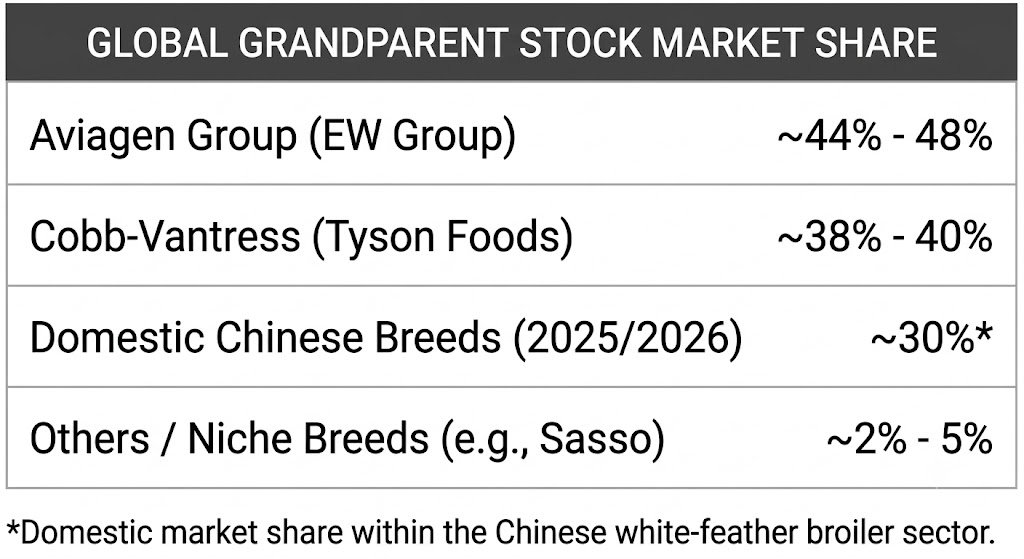
Market Position: The undisputed global leader, holding roughly 44% to 48% of the global broiler breeding market.
-
Ownership: Controlled by the German Wesjohann family through the EW Group.
-
Key Brands: Ross (the industry workhorse globally), Arbor Acres, and LDI.
-
Strategic Acquisitions: In 2018, Aviagen acquired Hubbard Breeders from Groupe Grimaud. This move consolidated control over the slow-growing and organic poultry markets (such as France’s Label Rouge), effectively closing off the primary alternative pathway for non-industrial genetics.
B. Cobb-Vantress
-
Market Position: The primary global competitor, holding approximately 38% to 40% market share.
-
Ownership: Wholly owned subsidiary of Tyson Foods, Inc. (USA).
-
Key Brands: Cobb500 and Cobb700
-
Core Advantage: Unmatched presence in North America, Latin America, and vertically integrated systems optimized for breast-meat yields and automated processing.
Mechanics of Planned Genetic Obsolescence
The primary breeding market operates on a four-tier genetic pyramid that enforces biological locks on its technology, preventing unauthorized replication.
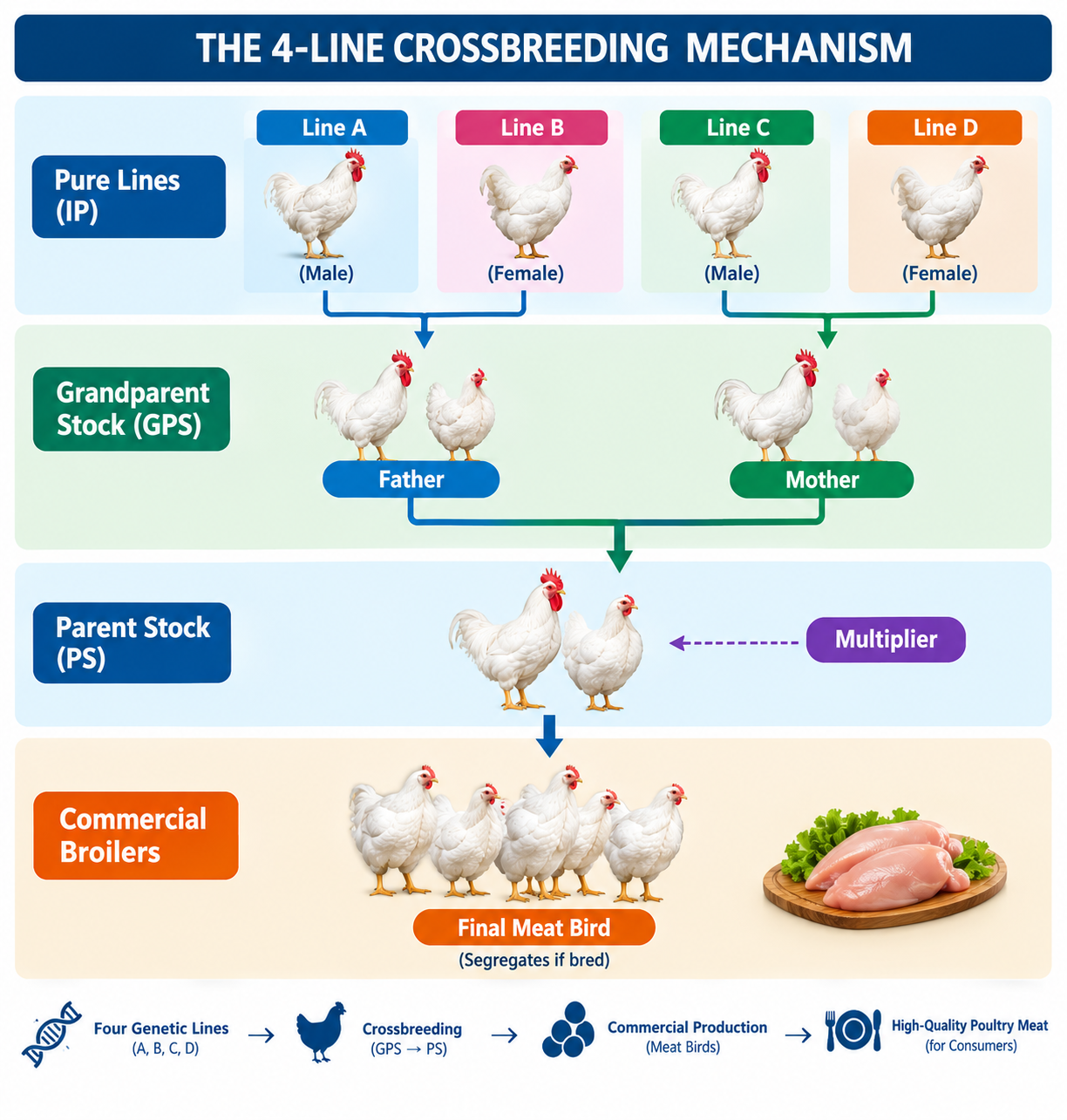
The Biological Lock (4-Line Hybridization)
-
Pure Lines / Great-Grandparents (GGP): The breeding company maintains four distinct, highly inbred pure lines labeled A, B, C, and D. These represent the proprietary IP and never leave secure bio-secure nuclear farms.
-
Grandparent Stock (GPS): What the company sells to regional integrators are single-sex offspring of these pure lines:
-
Male Line A (Roosters only)
-
Female Line B (Hens only)
-
Male Line C (Roosters only)
-
Female Line D (Hens only)
-
-
Parent Stock (PS): The customer crosses Line A times Line B to yield Parent Males, and Line C times Line D to yield Parent Females.
-
Commercial Broiler: Crossing the Parent Male and Parent Female generates the commercial broiler (A/B/C/D hybrid) slaughtered at ~6 weeks.
Why Farmers Cannot Self-Breed
If a farm attempts to breed commercial broilers with one another, Mendelian genetic segregation breaks the uniform hybrid vigor (heterosis). The resulting progeny exhibits massive biological variance: uneven growth rates, poor feed conversion ratios (FCR), structural weaknesses, and wildly inconsistent meat yields.
The farmer’s business model collapses unless they continuously purchase new Grandparent Stock or Parent Stock directly from the primary breeder.
Economic Leverage & Operational Scale
Selling final broilers directly would force primary breeders to hatch and ship tens of billions of day-old chicks globally each year—an operational impossibility. By selling Grandparent Stock, primary breeders outsource capital expenditure, feed costs, farm maintenance, and labor while maintaining complete market control.
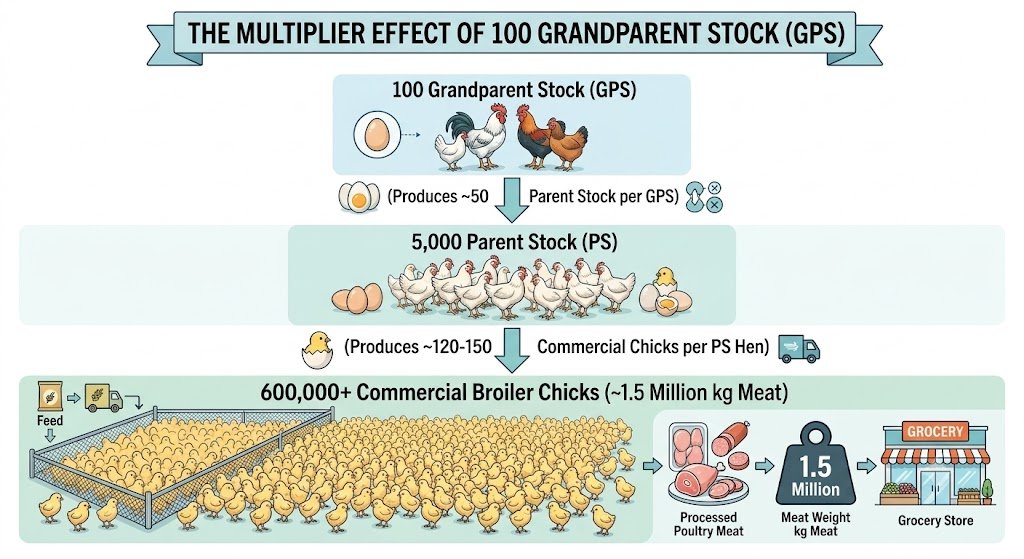
Terms to Tie Sales & Terms to Tie Relations
To maintain their dominance, primary breeders enforce strict contractual, technical, and relational mechanisms.
Terms to Tie Sales (Contractual & Structural Locks)
-
Single-Sex Supply Contracts: GPS packages are strictly distributed in unbalanced sex ratios. Customers are contractually barred from possessing or breeding both sexes of a single line.
-
Biosecurity & Traceability Audits: Breeders retain rights to inspect multiplier facilities. Any unauthorized genetic cross-matching leads to immediate termination of supply agreements and breach-of-IP lawsuits.
-
Bundled Feed & Management Tech: Primary breeders stipulate specific management handbooks, lighting schedules, and nutritional profiles tailored to their exact bird line, locking integrators into their technical ecosystem.
Terms to Tie Relations (Client Retention & Dependency)
-
Technical Service Integration: Primary breeders deploy field veterinarians, geneticists, and nutritionists who embed themselves into the customer’s operations to optimize Feed Conversion Ratios (FCR).
-
Customized Line Selection: Primary breeders adjust genetic selection pressure to match regional needs (e.g., heat tolerance for Southeast Asia vs. high breast-meat yield for North America), creating high switching costs for integrators.
-
Supply Security Guarantees: Given frequent global outbreaks of Highly Pathogenic Avian Influenza (HPAI), primary breeders maintain geographically isolated nuclear farms. Multipliers stay loyal to guarantee priority chick delivery during disease-driven market shortages.
China Angle: National Security & Domestic Innovation
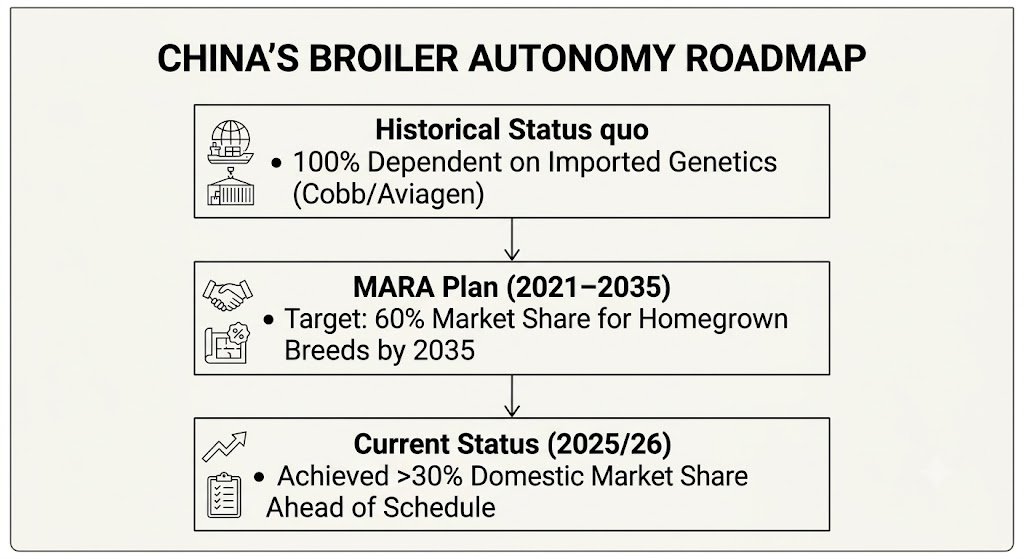
Historically, China imported nearly 100% of its white-feathered broiler breeding stock, leaving its poultry supply chain vulnerable to foreign disease bans, trade disputes, and geopolitical disruptions.
Strategic Policy Shift
In response to supply vulnerabilities, China’s Ministry of Agriculture and Rural Affairs (MARA) launched the National Broiler Genetic Improvement Plan (2021–2035), setting an explicit target for domestic breeds to capture at least 60% of the national market by 2035.
Breakthrough Domestic Breeds
China has successfully commercialized three primary domestic white-feather broiler varieties:
-
Shengze 901 (Fujian Shengnong Development)
-
Guangyu 1 (Foshan Xingsheng)
-
Wundar 1500 (Beijing DXWD)
China’s Market Progress
-
Surpassing Targets Ahead of Schedule: By 2025–2026, domestic breeds secured over 30% of China’s white-feather broiler market, reaching the halfway point of the 2035 goal in just four years
-
Integrated Scale: Companies like Shengnong Development utilize fully integrated supply chains—from domestic primary breeding farms to processing plants—enabling them to deploy domestic genetics at scale.
Strategic Summary & Market OutlooK
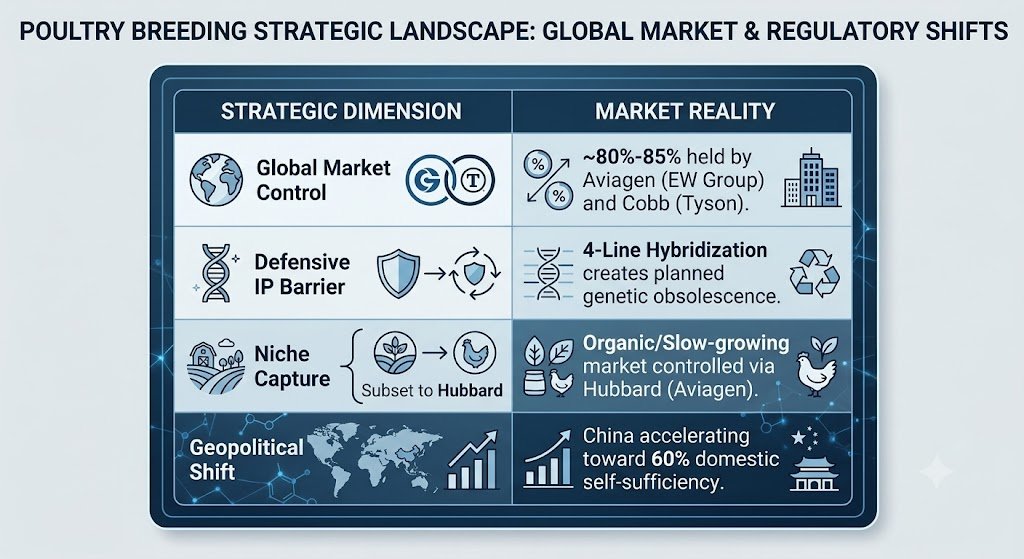
The Grandparent Stock market demonstrates how biological systems can be engineered into secure, recurring revenue models. While Western conglomerates maintain control over global poultry genetics, China’s rapid gains in domestic breeding signal a broader shift toward food sovereignty that could reshape international agribusiness.

 poultry market, Aviagen & Cobb market shares, biological IP locks, and China's 30%+ domestic breakthrough.)