


From monoclonal antibodies and canine cancer therapies to antibiotic alternatives, methane-reducing vaccines and AI-powered pet diagnostics, November’s developments highlight the expanding innovation landscape in animal health.
The global animal-health start-up ecosystem is attracting attention across several emerging technology segments. November 2026 has brought new investment into veterinary biotechnology, livestock immune health, companion-animal oncology and AI-led pet monitoring. Alongside funding announcements, companies in South Korea and the UK have reported product-development and business-expansion milestones.
The developments point to a broader shift in the industry: innovation is moving beyond conventional veterinary pharmaceuticals towards targeted biologics, non-antibiotic interventions, digital diagnostics and technologies addressing livestock sustainability. Here are eight companies worth watching.
Veterinary biotechnology and oncology attract investor interest
VETmAb BIO: Investment backs monoclonal antibody development for pets
US-based VETmAb Biosciences has received investment from TL Foundation to advance its pipeline of monoclonal antibody therapies for dogs and cats. The investment amount and valuation have not been disclosed.
The company is developing biologic medicines for chronic and debilitating companion-animal diseases. Its pipeline includes VMB-C001a, a long-acting anti-IL-23 monoclonal antibody being investigated for canine chronic inflammatory enteropathy, a condition associated with persistent gastrointestinal inflammation.
In October, VETmAb reported positive proof-of-concept results: 77.8% of dogs receiving VMB-C001a were classified as treatment successes, compared with 30% in the placebo group. The candidate has also been granted eligibility for the US FDA’s expanded conditional approval pathway.
The investment adds to growing interest in veterinary biologics, particularly therapies that target specific immune pathways rather than relying exclusively on conventional small-molecule drugs. These early results are encouraging, but further clinical and regulatory evaluation remains necessary.
Kyrexa: £1.5 million backing supports oral canine cancer therapy
UK-based Kyrexa is raising £1.5 million with backing from Animal Health Angels to support further clinical development of Rimcazole, an oral immunotherapy candidate for canine cancer.
The company is developing Rimcazole as a potential treatment option for dogs with cancer. Its approach is intended to combine anti-tumour, anti-angiogenic and immune-related effects in an oral medicine.
The investment is significant in the context of veterinary oncology, where treatment costs, access to specialist care and the availability of approved therapies remain important challenges. Kyrexa’s development programme will need to establish the candidate’s safety, efficacy and clinical value through further studies.
The reported funding is directed towards clinical development; it should not be interpreted as a product approval or commercial launch. Investor interest nevertheless reflects the growing opportunity in companion-animal cancer therapeutics.
ValiRx Animal Health: New venture focuses on veterinary oncology
UK life-sciences company ValiRx has established ValiRx Animal Health as a subsidiary to explore the development of its research portfolio for companion animals.
The initiative creates a route for evaluating whether selected oncology assets and related research can be translated into veterinary applications. It is a strategic venture-development announcement rather than a disclosed external funding round or a new veterinary drug launch.
The opportunity lies in adapting relevant oncology research for dogs and cats, where certain cancers have significant unmet treatment needs. The company’s progress will depend on asset selection, veterinary-specific development, clinical evidence and regulatory pathways. The move illustrates how human life-sciences research may create opportunities for veterinary medicine through carefully managed translational development.
Livestock innovation: Non-antibiotic health and climate technologies
Nutrivert: Up to US$4.85 million committed for non-antibiotic livestock trials
US-based Nutrivert has attracted an investment commitment of up to US$4.85 million from Arrow Ventures to support trials of its LDPP product, a candidate being developed as a non-antibiotic livestock immune stimulant.

The development programme includes trials involving approximately 4,800 pigs in the US Midwest. The study design compares animals receiving LDPP, antibiotics, both interventions or neither treatment. Key production measures include weight gain, feed conversion efficiency and mortality.
The commercial proposition is particularly relevant as livestock producers and the animal-health industry seek ways to reduce dependence on routine antibiotic use while maintaining animal health and production performance.
However, the critical test will be whether LDPP can demonstrate consistent benefits under commercial farm conditions. It remains a product under development, not an established replacement for antibiotics used to treat bacterial infections.
For the livestock industry, the study is worth watching because it evaluates a potential alternative against practical production benchmarks rather than relying only on laboratory or mechanistic findings.
Lucidome Bio: US$9 million raised for methane-reducing livestock vaccine
New Zealand-based Lucidome Bio has secured US$9 million to accelerate development of a vaccine intended to reduce methane emissions from grazing livestock. The funding brings together support from the Bezos Earth Fund, AgriZeroNZ, Meat & Livestock Australia and the New Zealand Agricultural Greenhouse Gas Research Centre.

The company’s approach targets methanogenic archaea, the microorganisms responsible for producing methane in the rumen. The vaccine is intended to stimulate an immune response that could interfere with methane production.
The funding will support further research and a series of cattle trials planned over the next 18 months. The programme is particularly relevant to pasture-based dairy, beef and sheep production systems, where feed-based methane-reduction interventions may be difficult to deploy consistently.
A commercially successful vaccine could offer an attractive route to reducing livestock emissions without requiring major changes to farm feeding systems. However, efficacy under real-world conditions, durability of the response and the absence of adverse effects on animal health or productivity will be essential.
The funding is an important development milestone, but a commercial methane vaccine is not yet available. Lucidome’s progress will be closely watched by the livestock, animal-health and agricultural climate-technology sectors.
AI and digital technologies reshape companion-animal care
Janus Labs AI: US$1.8 million pre-seed funding for contactless pet monitoring
US-based Janus Labs AI has raised US$1.8 million in pre-seed funding, led by New York Angels, with participation from other investors.
The company is developing contactless neural-sensing technology combined with artificial intelligence to monitor the health and wellbeing of dogs and cats. Its proposition is to combine neural information with physiological data to build individual profiles and identify potential changes in an animal’s condition.

The concept seeks to move pet monitoring beyond conventional activity trackers towards more sophisticated health and wellbeing assessment.
The technology is at an early stage, and its clinical value will depend on independent validation of the measurements, the reliability of its algorithms and evidence that the information can support meaningful veterinary decisions.
MetaDx: South Korean company expands AI diagnostics and veterinary clinic services
South Korean company MetaDx is developing AI-based diagnostic support tools while exploring expansion into veterinary clinic procurement and supply services.
Its CancerVET product analyses patterns of nine volatile organic compounds detected in blood samples to estimate the likelihood of tumours in dogs. Its VitalVET solution uses blood-test results and clinical information to help assess anaesthesia risk.
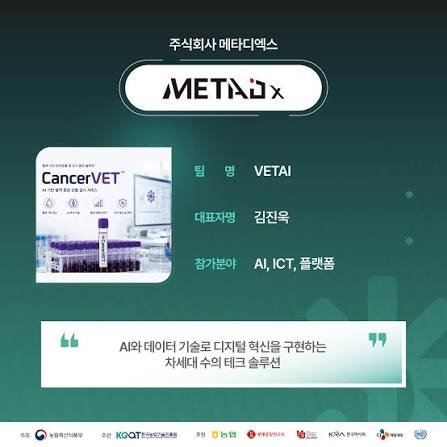
The company is also planning a maintenance, repair and operations supply business intended to help veterinary clinics manage procurement costs.
The combination of diagnostic support and clinic operations is notable. Veterinary technology businesses are increasingly exploring opportunities not only to improve clinical decision-making but also to address the operational costs and workflow challenges faced by veterinary practices. The diagnostic tools should be regarded as decision-support products; their clinical utility depends on appropriate validation and veterinary interpretation.
Elevenliter: Government recognition for smartphone-based AI pet screening
South Korean pet-technology company Elevenliter has been selected by the Ministry of Agriculture, Food and Rural Affairs for its A-Ventures programme, which recognises promising start-ups in the agri-food sector.
Its Lifet service uses smartphone photographs of a pet’s eyes, mouth and legs to analyse potential health conditions and assess their severity or progression. The company currently offers analysis services covering five categories: patellar luxation, periodontal disease, obesity, cataracts and skin disorders.
The approach aims to make preliminary pet-health screening more accessible to owners. Its longer-term value will depend on diagnostic accuracy, the ability to identify clinically meaningful changes and whether the technology encourages timely veterinary consultation.
Smartphone-based screening could become a useful component of preventive pet care, but it should not be confused with a definitive veterinary diagnosis.
What November’s developments mean for the animal-health industry
The eight companies illustrate five investment and innovation themes:
-
Veterinary biologics: Monoclonal antibodies and other targeted therapies are gaining attention as potential treatments for chronic and immune-mediated diseases in companion animals.
-
Veterinary oncology: Specialist investors are supporting the development of new cancer-treatment options for dogs and cats.
-
Antibiotic alternatives: Livestock immune-health products are being evaluated through large-scale trials that measure commercial production outcomes.
-
Climate-linked animal health: Methane-reduction technologies are attracting funding from investors focused on agriculture and emissions reduction.
-
AI-enabled veterinary care: Digital tools are expanding from basic pet tracking towards diagnostic support, health screening and clinic workflow management.
For India, these developments offer several potential areas for collaboration, technology adaptation and domestic product development. Poultry and dairy producers could benefit from validated non-antibiotic health interventions, while veterinary clinics and pet owners may increasingly adopt affordable diagnostic and monitoring technologies.
The most important commercial lesson is that innovation must ultimately demonstrate measurable value: better animal health, improved productivity, reliable clinical outcomes, lower costs or reduced environmental impact.
November’s start-up activity reinforces a clear direction for the global animal-health sector: the next wave of growth may be shaped as much by biotechnology, data and preventive health as by conventional veterinary medicines.

