


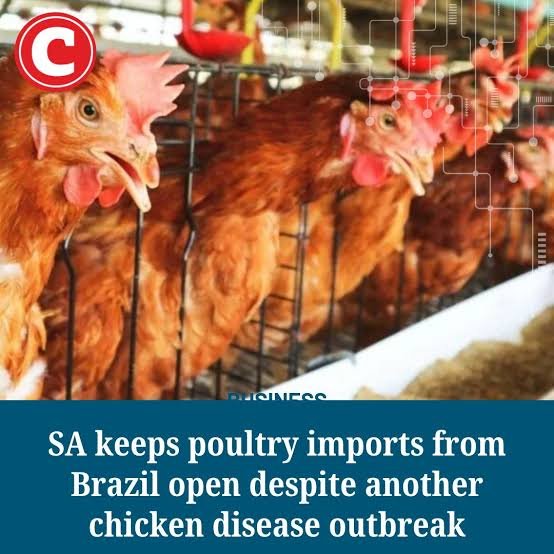
South Africa Maintains Regionalised Poultry Import Controls Following Newcastle Disease Outbreak in Brazil’s Santa Catarina
South Africa’s decision to maintain targeted poultry-import controls following a Newcastle disease outbreak in Brazil has received support from the South African Poultry Association (SAPA), which has welcomed the government’s decision not to impose a blanket nationwide restriction on Brazilian poultry products.
The outbreak was reported in Santa Catarina, Brazil, in October 2026. South Africa was notified by Brazilian authorities on 20 October and subsequently adopted a regionalised approach, restricting imports associated with affected areas while allowing trade from unaffected parts of Brazil to continue under veterinary certification requirements.
The policy illustrates the importance of regionalisation in international poultry trade, particularly when outbreaks are geographically confined within major exporting countries.
What South Africa’s import policy requires
South Africa’s Department of Agriculture confirmed on 28 October that it would not impose a countrywide ban on Brazilian poultry and poultry products.
Instead, trade from affected areas is restricted, while eligible consignments from unaffected areas may continue under agreed veterinary certification conditions. For fresh poultry meat, certification requirements include confirmation that:
-
The source premises have had no Newcastle disease cases during the previous six months.
-
There have been no Newcastle disease cases within a 10-kilometre radius of the source premises during the same period.
-
The relevant abattoir and cutting plant are not located within an infected zone.
Additional requirements apply to hatching eggs and day-old chicks, including longer disease-free periods for source farms and relevant facilities.
The approach is intended to prevent products originating from infected or epidemiologically linked premises from entering South Africa while preserving access to compliant supplies from unaffected regions.
SAPA supports the targeted approach
In comments reported on 9 November, SAPA welcomed the decision to avoid a nationwide restriction. The association argued that a regionalised approach offers a more proportionate balance between animal-health protection and trade continuity.
SAPA’s Broiler Organisation CEO Izaak Breitenbach said that South Africa imports approximately 18,000 tonnes of poultry meat from Brazil each month.
Because the restriction is not nationwide, the association does not expect a major disruption to retail supply or prices, provided that veterinary certification requirements are followed.
SAPA also noted that South African poultry producers have their own vaccination and biosecurity programmes for Newcastle disease, providing an additional layer of protection to the domestic flock.
These comments represent industry assessment rather than an official forecast of import volumes or consumer prices.
Why regionalisation matters to Brazil’s poultry trade
Brazil is one of the world’s leading poultry exporters. A disease event in a major poultry-producing state can have substantial trade implications if importing countries impose nationwide restrictions.
The country’s response to the October outbreak has therefore involved both epidemiological control and diplomatic engagement with trading partners. Brazil’s Ministry of Agriculture has been negotiating recognition of regionalisation, with the objective of limiting restrictions to the affected state or defined outbreak zones rather than the entire country.
The South African approach is consistent with this wider effort to preserve trade where animal-health evidence supports separation between affected and unaffected areas.
Disease-control implications
Newcastle disease is a highly contagious viral infection affecting birds, with potentially serious consequences for commercial poultry production.
Control measures typically involve surveillance, movement restrictions, cleaning and disinfection, appropriate vaccination programmes and management of affected premises. The effectiveness of regionalised trade controls depends on accurate outbreak mapping, reliable veterinary certification and transparent sharing of disease-surveillance information.
A breakdown in certification or traceability could undermine confidence in the system and lead to broader restrictions.
What to monitor next
The key developments for poultry producers and exporters are:
-
Further Newcastle disease detections in Santa Catarina.
-
Changes to the restricted geographic zones.
-
Additional recognition of regionalisation by importing countries.
-
Compliance with veterinary certification requirements.
-
Any new restrictions affecting Brazilian poultry products.
Bottom line: South Africa has chosen targeted, region-based controls rather than a blanket ban on Brazilian poultry imports following Newcastle disease in Santa Catarina. SAPA supports the approach, arguing that it protects biosecurity while limiting unnecessary disruption to poultry trade and domestic supply.

