


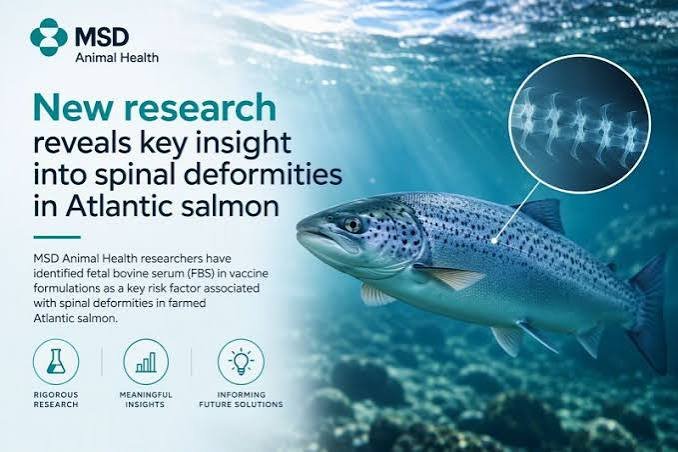
Foetal Bovine Serum Linked to Spinal Deformities in Atlantic Salmon Vaccine Study, Raising New Questions for Aquaculture Vaccine Manufacturing
A new study published in the Journal of Fish Diseases has identified an association between foetal bovine serum (FBS) in experimental oil-adjuvanted vaccines and a high incidence of cross-stitch vertebral deformities in Atlantic salmon. The findings could have implications for vaccine formulation, manufacturing quality control and fish-welfare management across the global salmon aquaculture industry.
Published online on 30 October 2026, the study, titled Effect of Foetal Bovine Serum in Oil-Adjuvanted Vaccines on Spinal Deformities and Growth in Atlantic Salmon (Salmo salar), investigated five experimental multivalent oil-adjuvanted vaccine formulations, with and without FBS and salmonid alphavirus (SAV) antigen.
The research is particularly significant because cross-stitch vertebrae, a spinal pathology described in 2020, have previously been associated with the use of inactivated salmonid alphavirus vaccines. The new findings suggest that the vaccine antigen itself may not be the only factor involved.
Experimental design and findings
Researchers followed approximately 1,600 Atlantic salmon subjected to different smoltification and temperature regimes. The fish were subsequently reared in sea cages and examined at slaughter.
The key results were:
Experimental formulation |
Reported cross-stitch deformity rate |
|---|---|
FBS-containing formulation 1 |
39.2% |
FBS-containing formulation 2 |
51.7% |
Serum-free formulations |
0–1% |
The difference between the FBS-containing and serum-free formulations was substantial. The findings indicate that the presence of FBS in the tested experimental formulations was associated with a markedly higher incidence of the specific vertebral pathology.
Severely affected fish also showed reduced growth and lower slaughter weights, suggesting that the implications extend beyond skeletal abnormalities to production performance and potentially carcass quality.
Why FBS matters in vaccine manufacturing
Foetal bovine serum is commonly used as a supplement in cell-culture systems, including processes used to propagate viruses for vaccine production. It provides growth factors, proteins, lipids and other components that support cell growth.
However, residual cell-culture materials may remain in harvested biological preparations unless adequately removed during downstream processing.
The salmon study raises the possibility that particular FBS-associated components or residues in oil-adjuvanted vaccine formulations may contribute to skeletal pathology. The responsible components and precise biological mechanism have not yet been established.
Importantly, the study does not demonstrate that all fish vaccines containing FBS cause spinal deformities, nor does it establish that all oil-adjuvanted salmon vaccines carry the same risk.
Implications for the salmon industry
For salmon producers, skeletal deformities can have consequences across several stages of production. They may compromise fish welfare, affect growth and feed efficiency, reduce harvest weights and create processing or grading challenges.
For vaccine manufacturers, the findings create a strong rationale for examining:
-
The composition and purity of cell-culture-derived vaccine components.
-
Residual FBS concentrations in finished vaccine formulations.
-
The relationship between vaccine manufacturing processes and skeletal pathology.
-
The use of serum-free manufacturing systems.
-
Long-term skeletal and growth outcomes following vaccination.
MSD Animal Health, which funded the study, has also introduced AQUAVAC S7, a seven-component salmon vaccine manufactured without serum. However, the experimental findings should not be interpreted as proof that this product eliminates every potential cause of vaccine-associated skeletal deformity under commercial conditions.
Further research required
The study provides a potentially important formulation-safety signal, but additional research is necessary to identify the specific FBS components responsible and establish the mechanism linking exposure to vertebral development.
Independent replication, dose-response experiments and commercial-scale assessments would help determine whether the observed differences translate consistently across production environments, genetic lines and vaccination schedules.
Industry significance
This research is not an argument against vaccination in aquaculture. It is a formulation-safety finding that could influence the development of serum-free production processes, vaccine procurement decisions and fish-welfare monitoring.
Bottom line: FBS-containing experimental salmon vaccine formulations were associated with cross-stitch deformity rates of 39.2–51.7%, compared with 0–1% in serum-free formulations. The findings make residual manufacturing components an important area for further vaccine-safety investigation.

