


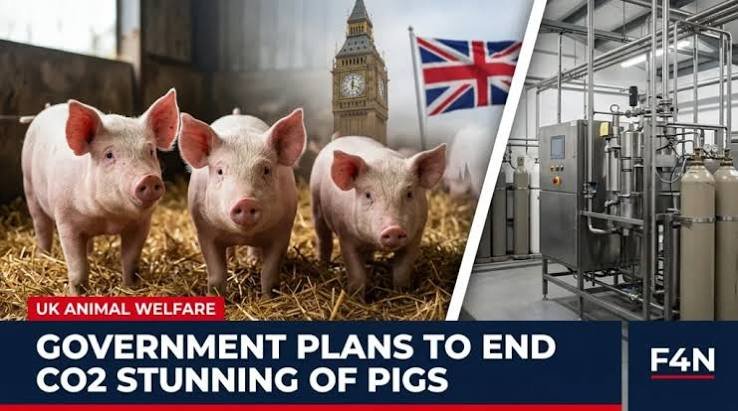
including panic and breathing difficulties, before animals lose consciousness.
Announced by the Department for Environment, Food & Rural Affairs (Defra) on 26th of October 2026, the proposal opens a public consultation on replacing the method with alternatives such as argon-gas stunning and automated electrical stunning. The consultation seeks views on animal-welfare benefits, technical feasibility, costs and the time required for processors to transition.
The consultation closes on 21 December 2026. The announcement does not itself introduce a final prohibition, establish a definitive compliance date or disclose a dedicated financial-support package for equipment conversion.
For the UK pig-processing industry, the proposal raises important questions about slaughterhouse investment, line compatibility, throughput, worker training and the reliability of alternative gas supplies. For international pork producers and equipment suppliers, it also provides a policy signal about the direction of travel in slaughter-welfare standards.
Official announcement: UK government — New plans to end carbon dioxide stunning of pigs to prevent suffering.
What has the UK government proposed?
High-concentration CO₂ stunning is used in British slaughterhouses to render pigs unconscious before slaughter. The method has been widely adopted in commercial pig processing, partly because it can accommodate groups of pigs and integrate into industrial processing systems.
However, the welfare concern centres on the period before loss of consciousness. Exposure to high concentrations of CO₂ can cause aversive respiratory sensations and distress. The government says independent evidence has highlighted significant welfare concerns associated with the practice.
The new proposal seeks to move the industry towards methods considered capable of reducing suffering during this stage of slaughter.
The consultation is intended to assess how a transition could be implemented in practice, taking account of animal welfare, the technical requirements of commercial facilities and potential effects on businesses and consumers.
It is important to distinguish the proposal from a completed regulatory change. The government has opened a consultation; the final policy, implementation timetable and any transitional provisions remain to be determined.
Alternatives Under Consideration
1. Argon-gas stunning – Argon is an inert gas that can be used in controlled-atmosphere stunning systems. It is being considered as an alternative to high-concentration CO₂.
Its practical performance depends on the design of the stunning system, gas concentration, exposure conditions, animal handling and confirmation that unconsciousness is achieved appropriately.
For processors, important questions include gas-supply reliability, chamber design, operating procedures, equipment modification and the cost of maintaining the system. Argon availability and delivered cost will also matter when facilities evaluate commercial feasibility.
The consultation will help establish how the proposed alternative could be implemented across different operating environments.
2. Automated electrical stunning – Electrical stunning uses controlled electrical current to induce unconsciousness. Automated systems can help standardise aspects of the process, but their suitability depends on equipment configuration, animal handling, throughput and the ability to achieve an effective stun consistently.
Processors would need to assess the required capital expenditure, installation requirements, staff training, maintenance and compatibility with existing slaughter lines.
Electrical stunning should not be assumed to be welfare-neutral under all conditions. Correct equipment settings, handling, monitoring and competent operation remain essential to achieving intended welfare outcomes.
Why Transition Planning Matters
A slaughterhouse cannot necessarily change stunning technology by replacing one component. Depending on the method selected, the transition may affect facility layout, animal movement, process timing, maintenance arrangements, operating procedures and workforce training.
The appropriate comparison is therefore not simply the price of one gas against another. It is the total cost and operational performance of the alternative system, measured against the welfare outcomes the government intends to achieve.
Consultation Scope and Timetable
The consultation asks stakeholders to consider the benefits and practical challenges associated with phasing out high-concentration CO₂ stunning.
Policy question |
Current position |
|---|---|
Proposed change |
Phase out high-concentration CO₂ stunning of pigs |
Alternatives identified |
Argon-gas stunning and automated electrical stunning |
Consultation opened |
26 October 2026 |
Consultation deadline |
21 December 2026 |
Main issues |
Welfare benefits, cost, technical feasibility and transition timescales |
Final prohibition announced? |
No |
Definitive compliance date announced? |
No |
Dedicated equipment-conversion funding announced? |
Not in the cited announcement |

