


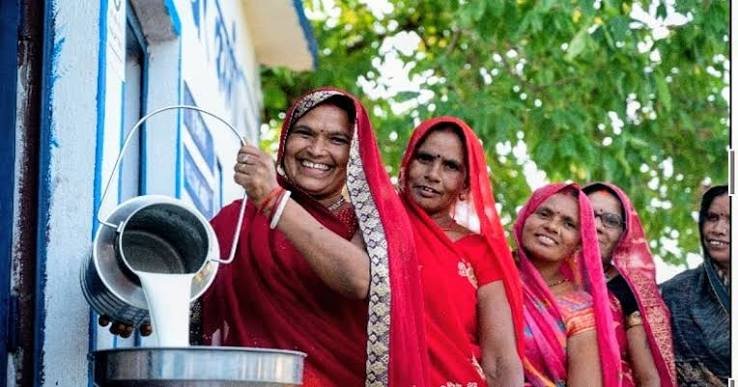
Five women-led dairy companies operating through Self-Help Group (SHG) networks under the Uttar Pradesh Rajya Gramin Aajeevika Mission (UPSRLM) have reportedly generated a combined ₹5,716.26 crore in turnover since 2019, marking a significant expansion of women-led enterprise in India’s rural dairy economy.
The reported achievement involves approximately 3.88 lakh women, positioning the initiative as more than a livelihood programme: it represents an emerging model of collective rural ownership, milk aggregation, processing and market participation.
The figures were reported on August 24–25, 2026. Because the ₹5,716.26-crore figure comes from contemporary reporting rather than an independently audited financial filing located in the sources reviewed for this article, it is best described as a reported combined turnover, rather than audited consolidated revenue.
From SHGs to Rural Dairy Enterprises
The development illustrates an important evolution in India’s SHG ecosystem.
Traditional SHGs were primarily designed to improve women’s access to savings, credit and livelihood opportunities. India’s DAY-NRLM framework explicitly aims to organise rural women into SHGs and support them in income-generating activities, including through revolving funds, community investment funds and bank-credit mobilisation.
The Uttar Pradesh model takes that architecture further by linking women to a commercially significant agricultural value chain: dairy. Instead of women participating only as individual milk producers, the emerging model creates collective entities capable of participating in:
milk procurement → aggregation → chilling → processing → value addition → branding → distribution → sales.
That distinction matters because the greatest economic value in dairy is not necessarily generated at the farm gate.
₹5,716 Crore: Why the Number Matters
The reported combined turnover of ₹5,716.26 crore since 2019 translates to an average of approximately: ₹952.7 crore per year across the five enterprises over a six-year period, assuming a simple 2019–2025 averaging period.
It would be inappropriate, however, to interpret this as annual profit or even current annual revenue. Turnover is the value of sales flowing through the businesses; it does not represent net income, margins or women’s individual earnings.
That distinction is particularly important for assessing the programme’s economic impact. The more meaningful question is whether the enterprises have increased:
-
milk procurement volumes;
-
farmer realisations;
-
women’s ownership of productive assets;
-
processing capacity;
-
margins from value-added dairy;
-
access to formal finance;
-
employment;
-
household income.
Those metrics would provide a stronger assessment of the programme’s long-term economic impact.
Why Uttar Pradesh Is an Important Dairy Market
The development is taking place in India’s largest milk-producing state.
The Uttar Pradesh government’s investment portal identifies the state as India’s No. 1 milk producer, accounting for approximately 16% of national milk production. It also reports that approximately 86% of farmers are landless or operate holdings of 0–1 hectare, making livestock particularly important as a source of rural income. The state’s dairy economy is also geographically broad:
-
Western Uttar Pradesh: approximately 50% of state milk production
-
Eastern Uttar Pradesh: approximately 31%
-
Central Uttar Pradesh: approximately 14%
-
Bundelkhand: approximately 5%
The government’s data identify Bulandshahr, Meerut, Agra, Aligarh and Saharanpur among the state’s leading milk-producing districts. This geographic spread creates a potentially powerful platform for decentralised women-owned dairy enterprises.
The Scale of the Women’s Network
The reported 3.88 lakh women participating in the dairy ecosystem is perhaps more strategically important than the turnover figure. At that scale, the initiative can potentially influence the dairy value chain at several levels.
Farm level – Women can participate directly in:
-
dairy animal management;
-
milking;
-
feeding;
-
breeding decisions;
-
animal-health management;
-
milk quality.
Aggregation level – SHGs and federations can facilitate:
-
milk collection;
-
quality testing;
-
bulk aggregation;
-
payment systems;
-
chilling.
Enterprise level – Women-led companies can move into:
-
processing;
-
packaging;
-
branding;
-
logistics;
-
institutional sales;
-
retail distribution.
This creates a progression from “women as livestock workers” to “women as dairy entrepreneurs.”
Why Collective Ownership Can Matter
Small dairy producers face a structural disadvantage: scale. An individual farmer producing a relatively small quantity of milk has limited bargaining power with processors, traders and input suppliers. A collective can potentially change that equation.
Individual producer
10–20 litres/day
↓
limited bargaining power
SHG / producer collective
hundreds or thousands of producers
↓
bulk milk
↓
quality testing
↓
chilling
↓
processing
↓
larger buyers / branded products
↓
greater potential value capture
The economic principle is similar to farmer-producer organisations in other agricultural sectors: aggregation can convert fragmented production into commercially meaningful supply.
UP’s Dairy Policy Is Also Building the Processing Ecosystem
The women-led SHG development is occurring alongside broader state dairy-policy initiatives.
Uttar Pradesh’s Dairy Development and Milk Products Promotion Policy 2022 aims to increase milk processing, improve market development and encourage technology and IT-based solutions. The state currently targets increasing milk processing from approximately 10% to 25%.
The policy also provides financial support for dairy infrastructure. According to Invest UP, eligible projects can receive:
-
capital investment grants of up to ₹5 crore for qualifying milk-processing or milk-product manufacturing investments;
-
interest subvention of up to ₹10 crore for qualifying new dairy-processing units;
-
interest support for animal-feed manufacturing;
-
support for cold-chain infrastructure.
This matters because women-led milk collection without processing capacity leaves much of the value chain outside the producer group. Processing is therefore likely to be the next major frontier.
The Strategic Opportunity: Move Beyond Liquid Milk
The biggest economic opportunity may not be simply increasing milk sales. It is value addition.
A mature women-led dairy enterprise can potentially develop products such as:
milk → curd → paneer → ghee → flavoured dairy → fermented products → milk powder → institutional products
with appropriate food-safety, processing and market infrastructure. Value-added dairy can potentially generate higher revenue per litre than raw milk, although margins vary considerably by product, processing cost, distribution and market positioning.
This is where India’s rural dairy SHG model could evolve from a livelihood programme into a rural consumer-brand ecosystem.
Animal Health Could Become the Next Bottleneck
There is another important implication for the animal-health industry. Scaling women’s dairy enterprises increases the economic value of every animal in the network.
That makes preventive animal health increasingly important. A commercial dairy enterprise needs reliable control of:
-
mastitis;
-
reproductive disorders;
-
metabolic disease;
-
parasitic infections;
-
calf morbidity;
-
vaccination;
-
nutrition;
-
fertility;
-
milk quality.

