



Veterinary AI Adoption More Than Doubles in Two Years
Artificial intelligence is becoming a routine operational tool across veterinary practices, according to the 2026 Veterinary AI Study released by veterinary software company Digitail in collaboration with the American Animal Hospital Association (AAHA).
Published recently, the study found that 83.7% of surveyed veterinary professionals reported using AI in practice, compared with 39.2% in the 2024 survey. The 2026 research collected 1,730 self-reported responses from veterinary professionals across the United States and Canada between July 27 and August 12.
The findings indicate a substantial expansion in AI adoption. However, the report also identifies a gap between using AI tools and integrating them into well-defined clinical and business processes.
The geographical and methodological scope matters: these figures describe survey respondents in the United States and Canada, not the global veterinary workforce or veterinary clinics in India.
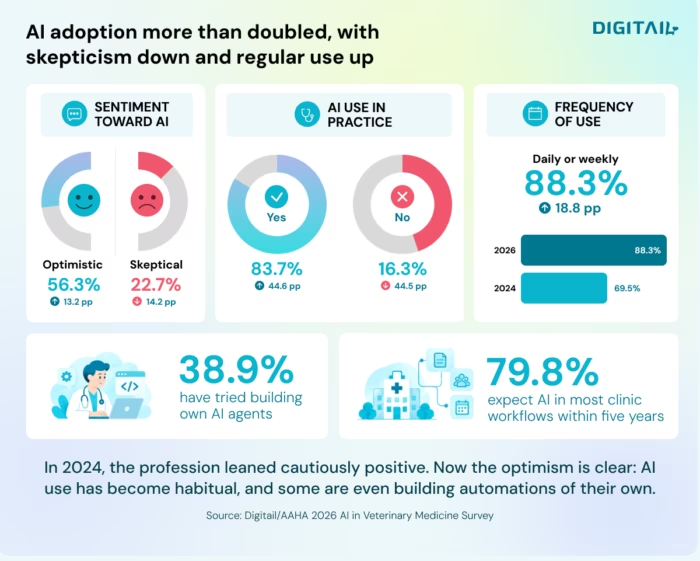
Key Findings at a Glance
Study metric |
2026 finding |
|---|---|
Veterinary professionals using AI |
83.7% |
AI adoption reported in 2024 |
39.2% |
AI users engaging daily or weekly |
88.3% |
AI users applying it to clinical documentation |
62.8% |
Practices adding AI without meaningful workflow changes |
65.2% |
Professionals expecting AI in most clinic workflows within five years |
79.8% |
Average AI maturity score |
2.67 out of 4 |
Source: Digitail and AAHA, Veterinary AI Study 2026. Percentages refer to the study’s specified respondent groups.
Clinical Documentation Leads Veterinary AI Applications
Clinical documentation emerged as the most common application, used by 62.8% of AI users. Tools in this category include AI scribes and systems that assist with preparing SOAP notes—structured records covering subjective information, objective findings, assessment and plan.
These tools can help convert consultations into draft medical records, reducing the administrative burden associated with documentation. AI is also being used for client communications, outreach, marketing and other practice-management activities.
The distinction between administrative support and clinical decision-making is important. Drafting a clinical note is not equivalent to independently establishing a diagnosis or prescribing treatment. Veterinary professionals must check generated records for accuracy, completeness, appropriate terminology and consistency with the actual consultation.
The study also found that respondents used AI across an average of 3.33 application areas, suggesting that adoption frequently extends beyond a single tool or workflow.
Sixfold Difference in Reported Business Outcomes
One of the study’s most notable findings concerns the relationship between AI maturity and reported business outcomes.
Practices classified at the highest AI maturity level reported an average of 4.05 positive outcomes, compared with 0.64 among practices at the lowest level—a roughly sixfold difference.
The researchers assessed maturity across six dimensions: strategy and intent, governance and oversight, vendor evaluation, workflow and technology integration, adoption depth, and capability and readiness.
The report also found that 70.9% of the least mature practices reported no measurable impact from AI, compared with approximately 11% of practices at the two highest maturity levels.
These figures describe an association based on survey responses, not proof that AI maturity alone caused better financial performance. Differences in practice size, staffing, management quality, technology infrastructure and starting performance may also contribute.
Nevertheless, the results support a practical management lesson: purchasing AI software is not the same as redesigning a practice to benefit from it.
Productivity, Client Retention and Digital Services
Respondents identified several areas in which AI had helped their practices:
-
44.3% reported increased patient throughput or the ability to see more patients.
-
32.0% reported improved client retention or satisfaction.
-
29.2% reported the ability to offer new or expanded digital services.
These are self-reported outcomes rather than independently audited financial results. Even so, they help identify where veterinary businesses are currently finding practical applications for AI.
For busy clinics, reduced documentation time may create opportunities to improve consultation capacity, strengthen client follow-up or reduce after-hours administrative work. The financial value depends on whether time saved is translated into better service, additional appointments, lower operating costs or improved staff retention.
Adoption Is Outpacing Governance and Workflow Redesign
Despite the rapid rise in AI use, implementation practices remain uneven. The study found that 65.2% of practices had introduced AI without meaningfully changing their workflows. Nearly half reportedly lacked an AI strategy or designated owner, while close to one-third had no AI governance arrangements in place.
This creates several operational risks. Unchecked AI-generated records may introduce errors into medical histories; unapproved tools may expose sensitive client or patient information; and inconsistent staff practices may make outputs difficult to review or reproduce.
A structured implementation programme should establish:
-
Approved tools and permitted use cases.
-
Human review requirements for clinical notes, recommendations and client communications.
-
Data protection, access controls and retention policies.
-
Staff training and clear accountability.
-
Defined performance indicators, including documentation time, correction rates, consultation capacity and client satisfaction.

