


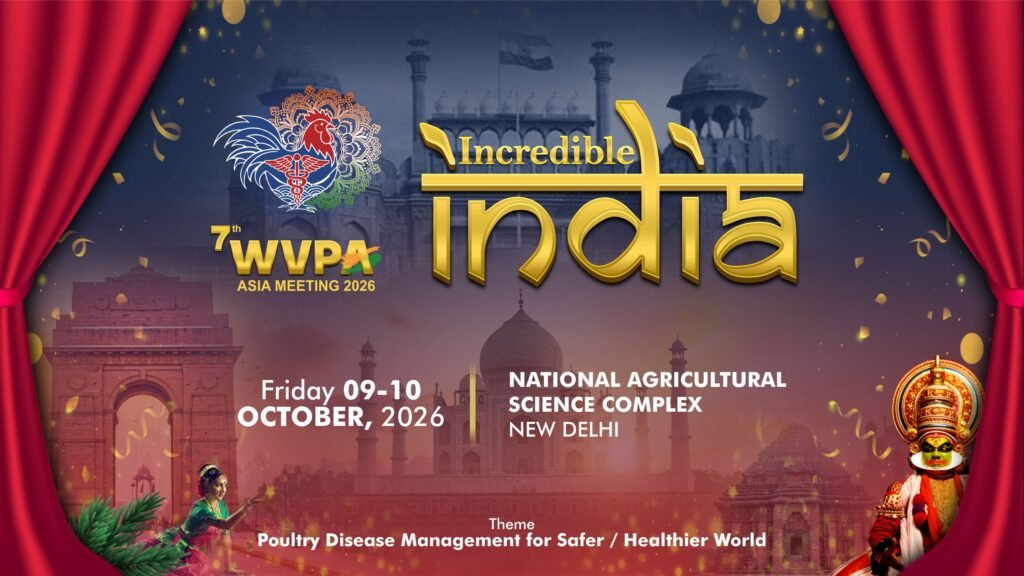
Post-event report | 12 October 2026 | Animal Health Industry | India
The 7th World Veterinary Poultry Association (WVPA) Asia Meeting 2026 concluded its scheduled programme at the National Agricultural Science Complex (NASC), New Delhi, on 10 October 2026, following three days of pre-conference and main-event activities beginning on 8 October. Held under the theme “Poultry Disease Management for a Safer/Healthier World,” the meeting brought together international and Indian expertise in poultry disease control, vaccination, diagnostics, food safety, gut health and One Health.
The official programme listed 42 international speakers, representing 15 countries and six regions, with more than 30 topics. The agenda combined scientific presentations, technical sessions, specialist workshops and an industry-facing panel on integrating academia, industry and policy to support a disease-free poultry future.
The published programme confirms the meeting’s technical priorities. Formal resolutions, attendance totals and new regulatory commitments were not independently established in the material reviewed for this report.
Avian influenza and vaccination take centre stage
Highly pathogenic avian influenza (HPAI) was a major focus of the pre-conference programme on 8 October. The dedicated workshop, “Changing Paradigm of HPAI: Global & Indian Perspectives,” addressed the evolving international disease situation, international standards, vaccine-trial findings and perspectives from poultry producers, vaccine manufacturers and veterinary authorities.
The programme included contributions from the World Organisation for Animal Health (WOAH), WVPA specialists, industry representatives and India’s Animal Husbandry Commissioner.
The technical discussions scheduled for 10 October extended this focus to international HPAI standards and prevention, vaccination strategies, antigen selection and field efficacy.
For India, the subject has direct relevance to poultry-sector resilience. Effective disease management depends on surveillance, early detection, farm-level biosecurity, appropriate vaccination strategies where authorised and applicable, and coordination between veterinary authorities and producers.
Industry implication
Vaccination cannot be treated as a stand-alone solution. Its effectiveness depends on the relationship between vaccine selection, field conditions, flock immunity, disease surveillance and biosecurity practices.
Five technical priorities emerging from the published programme
1. HPAI preparedness and disease surveillance
The programme placed avian influenza within a wider framework of international standards, disease monitoring and preventive action. Sessions involving WOAH expertise highlighted the importance of aligning domestic disease-management practices with internationally recognised approaches.
For poultry businesses, this reinforces the commercial importance of surveillance systems, rapid reporting, movement controls where required and farm-level contingency planning.
2. Vaccination effectiveness and next-generation technologies
The meeting’s agenda addressed vaccine trials, antigen selection, field efficacy and vaccine technologies for avian influenza.
These themes are relevant to vaccine manufacturers, veterinary pharmaceutical companies and integrated poultry producers seeking to improve protection under changing field conditions. The key commercial question is not simply whether a vaccine is available, but whether it delivers reliable protection within the intended production system and under appropriate monitoring.
The programme also included a specialist presentation on deuterium as a potential vaccine thermostabilisation approach. This should be understood as a research topic, not evidence that a new commercial vaccine-stabilisation technology has been validated or adopted.
3. Coccidiosis, Eimeria and intestinal health
Coccidiosis featured prominently in the scientific programme, including presentations on disease control, Eimeria infections and interventions intended to improve gut health and production performance.
These topics matter to broiler producers because intestinal disease can affect growth, feed conversion, flock uniformity and the economics of production. Effective control requires an integrated approach involving management, litter conditions, monitoring and appropriate preventive or therapeutic interventions.
The agenda also examined possible damage associated with processed feed pellets and the role of postbiotics in poultry nutrition. These topics point to growing scientific interest in the relationship between feed processing, intestinal function, immunity and productive performance.
4. Salmonella and safer poultry meat and eggs
The programme included a session on controlling zoonotic Salmonella, drawing on European and global experience, alongside presentations on poultry safety and interventions spanning pre-harvest and post-harvest stages.
This reflects the importance of controlling foodborne hazards throughout the production chain rather than relying solely on final-product testing.
For producers and processors, the relevant priorities include flock health, hygienic production, effective processing controls, environmental monitoring and verification of food-safety procedures.
5. One Health: linking veterinary science, industry and policy
A panel scheduled for 10 October, titled “One Health One Poultry: Integrating Academics, Industry and Policy for Disease-Free Future,” addressed the need to connect scientific research, industry practice and policy development.
This is particularly relevant where animal disease control intersects with zoonotic risks, food safety, antimicrobial stewardship and public-health preparedness.
However, the panel title and published agenda establish the intended focus of the discussion, not a formally adopted One Health declaration or a set of binding industry commitments.

Wider scientific agenda: genetics, diagnostics and workforce development
Beyond infectious disease management, the conference programme covered poultry breeding and genetics, molecular epidemiology, respiratory diseases, immune function, safe meat and egg production, and scientific publishing.
The international speaker list included expertise from Asia, Europe, North America and other regions, providing a platform for the exchange of research and field experience.
The programme also incorporated a student and young-scientist component, including guidance on publishing in the journal Avian Pathology. This supports the development of scientific capabilities and professional networks within veterinary poultry medicine.
What the meeting means for India’s poultry industry
The technical agenda is relevant across several parts of the poultry value chain.
Industry segment |
Key relevance |
|---|---|
Poultry integrators |
Disease prevention, flock performance, vaccination strategy and operational biosecurity |
Veterinary pharmaceutical companies |
Vaccine efficacy, diagnostics, disease monitoring and technology development |
Feed and nutrition companies |
Gut health, postbiotics, feed processing and nutritional interventions |
Hatcheries and breeding companies |
Genetics, flock health and disease prevention |
Poultry processors |
Salmonella control, hygienic production and food safety |
Veterinary laboratories |
Molecular epidemiology, surveillance and diagnostic capabilities |
Regulators and policymakers |
Disease reporting, international standards and One Health coordination |
Universities and research institutions |
Applied research, international collaboration and young-scientist development |
For India, the broader opportunity is to connect scientific advances with measurable outcomes at farm level. That means evaluating interventions using practical indicators such as disease incidence, mortality, vaccine performance, feed conversion, flock uniformity, food-safety results and the cost of prevention.
The conference programme does not itself establish improvements in these indicators. Such outcomes would need to be demonstrated through field data and subsequent implementation.
Commercial outlook: opportunities for the animal-health sector
The meeting’s focus areas point to several areas worth monitoring in the poultry-health market:
-
Avian influenza vaccines and diagnostics: technologies supporting appropriate vaccination programmes, surveillance and early detection.
-
Integrated disease management: solutions combining biosecurity, monitoring, vaccination and farm management.
-
Intestinal health: interventions addressing coccidiosis, gut integrity, nutrition and production efficiency.
-
Food safety: improved approaches to Salmonella monitoring and contamination control.
-
Molecular epidemiology: tools that improve understanding of pathogen transmission and support targeted responses.
-
Research partnerships: collaboration among veterinary institutions, industry and government to validate innovations under Indian field conditions.
These are potential commercial opportunities suggested by the scientific agenda, rather than announcements of new product launches, contracts or regulatory approvals at the meeting.
Conclusion
The 7th WVPA Asia Meeting 2026 in New Delhi placed poultry disease management at the intersection of veterinary science, vaccination, food safety, gut health and One Health collaboration.
Its published programme demonstrates the importance of coordinated approaches to HPAI preparedness, vaccination effectiveness, coccidiosis control, Salmonella prevention and stronger connections between research and commercial poultry production.
The next measure of impact will be the extent to which scientific insights translate into validated field practices, improved disease surveillance, stronger biosecurity and demonstrable gains in flock health and food safety.

