


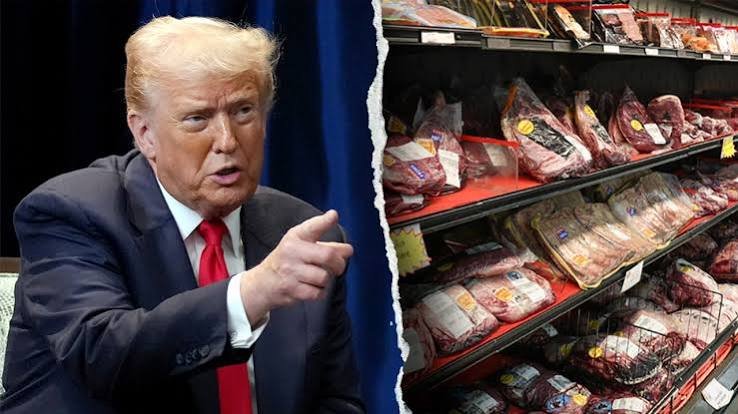
President Donald Trump has announced a temporary plan to allow up to 300,000 metric tons of beef for ground-beef production into the United States over a 90-day period without triggering the higher out-of-quota tariff, in an attempt to bring down historically elevated beef prices.
Trump said imported beef would be sold at 25% below prevailing market prices, with the administration arguing that the measure can provide short-term relief to consumers while the U.S. cattle herd rebuilds. The proposal, however, immediately triggered opposition from cattle producers and several Republican lawmakers representing major cattle-producing states.
The announcement comes at an unusually sensitive point in the U.S. cattle cycle. U.S. cattle inventories remain near multi-decade lows, July feedlot placements fell 11% year over year, and January–July 2026 beef production was down 5% from a year earlier.
The result is a policy dilemma that goes beyond the immediate price of hamburger: Can additional imports reduce consumer prices without weakening the economic incentives required to rebuild America’s cattle herd?
300,000-Tonne Import Proposal
Trump announced the policy on August 21, saying that the United States would permit up to 300,000 metric tons of product intended for ground beef to enter during the next 90 days without the additional out-of-quota tariff.
The administration has said the imported product would be sold at a 25% discount to current market prices, with the intended saving passed through to consumers. The measure is expected to be formalized through an executive order, reportedly within two weeks.
An important technical distinction is that this is not simply a blanket removal of every beef tariff. The proposal concerns the higher tariff that applies once imports exceed the applicable tariff-rate quota (TRQ).
The White House had already increased the 2026 in-quota quantity for certain lean beef trimmings by 80,000 metric tons, divided into four 20,000-ton quarterly tranches. The new announcement therefore represents a substantially larger temporary intervention than the earlier quota expansion.
Key numbers
| Indicator | Latest information |
|---|---|
| Proposed additional ground-beef imports | Up to 300,000 metric tons |
| Duration | 90 days |
| Claimed foreign-beef discount | 25% below current market prices |
| U.S. cattle & calves, Jan. 1, 2026 | 86.2 million head |
| July 2026 feedlot placements | 1.42 million head |
| Year-on-year placement change | -11% |
| Aug. 1 cattle on feed | 11.1 million head |
| July beef production | 2.09 billion lb |
| July beef production YoY | -5% |
| Jan.–July beef production YoY | -5% |
| July 2026 ground beef retail price | $6.885/lb |
Why Beef Prices Are So High
The import announcement is occurring against a structurally tight U.S. cattle supply. The USDA reported 86.2 million cattle and calves on U.S. farms on January 1, 2026, including 27.6 million beef cows, down 1% from a year earlier. The 2026 calf crop was estimated at 32.9 million head, down 2%.
The cattle inventory is important because beef production cannot respond to higher prices as quickly as poultry or pork production. A cow must be bred, produce a calf and raise it to slaughter weight. Rebuilding the breeding herd therefore takes multiple production cycles.
That is the fundamental constraint behind today’s market: Consumer demand can change quickly. Cattle supply cannot.
Retail Beef Prices Show the Pressure
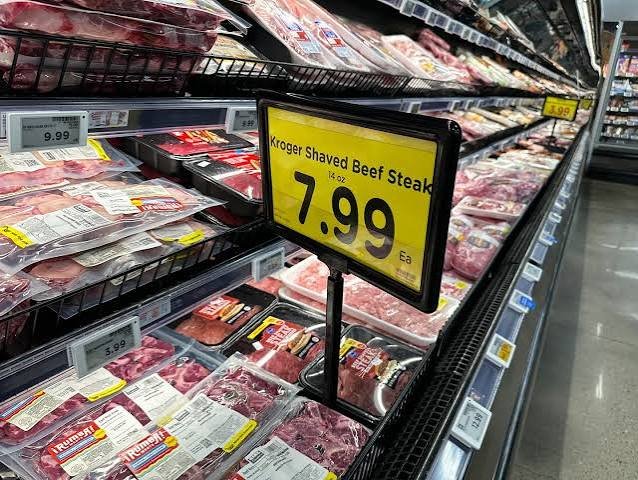
The consumer price data are equally significant. According to the U.S. Bureau of Labor Statistics series reported through the Federal Reserve’s FRED database, 100% ground beef averaged $6.885 per pound in July 2026, compared with $6.825 in June.
The July price was approximately 10.1% higher than a year earlier, according to the BLS-derived series. That makes ground beef one of the clearest consumer-facing indicators of the cattle-supply problem. For households, the issue is not the wholesale cattle price—it is the price appearing on the supermarket shelf.
Cattle-on-Feed Data Tell a Different Part of the Story
The USDA’s August Cattle on Feed report provides a particularly important signal. On August 1, feedlots with capacity of at least 1,000 head held approximately 11.1 million cattle, 2% above August 2025.
At first glance, the increase appears supportive of near-term beef supplies. But the more important number is placements.
July placements were approximately 1.42 million head, down 11% from July 2025, while net placements were about 1.37 million head. The July placement figure was the lowest for that month since the current series began in 1996, according to industry reporting of the USDA data.
This creates a potentially important supply signal: Current feedlot inventories can remain relatively high even while the pipeline of newly placed cattle is shrinking. That matters for future beef availability.
July Slaughter Data Reinforce the Tight-Supply Picture
The USDA’s August livestock-slaughter report showed:
-
2.37 million cattle slaughtered in July
-
7% below July 2025
-
2.09 billion pounds of beef production
-
5% below July 2025
For January through July, cumulative U.S. beef production was 5% below the same period of 2025. Overall commercial red-meat production was down 2%. The numbers are important because they provide an actual production measure rather than simply a price signal.
Supply-side equation
Fewer cows → fewer calves → lower placements → tighter slaughter supply → higher beef prices
The cattle cycle means that even if ranchers respond today by retaining more heifers, the resulting increase in beef availability will take time.
Why Ranchers Are Opposing the Import Plan
The ranchers’ argument is fundamentally different from the consumer argument. Consumers want cheaper beef now. Ranchers need prices high enough to justify:
-
retaining breeding cows
-
purchasing replacement heifers
-
investing in pasture
-
feed and forage production
-
veterinary care
-
fencing and infrastructure
-
financing
-
herd expansion

