


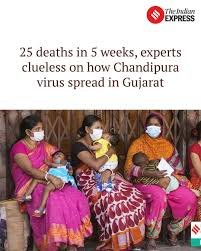
Chandipura Virus (CHPV) Livestock Screening & Reservoir Investigation in India’s Western States – Gujarat and Rajasthan
Location: Western India (Gujarat & Rajasthan Hotspots)
Investigating Bodies: National Joint Outbreak Response Team (NJORT), ICMR-National Institute of Virology (ICMR-NIV), ICAR-National Institute of Veterinary Epidemiology and Disease Informatics (ICAR-NIVEDI), Department of Animal Husbandry and Dairying (DAHD), and National Centre for Disease Control (NCDC).
Pathogen: Chandipura Virus (Vesiculovirus, Family Rhabdoviridae).
1. Epidemiological Background
Following a spike in pediatric cases of Acute Encephalitis Syndrome (AES) linked to Chandipura Virus (CHPV) across 12 districts of Gujarat and 3 districts of Rajasthan, national health agencies deployed a coordinated One Health surveillance framework
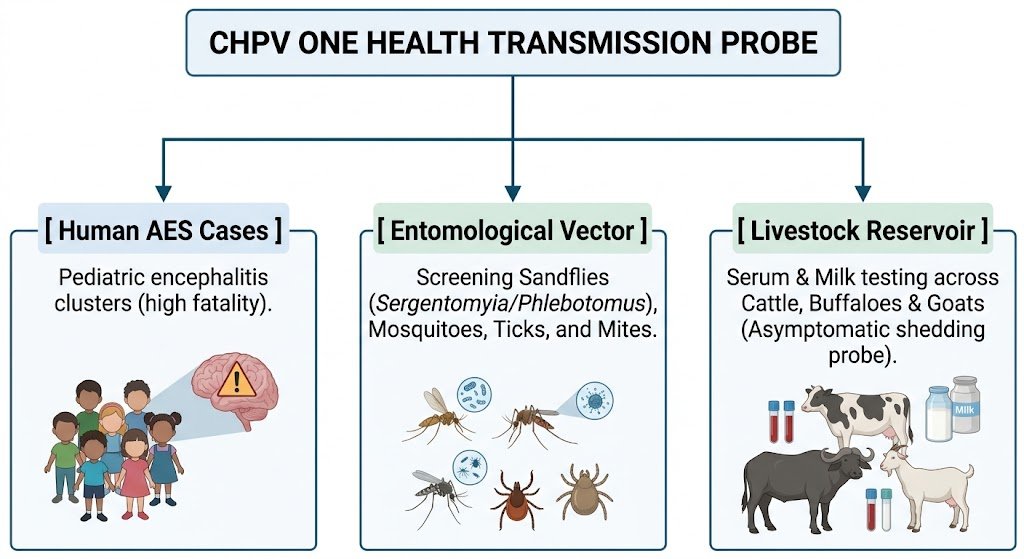
Because human index cases demonstrate high mortality in pediatric cohorts (under 15 years), state animal husbandry departments alongside national research institutes expanded active disease surveillance directly into domestic livestock herds. The objective is to evaluate whether cattle, buffaloes, and small ruminants serve as amplifying hosts, asymptomatic viral reservoirs, or mechanical vectors.
2. Livestock Testing Scope & Biological Sampling Protocols
Prior seroprevalence studies and field investigations have shown that farm animals in endemic regions frequently harbor anti-CHPV neutralizing antibodies. Current field operations have systematically sampled livestock housed in immediate proximity to confirmed human AES cases.
-
Expanded Animal Cohort: Multi-species sampling covering Cattle, Water Buffaloes (Bubalus bubalis), and Goats (Capra hircus).
-
Sample Matrix Collected:
-
Whole Blood & Serum: Screened via Reverse Transcription-Polymerase Chain Reaction (RT-PCR) for active viremia and viral RNA detection, along with neutralization assays (PRNT/ELISA) for antibody titering.
-
Bulk and Individual Milk Samples: Tested via molecular assays to check for potential viral shedding or lateral transmission routes in dairy-producing livestock.
-
Sample Volume: Over 70 domestic animal blood and serum specimens (alongside corresponding milk samples) are currently undergoing high-throughput processing at reference laboratories.
-
3. Vector Dynamics & Entomological Interventions
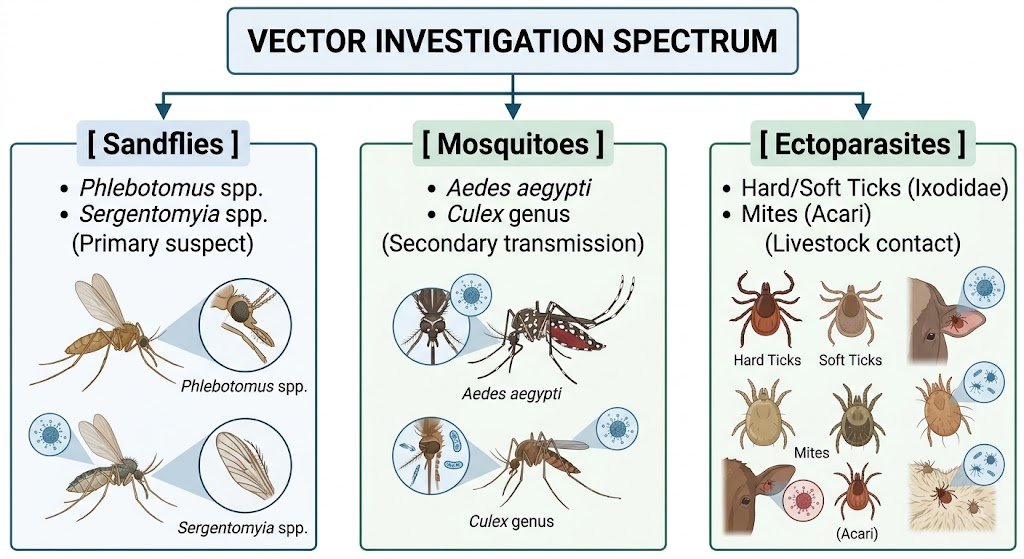
While Phlebotomine sandflies (Phlebotomus papatasi and Sergentomyia species) are the primary historical vectors associated with CHPV, entomological testing during recent outbreaks has yielded zero RT-PCR positives across thousands of captured sandflies. This disparity has forced researchers to widen entomological and ectoparasite screening to secondary vectors:
-
Ectoparasites (Ticks & Mites): Ticks and livestock mites harvested directly from domestic cattle and goats in affected villages are being crushed and screened for CHPV RNA via RT-PCR.
-
Mosquito Genera (Aedes & Culex): Given the low density of sandflies in certain rural clusters, mosquito pools collected near animal sheds (gaushalas) are being evaluated as potential bridge vectors.
4. Analytical & Diagnostic Testing Matrix
Parameter / Dimension |
Human Clinical Surveillance |
Livestock Animal Surveillance |
Vector / Entomological Probe |
Primary Target Population |
Pediatric patients (AES / Acute Febrile Illness) |
Cattle, Buffaloes, Goats, Horses |
Sandflies, Mosquitoes, Ticks, Mites |
Biological Specimens |
Serum, CSF, Nasopharyngeal swabs |
Whole Blood, Serum, Milk |
Pool homogenates (crushed whole insects/ticks) |
Primary Diagnostic Assay |
RT-PCR, CHPV IgM Capture ELISA |
RT-PCR, Neutralizing Antibody Titers |
Molecular Extraction & RT-PCR Amplification |
Genomic Surveillance |
Whole Genome Sequencing (GBRC, Gandhinagar) |
Comparative Genomic Alignment |
Phylogenetic Strain Mapping |
Current Research Goal |
Acute clinical management & fatality reduction |
Reservoir identification & asymptomatic shedding assessment |
Identification of active transmission vector species |
5. One Health & Veterinary Public Health Significance
-
Asymptomatic Amplification: Previous studies by ICMR-NIV indicated that up to 30–40% of adult humans in endemic villages and a significant proportion of domestic farm animals test positive for anti-CHPV neutralizing antibodies. This confirms past exposure without overt clinical illness in animals.
-
Break in Transmission Chain: If domestic livestock are confirmed as dead-end hosts rather than true reservoir hosts, public health interventions can focus resources on vector abatement (indoor residual spraying, dust insecticides for animal sheds, and midge/tick control) rather than livestock culling or movement restrictions.
-
Genomic Alignment: Whole-Genome Sequencing (WGS) conducted at the Gujarat Biotechnology Research Centre (GBRC) is cross-referencing minor genetic variations in human isolates against animal and vector isolates to trace viral evolution and lineage stability across Western India.

)