


India’s rapidly expanding livestock economy is facing a less visible constraint: the availability and nutritional quality of feed and fodder.
A recent assessment attributed to the Indian Council of Agricultural Research (ICAR) estimates shortages of 37.5% for concentrate feed, 14.1% for green fodder and 2.4% for dry fodder. The figures have renewed attention on whether India’s feed-resource base can keep pace with rising demand for milk, meat, eggs and other livestock products.
The finding is particularly important because feed is not simply a production input. For dairy, meat and other animal-production systems, dietary energy, protein, minerals, fibre and overall nutrient balance directly influence growth, reproduction, health and productivity.
Concentrate Feed Is the Largest Identified Gap
The most significant number in the assessment is the 37.5% concentrate-feed deficit. The reported assessment estimates annual concentrate-feed requirements at approximately 254.8 million tonnes, compared with available resources that are insufficient to meet nutritional requirements.
Green fodder requirements were reported at approximately 931.1 million tonnes, with a 14.1% deficit, while dry-fodder requirements were estimated at approximately 488.5 million tonnes, with the reported deficit at 2.4%.
Feed resource |
Reported requirement |
Reported deficit |
|---|---|---|
Concentrate feed |
~254.8 million tonnes |
37.5% |
Green fodder |
~931.1 million tonnes |
14.1% |
Dry fodder |
~488.5 million tonnes |
2.4% |
Important data note: these percentages should not be treated as universally accepted national feed-deficit estimates. Feed-gap estimates vary substantially according to the animal population covered, nutritional standards, assumptions about actual consumption, conversion factors and whether the analysis measures physical availability or nutritional adequacy.
That methodological distinction is important because a 2025 peer-reviewed pan-India analysis published in Frontiers in Sustainable Food Systems reached a different conclusion: it estimated a major green-fodder deficit, but reported aggregate surpluses of dry fodder and concentrates under its methodology.
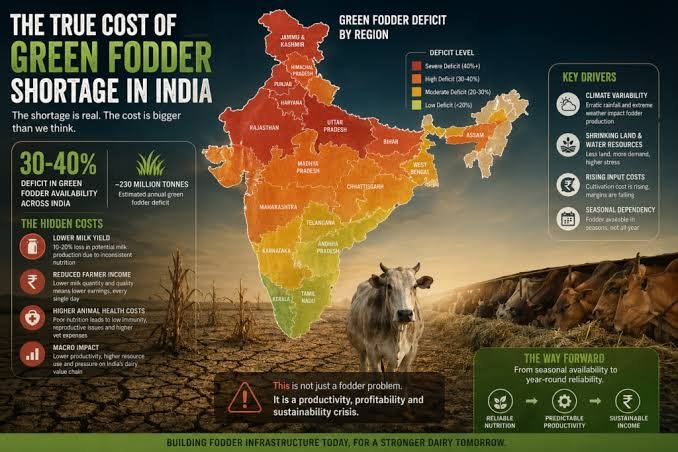
This does not necessarily mean that one assessment is “wrong”. It demonstrates that India’s feed problem is partly a quantity problem and partly a distribution, quality, accessibility and ration-balancing problem.
Why Concentrate Feed Matters
Concentrates are generally energy- or protein-dense feed ingredients used to complement roughages.
For high-producing dairy animals, simply increasing the amount of crop residue or low-quality roughage cannot necessarily meet requirements for metabolizable energy, protein and other nutrients. This is why the quality of the ration matters as much as its physical volume.
A 2019 ICAR-National Dairy Research Institute review noted that feed and fodder scarcity and poor-quality nutrition remain important constraints on livestock productivity. It also highlighted substantial differences between estimates of national feed deficits and cautioned that national averages can conceal major regional and seasonal shortages.
The practical implication is straightforward: More feed does not automatically mean better nutrition.
The objective must be nutritionally balanced feed at the lowest economically and environmentally sustainable cost.
India’s Livestock Economy Is Expanding
The timing of the assessment is significant. India’s livestock sector has increasingly moved from subsistence-oriented production toward commercially driven dairy, poultry, meat and other animal-production systems.
The latest assessment reported that livestock-sector growth has been strong, while demand for feed is consequently increasing. The broader production numbers illustrate the scale of the transformation.
Milk production increased from approximately 146.3 million tonnes in 2014–15 to 247.9 million tonnes in 2024–25, according to government data cited in recent reporting. Egg production also rose substantially over the same period.
This creates a fundamental equation for the industry: More animals + higher productivity + higher production targets = greater demand for nutrients
Unless feed efficiency improves simultaneously, additional production will require additional feed resources.
Green-Fodder Problem Is Different
The reported 14.1% green-fodder deficit needs to be viewed differently from the concentrate deficit. Green fodder is highly dependent on:
-
land availability
-
irrigation
-
rainfall
-
fodder seed supply
-
cropping patterns
-
seasonality
-
transport
-
storage and conservation
India has historically devoted a relatively small proportion of agricultural land to dedicated fodder cultivation.
NITI Aayog has previously noted that fodder crops occupied only about 4.9% of gross cropped area, with this share remaining broadly stagnant for decades. It also identified shrinking grazing resources, inadequate fodder-seed systems and regional imbalances as structural constraints. Consequently, simply asking farmers to “grow more fodder” is not sufficient.
The competition for land is between food crops, cash crops, fodder and other agricultural uses.
India May Have a Distribution Problem as Much as a Production Problem
This is where the latest evidence becomes particularly interesting. The 2025 Frontiers study found that, under its methodology, India had a large green-fodder deficit but surpluses of dry fodder and concentrates at national level. The researchers argued that the problem includes poor information, limited access to available resources and transportation constraints.
That finding has major policy implications. A national surplus does not mean that a dairy farmer in a fodder-deficit district has access to affordable feed.
Feed can be: available nationally → unavailable regionally → unavailable seasonally → unaffordable locally.
Therefore, India’s feed-security strategy needs to address logistics and market infrastructure, not merely production.
Crop Residues Are an Underused Feed Resource
India generates very large quantities of agricultural residues, including cereal straws and other crop by-products.
These materials already constitute an important component of livestock diets. NITI Aayog has previously estimated cereal residues to account for around 71% of overall feed resources used for animal feeding, with green fodder contributing about 23% and concentrates about 6% in the cited assessment.
But crop residue has an important limitation: Physical availability does not equal nutritional availability.
Wheat and rice straw, for example, can provide substantial fibre but may be relatively poor in protein and digestible nutrients compared with the requirements of high-producing animals. Consequently, technologies that improve:
-
digestibility
-
protein availability
-
nutrient density
-
preservation
-
storage
-
ration formulation

