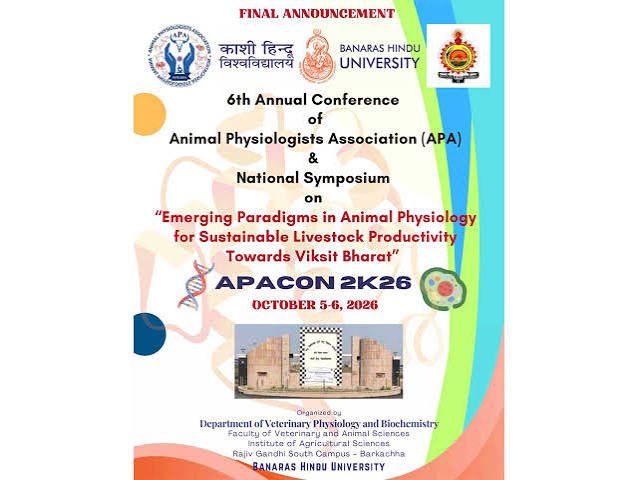
VARANASI/MIRZAPUR, INDIA — October 5, 2026: The Faculty of Veterinary and Animal Sciences (FVAS), Banaras Hindu University (BHU) is hosting the 6th Annual Conference of the Animal Physiologists Association (APACON-2026) and accompanying National Symposium on October 5–6, 2026, at the Rajiv Gandhi South Campus of BHU in Mirzapur, Uttar Pradesh.
Organised by the Department of Veterinary Physiology and Biochemistry, Institute of Agricultural Sciences, BHU, in collaboration with the Animal Physiologists Association (APA), the two-day scientific meeting represents an important milestone for FVAS, being described as the Faculty’s first major national scientific conference at the Rajiv Gandhi South Campus.
Science of Livestock Productivity Takes Centre Stage
The conference theme—“Emerging Paradigms in Animal Physiology for Sustainable Livestock Productivity Towards Viksit Bharat”—places animal physiology at the centre of discussions around the future of Indian livestock production.
The scientific programme addresses challenges that are increasingly important to India’s animal-health and livestock economy, including climate change, heat stress, emerging diseases, reproductive efficiency, nutrition, animal welfare, resource constraints and the need for sustainable animal production.
Sessions are expected to span climate-resilient livestock production, stress physiology, reproductive physiology, assisted reproductive technologies, precision livestock farming, genomics and nutrigenomics, conservation and genetic improvement of indigenous breeds, and sustainable dairy development.
This breadth is significant for the animal-health industry because productivity increasingly depends on an integrated understanding of the animal rather than disease treatment alone. Heat tolerance, fertility, nutrition, genetics, welfare and disease resilience are interconnected determinants of livestock performance.
Strong Academic–Industry Interface
APACON-2026 brings together scientists, academicians, veterinarians, researchers, industry professionals, young scientists, research scholars and students, with participation extending into allied disciplines including biotechnology, biomedical engineering, zoology and translational sciences.
The conference has received support from organisations including DRDO, the Anusandhan National Research Foundation (ANRF), the Institute of Eminence and the Ministry of Education, while animal-health and reproductive-technology companies including Virbac, IMV and Minitube are associated with the event.
The inaugural programme features Ajit Kumar Chaturvedi, Vice-Chancellor of BHU, as Chief Guest and Ravi Kumar Gandham, Director of the National Institute of Animal Biotechnology (NIAB), as Guest of Honour. Senior representatives associated with BHU, the Animal Physiologists Association and ICAR-IVRI are also participating.
Why APACON-2026 Matters to Animal Health
For India’s animal-health ecosystem, the importance of APACON-2026 extends beyond an academic conference. The research themes point toward several areas likely to shape future livestock-health strategies: precision livestock management, climate adaptation, reproductive biotechnology, genomics, nutrigenomics and evidence-based approaches to improving indigenous breeds.
The emphasis on sustainable productivity is particularly relevant as Indian livestock systems confront increasing environmental stress while demand for milk, meat and other animal-derived foods continues to grow.
The event also provides young researchers with opportunities to present research, interact with established scientists and develop academic and professional collaborations—potentially strengthening the research-to-industry pipeline for India’s veterinary and livestock sectors.
Analyst View
APACON-2026 signals a broader evolution in Indian animal-health research—from a predominantly disease-centric model toward a more integrated productivity-and-resilience framework.
The convergence of physiology, genetics, nutrition, reproductive technologies, precision livestock farming and climate adaptation could become increasingly important to improving animal productivity while maintaining health and welfare.
For the Indian animal-health industry, the conference is therefore worth watching not simply for individual research findings, but for the technology, diagnostics, breeding, nutrition and management priorities emerging from India’s veterinary research community.