


Asia | Swine | African Swine Fever | Wildlife Health | One Health
African swine fever (ASF) is emerging as not only a major commercial swine disease but also a potentially severe biodiversity and wildlife-conservation threat, according to a new roadmap developed by 31 scientists and published in Nature Reviews Biodiversity.
The researchers identify 12 endemic wild-pig species in Asia as being at significant risk and call for eight priority actions spanning surveillance, conservation breeding, policy and emergency financing.
From commercial disease to biodiversity crisis
ASF emerged in China in late 2018 and spread rapidly through Asia. The virus can cause extremely high mortality in both domestic and wild pigs. The economic consequences for the global pork industry have been substantial. The researchers cite estimated pork-industry losses of approximately US$130–192 billion associated with the Asian ASF crisis.
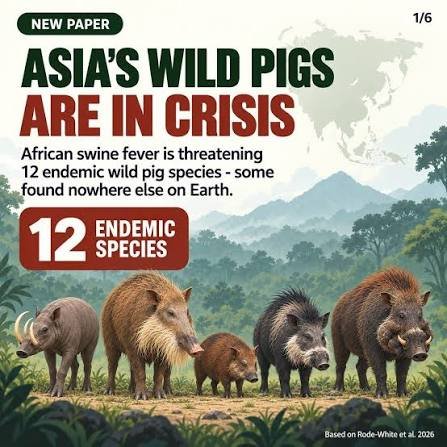
However, the impact on wildlife has received considerably less attention. Asia is a globally important centre of wild-pig diversity, with species that occur nowhere else.
The study reports that five of the 12 endemic species are now classified as Critically Endangered and another as Endangered under recent IUCN Red List assessments. ASF infection has been confirmed or is strongly suspected in at least six endemic species.
Why wild pigs matter to ecosystems
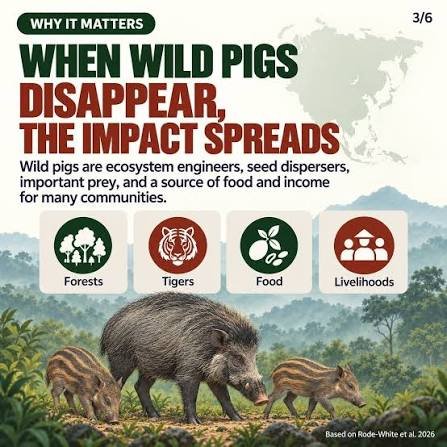
Wild pigs perform important ecological functions. They disperse seeds, disturb and aerate soil and contribute to food webs supporting predators including tigers and leopards.
Some species also have important cultural and food-security roles for indigenous and rural communities. The researchers therefore argue that ASF has evolved beyond a conventional animal-health problem into a combined conservation, food-security, livelihood and ecosystem challenge.
Indonesia represents a major pressure point
The Indonesian archipelago is highlighted as a particular concern because it contains several evolutionarily distinctive endemic pig species. ASF has affected babirusas and endemic warty pigs on Sulawesi, where isolated populations may have limited capacity to recover from severe mortality events.
For island-endemic species, the combination of disease, habitat loss and hunting can create a particularly dangerous situation because populations may have few opportunities for recolonisation.
The scientists warn that extinction within a single generation could become possible for some island species.
Eight priority actions
The roadmap identifies eight priority areas, with three requiring particularly urgent attention:
-
Early-warning disease surveillance
-
Expanded captive-breeding programmes
-
Emergency conservation financing
Only five of the 12 endemic wild-pig species currently have ex-situ populations, and some of these populations are considered too small to provide long-term security.
The proposed surveillance architecture could include conventional veterinary surveillance alongside AI-enabled monitoring and citizen-science reporting.
Implications for commercial swine health
The development also matters to commercial pig producers. Wild and domestic pig populations can interact directly or indirectly through farms, feed, transport, carcasses, contaminated materials and human movement.
Therefore, wildlife surveillance could potentially become an additional component of regional ASF early-warning systems. The development strengthens the case for:
-
wildlife disease surveillance;
-
genomic sequencing;
-
molecular diagnostics;
-
environmental sampling;
-
movement monitoring;
-
farm biosecurity;
-
carcass detection;
-
digital disease mapping.
One Health becomes unavoidable
The study’s central message is that ASF cannot be addressed effectively through a livestock-only framework. The disease simultaneously affects:
commercial pigs → wild pigs → ecosystems → food security → rural livelihoods.
This makes ASF one of the clearest examples of a modern One Health disease-management challenge.
Animal-Health Industry Takeaway
The expansion of ASF into wildlife conservation creates a new market and research requirement for cross-species surveillance, rapid diagnostics, genomic epidemiology and digital disease intelligence. For Asia, ASF management is increasingly becoming a biodiversity and food-system issue as well as a pork-production issue.

