


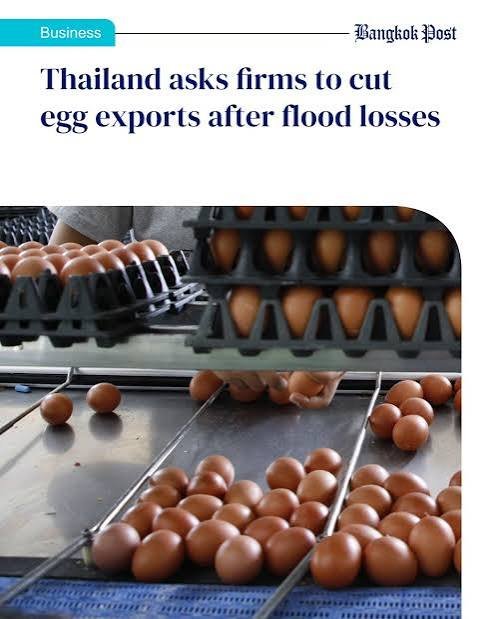
Thailand is tightening management of its egg supply chain after severe flooding disrupted major layer-producing areas and killed millions of poultry birds. The country’s Department of Internal Trade (DIT), under the Ministry of Commerce, has asked egg exporters to reduce shipments by 30–50% and, in some cases, postpone shipments through December 2026, with the objective of directing more eggs into the domestic market.
The intervention comes as flooding has caused substantial losses in eastern Thailand, particularly in Chachoengsao, one of the country’s important egg-producing areas. The latest assessment reported approximately 2.76 million dead laying hens, 483,228 dead pullets and 12,378 dead parent-stock birds in Chachoengsao, Chonburi, Prachinburi and Nakhon Nayok as of October 1.
The scale of mortality is significant because the impact is not limited to immediate egg output. The loss of productive hens reduces the national laying flock, while flooded roads, damaged farm infrastructure and disrupted logistics can prevent eggs from reaching wholesalers and retailers even where production capacity remains intact.
EXPORTS CUT TO PROTECT DOMESTIC SUPPLY
Thailand’s government has requested that exporters reduce egg shipments by 30–50% from normal levels. According to industry reporting, daily exports that normally run at approximately 800,000–900,000 eggs are expected to fall to around 600,000–700,000 eggs per day during the October–December intervention period.
Exporters have also been asked to submit their October and November export plans to the Department of Internal Trade so authorities can monitor supply conditions more closely.
The policy is primarily a domestic food-security and price-management intervention, rather than a formal export ban. Thailand remains an important regional supplier of fresh eggs, particularly to Singapore and Hong Kong.
Thailand exported approximately 518 million fresh eggs in 2025, worth about US$56.2 million, with Singapore accounting for approximately 74% of export value. Domestic consumption, however, dominates the sector: around 97% of Thailand’s egg production is consumed domestically, with exports accounting for only about 3%.
THE NUMBERS BEHIND THE SUPPLY SHOCK
Indicator |
Latest position |
|---|---|
Estimated dead laying hens |
2.76 million |
Dead pullets |
483,228 |
Dead parent-stock birds |
12,378 |
Normal national egg production |
~42–43 million eggs/day |
Normal daily exports |
~800,000–900,000 eggs |
Targeted export volume |
~600,000–700,000 eggs/day |
Export reduction requested |
30–50% |
Layer replacement age |
80 → 85 weeks |
Additional hens expected in system |
~4.4 million |
Additional eggs expected |
~3 million/day |
Target period |
October–December 2026 |
Farm-gate price target |
THB 4/egg |

