


As many countries of the world are witnessing increasing outbreaks of African Swine Fever – it would only be prudent to consider the approved and commercially available vaccines, if any and what is their respective efficacy. This detailed report precisely answers these basic questions.
The most important distinction in the global ASF vaccine market is between regulatory approval, emergency or controlled-use authorisation, commercial availability, and demonstrated effectiveness under field conditions. These are not interchangeable terms.
The strongest established commercial evidence remains concentrated in Vietnam, where live-attenuated vaccines have been deployed since 2022. The Philippines has now approved commercial sale of AVAC ASF LIVE, according to its Department of Agriculture on 2 September 2026. Indonesia has also been reported as having authorised emergency use of AVAC ASF LIVE in 2025.
A second important distinction is between protection in a controlled challenge study and real-world vaccine effectiveness. Challenge studies can demonstrate protection against a particular virus strain under defined conditions; field performance also depends on vaccine handling, pig age and health, circulating virus, biosecurity, coverage and surveillance. The World Organisation for Animal Health (WOAH) published specific guidance on field evaluation and post-vaccination monitoring in 2026 because these data remain critical to assessing newer ASF vaccines.
This report therefore separates commercial vaccines from candidates, maps the regulatory position by region, and assesses what the available efficacy data can—and cannot—support.
Global ASF Vaccine Approval and Availability Map
The following is the verified position based on official government information, FAO reporting and published scientific sources available by 26 October 2026. “No verified approval” means I did not find evidence of a national authorisation for commercial ASF vaccination in the reviewed sources; it is not a substitute for checking every national veterinary-products register.
Country / market |
Vaccine or programme |
Regulatory status as of 26 October 2026 |
Availability interpretation |
|---|---|---|---|
Vietnam |
NAVET-ASFVAC; AVAC ASF LIVE; DACOVAC-ASF2 |
Licensed for use, with dates reported by FAO |
The principal established commercial ASF vaccine market |
Philippines |
AVAC ASF LIVE |
Commercial sale approved on 2 September 2026 |
Approved for fattening pigs under the applicable national conditions |
Indonesia |
AVAC ASF LIVE |
Emergency-use authorisation reported on 23 April 2025 |
Authorised under a national emergency-use decision; not evidence of unrestricted international approval |
Republic of Korea |
CAVAC ASF-X and a Komipharm-developed vaccine |
Export-only authorisations reported in April 2026 |
Not equivalent to authorisation for routine domestic vaccination |
India |
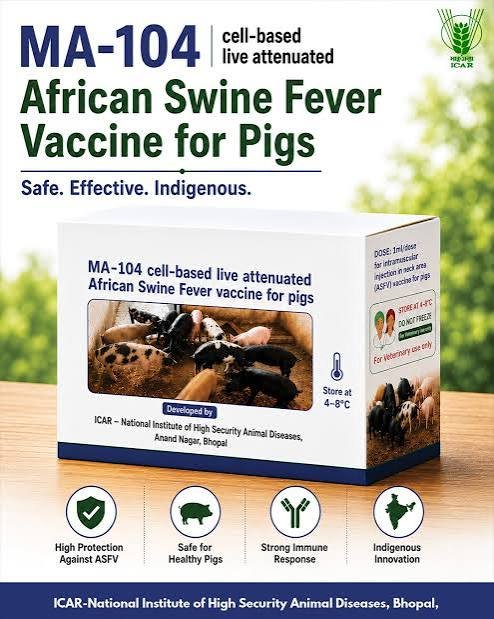
ICAR–NIHSAD indigenous live-attenuated vaccine |
Developed and field-validated; official announcement made on 4 August 2026 |
Commercial marketing approval and market availability must be confirmed separately |
China |
Various experimental candidates and research programmes |
No verified commercial ASF vaccine authorisation identified |
Experimental development is not commercial approval |
European Union / Europe |
Research candidates |
No authorised commercial ASF vaccine identified in the reviewed official sources |
No routine vaccination product authorised for use |
Latin America and the Caribbean |
Research candidates |
No verified commercial ASF vaccine authorisation identified |
No established commercial ASF vaccine market identified |
Africa |
Research and potential future deployment |
No vaccine identified that meets the relevant international safety, efficacy and licensing expectations for regional deployment |
WOAH regional guidance urges caution against importing or using currently available commercial vaccines in Africa |
Other Asian markets |
Candidates and potential import programmes |
No additional national commercial approval independently verified in this review |
Do not infer approval from the presence of ASF, a research trial or a proposed import |
Sources: FAO’s ASF situation update for Asia and the Pacific, Vietnam’s AVAC product-use notice, the Philippine Department of Agriculture’s 2 September 2026 announcement, the Indian government’s ICAR vaccine announcement, and WOAH’s 2026 vaccine guidance.
The 3 Commercial Vaccines Licensed in Vietnam

NAVET-ASFVAC – Manufacturer: NAVETCO · Vietnam
NAVET-ASFVAC was licensed in Vietnam in June 2022, according to FAO. It is a live-attenuated ASF vaccine developed for pigs. Published reviews report complete protection in controlled challenge studies against virulent genotype II virus and approximately 95% protective immune response in regulatory monitoring covering more than 140 farms. The review reports more than 600,000 doses administered across provinces in the evaluation period.
 AVAC ASF LIVE –Manufacturer: AVAC Vietnam JSC · Vietnam, Indonesia and Philippines
This live-attenuated, gene-deleted vaccine has the broadest independently confirmed geographic footprint among the products reviewed. Vietnam licensed it in 2022; Indonesia authorised emergency use in April 2025; and the Philippines approved commercial sale in September 2026. Published data include controlled challenge protection against genotype II virus and post-licensure monitoring involving 178,767 vaccinated pigs across five Vietnamese provinces.

DACOVAC-ASF2 – Manufacturer: DABACO Group · Vietnam
FAO reports licensing in March 2025. A 2026 scientific review cites a secondary report of protective immune responses ranging from 80% to 100% in large-scale field use involving approximately 300,000 doses on farms managed by the manufacturer. This is useful deployment evidence, but it is less independently persuasive than a standardised, independently controlled field-effectiveness study.
What Does “Licensed in Vietnam” Mean in Practice?
The commercial record has evolved since 2022. AVAC stated in June 2025 that approximately 3.5 million AVAC ASF LIVE doses had been used domestically and exported, while warning that its vaccine was not officially authorised for breeding pigs, including sows and boars, at that time. The manufacturer advised vaccination only of healthy fattening pigs in accordance with the approved procedure and warned against use in pigs already infected with field ASF virus.
A separate 2026 scientific review estimates that approximately 10 million doses of vaccines from AVAC and NAVETCO had been produced and supplied in Vietnam since authorisation. This is a cumulative supply estimate, not a count of currently protected pigs: doses supplied, doses administered, animals seroconverting and animals protected against infection are different measures
Field Efficacy and Safety: What the Data Actually Show
The table below distinguishes experimental protection, immune response and field observations. The percentages should not be compared as if they all measured the same outcome.
Vaccine / evidence |
Reported result |
What it supports |
Key limitation |
|---|---|---|---|
NAVET-ASFVAC, controlled challenge |
Complete protection reported against virulent genotype II ASFV |
Strong homologous-strain experimental efficacy |
Does not establish protection against every circulating genotype or field exposure |
NAVET-ASFVAC, regulatory monitoring |
Approximately 95% protective immune response across more than 140 farms |
Evidence of immunogenicity across multiple farms |
Immune response is not the same as demonstrated prevention of field infection or transmission |
AVAC ASF LIVE, controlled challenge |
Complete protection reported against virulent genotype II ASFV |
Strong experimental efficacy against the tested strain |
Challenge conditions may not represent all field conditions |
AVAC ASF LIVE, smaller challenge evaluations |
Protection rates of 80–100% reported across selected studies |
Supports efficacy under more than one experimental setting |
Different protocols and small selected groups limit direct comparison |
AVAC ASF LIVE, Vietnam monitoring |
93.4% protective immune response reported across more than 500 farms |
Broad deployment and immune-response evidence |
Not a standardised, independently controlled vaccine-effectiveness estimate |
AVAC ASF LIVE, Vietnam post-licensure monitoring |
178,767 pigs across five provinces; reported adverse reactions or mortality of 0–0.03%; 197/197 tested samples antibody-positive |
Large-scale safety and immunogenicity observations |
Passive/administrative reporting, non-uniform monitoring and selected serology samples |
DACOVAC-ASF2, field deployment |
80–100% protective immune response reported from approximately 300,000 doses |
Evidence of substantial field deployment |
Secondary reporting from manufacturer-managed farms; limited independent validation located |
AVAC ASF LIVE, Philippine field trials |
100% seroconversion reported in a published review |
Evidence that vaccinated pigs mounted an antibody response under those trial conditions |
Seroconversion does not by itself establish protection against infection, disease or onward transmission |
Sources: 2026 review in Transboundary and Emerging Diseases and the cited product-use information.
AVAC ASF LIVE: the most detailed published field dataset located
A review published on 18 September 2026 summarised post-licensure surveillance in five Vietnamese provinces during 2024 and early 2025. The reported total was 178,767 vaccinated pigs. The authors reported adverse reactions or mortality following vaccination in the range of 0% to 0.03%, and 197 of 197 samples evaluated in the reported serological monitoring were antibody-positive. The same review reports the following field observations:
-
In Phu Yen District, Son La Province, repeated ASF outbreaks had been reported between 2021 and 2023, with no new outbreaks recorded after vaccination during the observation period covered by the report.
-
In Quang Ngai Province, no new outbreaks were detected during the reported monitoring period following vaccination of more than 41,000 pigs from 4,363 households.
-
In Lang Son Province, vaccination was associated with a reduction in reported ASF occurrence; approximately 90% of reported outbreaks had passed a 21-day observation period without further reported cases.
- In Tien Giang Province, one herd experienced ASF detection seven days after vaccination. The authors note that some pigs may have been incubating infection at vaccination or may have been infected soon afterwards.
These observations are commercially important, but they do not prove that vaccination alone caused the reported reductions. The data were drawn from provincial and administrative reports with differing surveillance procedures, and the authors explicitly caution that the findings are descriptive rather than standardised quantitative estimates of vaccine effectiveness. The 100% seropositivity figure applies to the samples tested, not necessarily every vaccinated pig.
Why WOAH’s Assessment Matters
WOAH’s May 2026 guidance says that, at the time of publication, there were no widely recognised ASF vaccines that had demonstrated strong effectiveness under field conditions. It distinguishes controlled experimental efficacy from field effectiveness and post-vaccination monitoring.
This is not a claim that the Vietnamese vaccines have no value. It means that positive challenge results and promising field observations still need to be complemented by rigorous studies capable of measuring disease outcomes under natural exposure, identifying rare safety events and monitoring vaccine-virus behaviour.
For market analysis, the most defensible conclusion is:
-
Strongest evidence: protection against tested homologous genotype II strains in controlled challenge studies.
-
Encouraging evidence: substantial field deployment, immune responses and favourable observational safety reports.
-
Important evidence gap: standardised, independent, controlled estimates of field effectiveness across different production systems and circulating viral variants.
Asia: Country-by-Country Commercial and Regulatory Status
Vietnam — established commercial use, but viral evolution is a major concern
Vietnam remains the central market for licensed ASF vaccines. NAVET-ASFVAC, AVAC ASF LIVE and DACOVAC-ASF2 have all been reported as licensed for use there. However, ongoing ASF outbreaks and the emergence of recombinant genotype I/II viruses complicate assessment of how well existing genotype II-based vaccines will perform against all circulating strains.
A particularly important update came from Vietnam’s Department of Animal Health and Production (DAHP): sequencing reported in 2026 found that 357 of 427 representative samples (83.6%) were recombinant between genotypes I and II. This is a proportion of the sampled diagnostic material, not a population-based estimate of the prevalence of recombinant virus in every Vietnamese pig herd.
Philippines — Commercial Approval is now Confirmed
The Philippine Department of Agriculture announced on 2 September 2026 that the Bureau of Animal Industry (BAI) had approved commercial sale of AVAC ASF LIVE, the first ASF vaccine cleared for public sale in the country. The authorisation is described as being for fattening pigs. A second product, PROVAC from South Korea, was still undergoing BAI testing in that announcement.
The Philippines had previously used AVAC ASF LIVE in a government-controlled vaccination programme. A 2026 review reports favourable safety observations and 100% seroconversion in BAI field trials, but this should not be mistaken for 100% field protection against ASF infection.
The commercial implications are substantial: a formal retail channel could widen access beyond government-controlled programmes. Actual market penetration will depend on product supply, price, approved target animals, veterinary oversight, producer confidence and the extent to which vaccination can be integrated with movement control and biosecurity. The government has discussed a proposed ₱1 billion allocation to support vaccination for backyard pig farms, but this is a funding request, not evidence that the entire amount has been appropriated or spent.
Indonesia — Emergency Use, not a Universal Licence
Indonesia authorised emergency use of AVAC ASF LIVE on 23 April 2025 under a Ministry of Agriculture decision. FAO’s regional update reports that the first batch of 120,000 doses was imported in June 2025 and that a government distribution plan was subsequently discussed.
This is a distinct regulatory category from routine commercial registration. The emergency-use decision confirms authorisation under the relevant Indonesian framework, but the evidence reviewed here does not establish the volume ultimately administered, national coverage, independently measured field effectiveness or the current stock available for purchase. Those questions require follow-up with Indonesia’s veterinary authorities and programme records.
Republic of Korea — Export-only Approvals and PROVAC Evaluation
FAO reports that in April 2026 the Republic of Korea’s Animal and Plant Quarantine Agency (APQA) granted export-only authorisations for two ASF vaccines developed by Choong Ang Vaccine Laboratories and Komipharm.
An export-only authorisation is not the same as permission for routine vaccination of pigs in the country of manufacture. It can support product development and international supply, but the product’s registration, import permit and label must still be checked in the destination country.
India — Indigenous Vaccine Developed, but Commercial Status Not Confirmed as Yet
On 4 August 2026, India’s Press Information Bureau announced an indigenous live-attenuated ASF vaccine developed by ICAR–National Institute of High Security Animal Diseases (NIHSAD), Bhopal. The announcement describes a genotype II virus with unique gene deletions, propagated using the widely available MA-104 cell line. The government stated that the vaccine had undergone laboratory assessments including safety, genetic stability, immunogenicity, protective efficacy and virulence-reversion studies, and had been field-validated in collaboration with the Department of Animal Husbandry and Dairying.
The announced regimen is for healthy pigs above eight weeks of age, with a 1 mL intramuscular dose followed by a booster 14 days later. Those are the details in the government announcement; they should not be treated as a final commercial label unless and until the product’s approved instructions and marketing authorisation are published.
Regulatory status assessment: India has publicly announced vaccine development and field validation. The source reviewed does not itself confirm a commercial marketing licence, commercial launch date, manufacturer distribution network, price or export authorisation. I would therefore classify India as developed/field-validated; commercial authorisation not verified from the cited announcement—rather than list it as an established commercial vaccine market.
Other Asian Countries
Market |
Position as of 26 October 2026 |
|---|---|
China |
No verified commercial ASF vaccine authorisation identified in the reviewed sources. Experimental candidates should not be treated as licensed products. |
Thailand, Malaysia, Laos, Cambodia, Myanmar, Nepal, Bangladesh and other ASF-affected Asian markets |
No additional national commercial approval independently verified in this review. |
Countries considering imports |
Any import, emergency-use or trial permission must be checked against the national veterinary regulator; approval in Vietnam, Indonesia or the Philippines does not automatically apply elsewhere. |
FAO’s regional surveillance and response update is a useful monitoring source for country developments, but a disease notification or vaccine research report is not in itself proof of marketing authorisation.
Europe: no authorised commercial ASF vaccine identified
The European Commission’s ASF information page states that no vaccine exists for use against the disease in the EU, and European disease-control measures remain centred on surveillance, biosecurity, movement restrictions, regionalisation and culling where required.
European research programmes continue to investigate ASF vaccine candidates, including live-attenuated and other platforms. These programmes should be categorised as research and development—not as commercial supply.
For European pig producers and animal-health companies, the current market opportunity is therefore primarily in diagnostics, surveillance, biosecurity, disinfection, farm-management systems and outbreak response, rather than sales of a nationally authorised ASF vaccine.
Latin America and the Caribbean: no commercial approval verified
The region has strong commercial interest in ASF preparedness because of the potential impact on pig production, trade and biosecurity. Nevertheless, the regulatory distinction remains essential: a vaccine candidate developed elsewhere, an imported research sample, a laboratory study or an informal sales claim is not a national marketing authorisation.
For Brazil and other major pork-producing markets, any future vaccine decision would need to account for local veterinary legislation, the disease-status objective, diagnostic capability, traceability, potential trade implications and the risk of using a live vaccine in an area where eradication or freedom from infection is the priority.
The absence of a verified approval in this review should not be read as a claim that no research is taking place. It means that a commercial ASF vaccine registration for these markets could not be substantiated from the sources reviewed.
Africa: significant genotype and regulatory concerns
Africa presents a particularly difficult vaccine-development challenge because ASF virus diversity is much greater than in the genotype II-dominated settings for which the currently commercialised vaccines were developed.
In its October 2025 Lomé Declaration, the WOAH/GF-TADs Africa regional group stated that no ASF vaccines then available fully met WOAH international standards for safety, efficacy, purity and prior licensing. The declaration also warned that current licensed products are based on genotype II, while Africa has 24 recognised genotypes, and called for caution over importing or using available commercial vaccines in the region.
Major safety and effectiveness issue: recombinant viruses
The biggest scientific uncertainty affecting the current commercial ASF vaccine market is the emergence of recombinant ASF viruses, particularly genotype I/II recombinants reported in Vietnam.
A September 2026 review in Transboundary and Emerging Diseases notes that the proportion of genotype I/II recombinants in sampled diagnostic material increased markedly in Vietnam. It also discusses experimental evidence that genotype II-based live-attenuated vaccines may provide incomplete protection against some highly virulent recombinant strains.
Three points are important for interpreting these findings:
-
Recombinant-virus detection does not prove that a vaccine caused the recombination. The origin and epidemiological significance of individual recombinant viruses require genomic and epidemiological investigation.
-
Incomplete cross-protection is not equivalent to zero protection. Results depend on the specific vaccine, recombinant virus, challenge dose and study design.
-
A breakthrough infection does not automatically mean that a vaccine has failed completely. Infection, clinical disease, mortality, shedding and onward transmission are different endpoints and must be assessed separately.
Live-attenuated vaccines can replicate in the host, which is part of why they can stimulate strong immunity. That same property requires careful evaluation of genetic stability, persistence, shedding, transmission and possible recombination. The 2026 scientific review describes these as legitimate biosafety considerations, while also noting the potential benefits of vaccination in endemic settings.
Vaccine pipeline: what is approved versus still being evaluated?
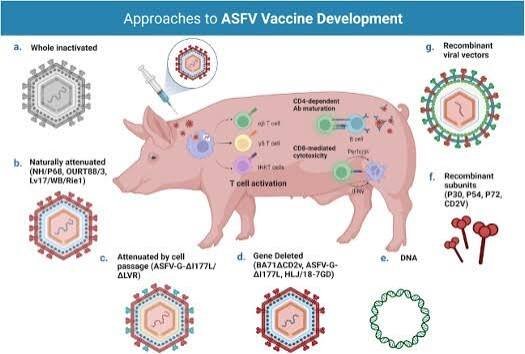
Several additional vaccine programmes are important to the global market, but they should not be counted as commercial products unless their regulatory status supports that classification.
Candidate or programme |
Developer / country |
Position at 26 October 2026 |
|---|---|---|
PROVAC |
South Korea |
Reported as undergoing Philippine BAI evaluation in September 2026; no Philippine commercial approval verified |
CAVAC ASF-X |
Choong Ang Vaccine Laboratories, South Korea |
Export-only authorisation reported; not equivalent to domestic-use approval |
Komipharm ASF vaccine |
Komipharm, South Korea |
Export-only authorisation reported; destination-country registration still matters |
ICAR–NIHSAD indigenous ASF vaccine |
India |
Development and field validation publicly announced; commercial marketing approval not confirmed in the cited announcement |
Experimental gene-deleted live vaccines |
Multiple research institutions internationally |
Research-stage candidates; results should not be conflated with a registered product |
Subunit, vectored, DNA/mRNA and other platforms |
Multiple international research programmes |
Research and development; none identified as a commercially licensed ASF vaccine in the reviewed sources |
Sources: FAO regional ASF update, Philippine Department of Agriculture, Indian government announcement, and the 2026 scientific review.
Commercial and Investment Implications
The ASF vaccine market is developing, but the commercial opportunity is shaped by regulatory fragmentation, the need for local evidence and uncertainty over cross-protection.
Market opportunity |
Commercial rationale |
Main constraint |
|---|---|---|
Vaccine manufacturing |
Licensed products can serve endemic markets with approved labels and distribution |
Regulatory approval, manufacturing consistency and supply capacity |
Regional licensing and distribution |
Countries affected by ASF may consider vaccines as part of control programmes |
National approval is required; one country’s licence does not transfer automatically |
Diagnostics and sequencing |
Vaccine use increases the value of distinguishing field-virus infection, vaccine-virus detection and recombinant strains |
Assay validation, laboratory capacity and surveillance coverage |
Field-efficacy studies |
Regulators and producers need credible evidence under local conditions |
Cost, study design, adequate comparison groups and independent oversight |
Cold-chain and veterinary services |
Correct storage, handling and administration are essential for product performance |
Farm infrastructure, veterinary access and smallholder economics |
Biosecurity and integrated disease control |
Vaccination is most useful when combined with surveillance and movement controls |
Compliance, traceability and sustained producer participation |
What would make a vaccine commercially compelling?
For an animal-health company or investor, the strongest product proposition would combine:
-
A clear and verifiable national marketing authorisation.
-
Robust efficacy data against relevant local ASF virus variants.
-
Transparent safety and genetic-stability evidence.
-
Large-scale, independently evaluated field results.
-
Practical manufacturing capacity and dependable supply.
-
A clear label defining eligible pigs and vaccination conditions.
-
Validated diagnostic and post-vaccination monitoring protocols.
-
A cost per protected pig that is commercially workable for producers.
The key commercial metric is not simply doses sold. A more useful evaluation would track eligible pigs vaccinated, completion of the approved schedule, confirmed disease outcomes, mortality, adverse events, field-virus variants and the cost per animal protected. Without these measures, high dose volumes or antibody positivity can overstate what is known about real-world disease control.
Final Assessment
As of 26 October 2026, Vietnam remains the centre of established commercial ASF vaccination, with three licensed products reported there: NAVET-ASFVAC, AVAC ASF LIVE and DACOVAC-ASF2.
AVAC ASF LIVE has the clearest verified expansion into other markets, with Indonesian emergency-use authorisation and Philippine commercial approval. South Korea’s export-only authorisations and India’s indigenous vaccine development are important developments, but they must be kept separate from confirmed routine commercial use.
The efficacy evidence is promising, particularly for protection against tested genotype II strains. However, field results are heterogeneous, several reported measures concern immune response rather than direct protection, and WOAH continues to emphasise the need for rigorous field evaluation and post-vaccination monitoring. The emergence of recombinant viruses in Vietnam makes strain-specific effectiveness and genomic surveillance especially important.
ASF vaccines are becoming a meaningful component of the animal-health market, but they are not a substitute for biosecurity, surveillance, movement controls and rapid outbreak response at this current moment. The strongest long-term commercial position will belong to products supported by credible local evidence, clear regulatory status and transparent safety monitoring.
Sources and Reference Library
-
WOAH (2026). Guidelines for African swine fever (ASF) vaccines: field evaluation and post-vaccination monitoring. Official document.
-
FAO. ASF situation in Asia & Pacific update. Country-level licensing and vaccination-programme updates. Regional surveillance page.
-
Diep et al. (2026). Live Attenuated Vaccines for African Swine Fever: Perspectives on Their Use and Strategic Directions. Transboundary and Emerging Diseases, first published 18 September 2026. Scientific review.
-
AVAC Vietnam (2025). Product-use notice explaining approved target pigs and restrictions on use in breeding animals. Manufacturer notice.
-
Philippine Department of Agriculture (2 September 2026). BAI clears first ASF vaccine for commercial sale. Official announcement.
-
Government of India, Press Information Bureau (4 August 2026). Indigenous African Swine Fever (ASF) Vaccine Developed by ICAR Bolsters India’s Biosecurity. Official announcement.
-
WOAH/GF-TADs Africa (2025). The GF-TADs Lomé Declaration on vaccines and vaccination against African Swine Fever. Regional position statement.
-
European Commission. African swine fever: disease and control measures. Official EU information.

 vaccine market, leading vaccine platforms, regulatory approvals, field-efficacy and safety concerns)