


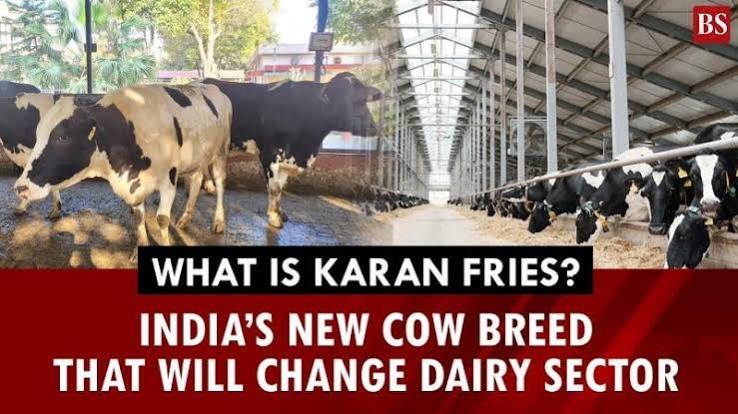
KARNAL, Haryana — October 2026: India’s Karan Fries cattle breed is attracting attention as a home-developed dairy genetic resource designed to combine high milk-production potential with adaptation to Indian climatic conditions.
Developed over decades by scientists at the ICAR–National Dairy Research Institute (NDRI), Karnal, Karan Fries is a synthetic breed produced through the crossing of Holstein Friesian cattle with the indigenous Tharparkar breed. The Holstein Friesian contributes high milk-production potential, while Tharparkar genetics are associated with adaptation to hot conditions and local production environments.
The breed was included in India’s registered synthetic cattle-breed list maintained by the ICAR–National Bureau of Animal Genetic Resources. Its registration recognises the stabilised population as a distinct genetic resource for breeding and conservation. Source: ICAR-NBAGR.
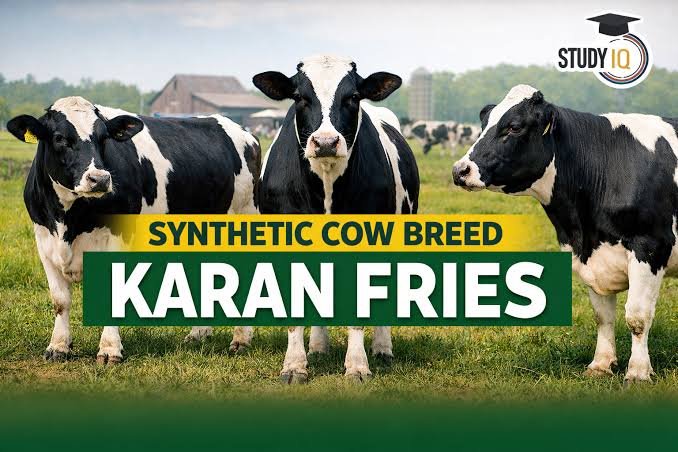
How much milk can Karan Fries cows produce?
NDRI’s published herd-performance data provide a useful distinction between average performance and exceptional peak production.
Performance measure |
Karan Fries |
|---|---|
Average total lactation yield in NDRI herd data |
3,585 kg |
Average yield over a standardised 305-day lactation |
3,393 kg |
Best recorded yield in a single day in the published table |
46.5 kg |
These are institute herd figures, not guaranteed production levels for every cow or every farm. Feeding, genetics, lactation stage, health, housing and management all affect actual performance.
The often-cited figure of 46.5 kg per day is a peak daily yield, not the average daily production of a typical Karan Fries cow. For farmers evaluating the breed, average lactation yield, persistency of production, fertility, health and lifetime productivity are more informative than a single peak record.

Why combine Holstein Friesian and Tharparkar genetics?
Dairy breeding programmes often seek to balance production with adaptation, reproductive performance and resilience. High milk output can increase nutrient requirements and metabolic stress, particularly when cows are exposed to heat, poor-quality feed or inadequate cooling.
Karan Fries aims to combine the productivity associated with Holstein Friesian ancestry with traits from Tharparkar, an indigenous breed adapted to Indian conditions. A stabilised synthetic population can also support more consistent breeding and selection than repeated use of first-generation crosses alone.
However, genetic potential is not the same as guaranteed heat tolerance. The degree to which a cow copes with high temperatures depends on several factors, including humidity, shade, ventilation, drinking-water access, nutrition, disease burden and individual genetics.
What does this mean for Indian dairy farmers?
The potential value of Karan Fries depends on how the breed performs under different farm systems. For organised farms, selection may focus on milk yield, feed conversion, fertility, udder health and longevity. For smallholder farmers, the economics also depend on feed costs, veterinary access, breeding services, housing and milk procurement prices.
Before investing in any high-yielding animal, farmers should review:
-
The animal’s actual lactation records and pedigree.
-
Reproductive history, calving interval and fertility.
-
Milk fat and solids-not-fat (SNF) performance.
-
Veterinary records, udder health and disease history.
-
Availability of suitable feed, clean water and heat-abatement facilities.
-
The local cost of breeding, replacement and ongoing care.
The economics of dairy production are determined by saleable milk and lifetime profitability—not peak yield alone.
Climate adaptation remains a management challenge
Heat stress can reduce feed intake, milk production, fertility and animal welfare. Breeding for adaptation can contribute to resilience, but genetics must be supported by practical heat-management measures.
These include shade, good airflow, access to drinking water, appropriate feeding schedules and cooling systems where economically feasible. Under hot and humid conditions, evaporative cooling may be less effective than in dry climates, making farm-specific design important.
For India’s dairy sector, breeding programmes that measure both production and adaptation traits could help farmers manage climatic variability. Continued evaluation across different states and production systems will be important to establish how well Karan Fries performs beyond institute herds.
Outlook: a useful addition to India’s dairy genetic toolkit
Karan Fries represents a long-term investment in Indian livestock breeding. Its registration, documented production potential and development history provide a foundation for further selection and field evaluation.
The breed should not be promoted as a universal replacement for indigenous cattle or other crossbreds. The appropriate choice depends on local conditions, farmer objectives and the ability to provide adequate nutrition, reproductive management and heat mitigation.
Industry outlook
Karan Fries adds a locally developed option to India’s dairy-breeding portfolio. Its broader impact will depend on field-level performance, access to quality breeding material, reproductive efficiency and the economics of milk production across diverse Indian farming systems.

