


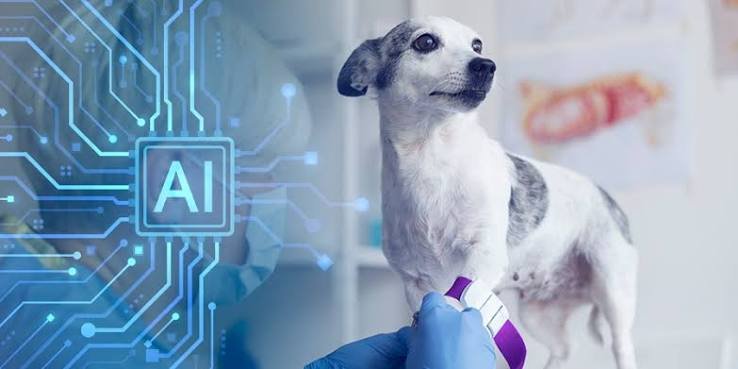
The global artificial intelligence (AI) in animal-health market is projected to reach $7.0 billion by 2033, expanding at a compound annual growth rate (CAGR) of 18.9% between 2026 and 2033, according to a market forecast published by Grand View Research.
The market research firm estimates that the sector was valued at $1.8 billion in 2025 and will increase to approximately $2.1 billion in 2026. Growth is expected to be supported by the increasing adoption of AI across veterinary diagnostics, animal identification, tracking and monitoring, and livestock management.
The forecast reflects the growing role of data-driven tools in both companion-animal and production-animal health. AI is moving beyond experimental applications into diagnostic workflows, clinical decision support, farm monitoring and veterinary practice operations.
Market forecast: $1.8 billion in 2025 to $7 billion by 2033
Grand View Research’s estimates indicate a rapidly expanding market:
| Market indicator | Estimate |
|---|---|
| Global market size, 2025 | $1.8 billion |
| Estimated market size, 2026 | $2.1 billion |
| Forecast market size, 2033 | $7.0 billion |
| CAGR, 2026–2033 | 18.9% |
| Largest regional market, 2025 | North America |
| North American revenue share, 2025 | 38.4% |
The forecast implies that the market could more than triple between 2026 and 2033. It is important to note that these are commercial market estimates from a research provider, not audited industry revenue figures. Different market studies may produce different valuations depending on how they define AI software, hardware, services and veterinary applications.
Veterinary diagnostics is a major application area
One of the most commercially significant uses of AI in animal health is diagnostic support. AI systems can analyse medical images, laboratory data and clinical records to help identify abnormalities and support veterinary interpretation. Applications include:
-
Radiology and diagnostic imaging.
-
Digital pathology and laboratory analysis.
-
Dermatological image assessment.
-
Clinical decision-support tools.
-
Disease-risk prediction and monitoring.
-
Automated interpretation of selected diagnostic tests.
Grand View Research identifies diagnostics as the leading application segment, accounting for an estimated 54.5% of market revenue in 2025. The figure indicates the importance of diagnostic applications within the firm’s market definition.
AI-based diagnostics may improve workflow efficiency by prioritising cases, highlighting abnormalities and reducing the time required for certain forms of image interpretation. However, these tools should be viewed as decision-support systems rather than replacements for veterinary examination, clinical judgement or confirmatory testing.
Livestock management creates a second major growth opportunity
The application of AI in livestock production is expanding beyond conventional farm automation. Computer vision, machine learning and sensor-based systems can support:
-
Early detection of lameness and mobility problems.
-
Body-condition scoring.
-
Monitoring of feeding and drinking behaviour.
-
Heat detection and reproductive management.
-
Identification and tracking of individual animals.
-
Detection of abnormal behaviour and potential illness.
-
Production and performance monitoring.
These systems can help producers identify animals requiring attention earlier and prioritise veterinary intervention. The commercial value is especially relevant in large dairy, poultry, swine and feedlot operations, where manual observation of every animal is difficult.
AI-based livestock systems can also generate longitudinal records, allowing farmers and veterinarians to track changes over time rather than relying solely on isolated observations.
Companion-animal AI remains a major market segment
The market research estimates that companion animals accounted for 69% of AI animal-health market revenue in 2025.
Applications in companion-animal practice include imaging interpretation, clinical documentation, pathology support, patient monitoring and administrative automation. The opportunity is supported by the growing use of digital records and diagnostic equipment in veterinary clinics. AI tools may help practices manage increasing volumes of clinical information and improve consistency in selected workflows.
However, commercial adoption will depend on evidence of clinical utility, integration with existing practice-management systems, data privacy, regulatory expectations and the willingness of veterinary professionals to incorporate AI into clinical decisions.
North America leads, while Asia-Pacific is forecast to grow rapidly
Grand View Research estimates that North America accounted for 38.4% of the global market in 2025, making it the largest regional market. The research firm identifies Asia-Pacific as the fastest-growing region over the 2026–2033 forecast period.
The region’s growth opportunity is linked to its large livestock populations, expanding veterinary infrastructure, rising adoption of digital technologies and demand for improved production efficiency.
For India, AI tools that can operate through smartphones and low-cost digital platforms could be particularly relevant. Solutions that reduce dependence on expensive farm hardware may help extend animal-health screening and advisory services to smaller producers.
Indian example: AI-powered livestock screening
India’s Gau Swastha platform illustrates the potential of image-based AI in livestock health. The system has been reported as operating across 26 Karnataka Veterinary Department polyclinics and benefiting more than 50,000 farmers.
It uses a smartphone photograph to generate an animal-health and productivity assessment in under 30 seconds. Reported capabilities include screening for 33 cattle diseases, breed identification, assessment of breeding potential and recommendations relating to nutrition and fodder.
The platform’s reported training resources include 40,000 annotated cattle images, 1,000 symptom-to-disease mappings and more than 30 veterinary treatment protocols. These are platform-reported specifications and deployment figures, not independently established measures of diagnostic accuracy.
The forecast is encouraging, but the commercial success of AI in animal health will depend on more than the availability of new algorithms. Key considerations include:
-
Clinical validation: Systems must demonstrate acceptable performance across species, breeds, age groups and disease presentations.
-
Veterinary oversight: AI outputs need appropriate professional interpretation, especially where diagnosis or treatment decisions are involved.
-
Data quality: Reliable systems require representative, accurately labelled datasets.
-
Workflow integration: Tools must fit into existing clinical and farm-management processes.
-
Affordability: Pricing must reflect the economics of veterinary practices and livestock producers.
-
Regulatory and liability frameworks: Clear expectations are needed for diagnostic claims, clinical decision support and responsibility for errors.

