



South Korea’s CMG Pharmaceutical and CHA Medical are advancing a joint research and commercialization program focused on three functional-material platforms, with applications spanning human wellness and veterinary health. A notable pipeline asset is Colostrum EXO (EV), designed for potential use in pet health management.
The collaboration is strategically significant because it brings together pharmaceutical development, regenerative-medicine expertise and extracellular-vesicle (EV) technology—an area attracting increasing interest in companion-animal health.
Three-material pipeline targets multiple markets
The companies are pursuing three functional materials, with the cognitive-function botanical extract reportedly positioned as the fastest route toward commercialization. In parallel, the partners are developing pet-care applications based on extracellular vesicles derived from colostrum.
CMG Pharmaceutical operates within the broader CHA ecosystem, which includes CHA Biotech, CHA Healthcare and CHA Meditech. The group has established capabilities spanning biotechnology, clinical research, biomaterials and medical technologies.
The structure of the program is therefore notable: rather than treating pet health as an isolated nutraceutical opportunity, the partners appear to be applying biomedical platform technologies to companion-animal wellness.
Why Colostrum-Derived EVs Matter
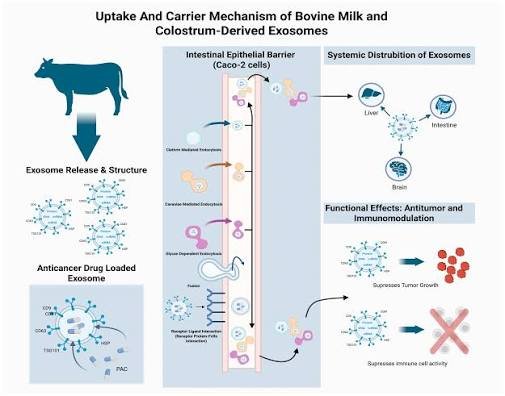
Extracellular vesicles are nano-sized biological particles that can carry proteins, lipids, nucleic acids and other molecular signals between cells. Their potential value in veterinary medicine lies in their ability to act as cell-free biological signalling systems, although the clinical evidence base remains considerably less mature than the commercial interest.
Research has demonstrated that bovine colostrum contains extracellular vesicles with biologically active components. A peer-reviewed study published in Frontiers in Cell and Developmental Biology reported that bovine-colostrum-derived exosomes promoted proliferation of human dermal papilla cells and demonstrated hair-growth effects in preclinical models. Importantly, the authors described the work as preclinical evidence, not proof of clinical efficacy in humans or animals.
Another study in Pharmaceutics investigated bovine-colostrum-derived exosomes and reported biological activity associated with protection against oxidative stress in cellular models.
These studies provide scientific rationale for further investigation, but they should not be interpreted as establishing that a commercial Colostrum EXO product will prevent or treat a particular disease in dogs or cats.
Pet Health Could Become an Important Application
The veterinary opportunity is particularly interesting because colostrum itself is already used in companion-animal supplementation.
Veterinary guidance from VCA notes that bovine colostrum is used in animal supplements and may provide local gastrointestinal and immune-support effects, while emphasizing that rigorous clinical evidence for many supplement claims remains limited. An EV-based product represents a different proposition from conventional whole-colostrum supplementation.
| Conventional colostrum | Colostrum-derived EV platform |
|---|---|
| Complex biological matrix | More specifically defined vesicle fraction |
| Immunoglobulins, lactoferrin and other proteins | EV-associated proteins, lipids and signalling molecules |
| Primarily nutritional/supplement approach | Potential bioactive-material platform |
| Established supplement category | Emerging biotechnology category |
| Relatively straightforward formulation | Requires characterization, purification and quality control |

