



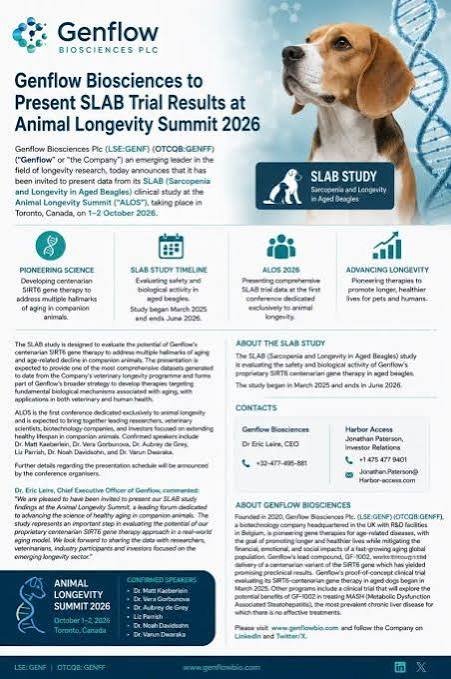
Genflow Biosciences has reported that its SLAB (Sarcopenia and Longevity in Aged Beagles) clinical trial has met its primary endpoint, marking a potentially important development in veterinary longevity biotechnology.
The randomized, blinded study involved 24 Beagles aged over 10 years and evaluated Genflow’s SIRT6-based gene-therapy approach for sarcopenia and longevity-related outcomes. Detailed trial results are scheduled to be presented at the Animal Longevity Summit in Toronto on October 1–2, 2026.
This story is important, but it should be treated as a September 8 development, rather than September 10 breaking news.
What is Genflow trying to achieve?
Genflow is developing therapies based on SIRT6, a gene associated with cellular processes involved in ageing. The company’s broader scientific strategy is to investigate whether introducing a centenarian-associated variant of SIRT6 can influence biological ageing and age-related disease.
Its veterinary programme includes GF-1004, a non-human version of its SIRT6-based technology intended for dogs. Genflow describes GF-1004 as a veterinary product in its pipeline, with SIRT6c delivered through plasmid DNA.
The SLAB trial
The SLAB trial is particularly notable because it moves longevity science beyond laboratory animals into aged companion dogs. According to Genflow, the study was a comparative, randomized and blinded trial involving 24 aged Beagles, divided into treatment and control groups.
The company’s programme evaluates both efficacy and safety, with the broader objective of assessing whether SIRT6-based intervention can address age-related decline and sarcopenia.
The primary-endpoint announcement is therefore a milestone for veterinary longevity research. However, the size of the trial is important when interpreting the result.
With only 24 animals, the study is a relatively small proof-of-concept investigation. It can provide an important biological signal, but it is not sufficient on its own to establish that the treatment extends lifespan or meaningfully delays multiple age-related diseases.
Why dogs matter in longevity research
Dogs are increasingly important in translational ageing research because naturally ageing companion dogs develop many age-associated conditions in real-world environments. Unlike laboratory rodents, companion dogs share human households, environmental exposures and aspects of clinical care.
That makes canine studies potentially valuable as an intermediate step between laboratory research and human clinical development. The opportunity is particularly relevant to the emerging animal longevity market, where pharmaceutical and biotechnology companies are investigating interventions targeting ageing biology rather than individual diseases.
The key question: biological age versus lifespan
One of the most important distinctions in interpreting Genflow’s announcement is between biological-age biomarkers and actual lifespan or healthspan. A treatment that changes a molecular or epigenetic measure of ageing does not automatically demonstrate that an animal will:
-
live longer;
-
remain disease-free longer;
-
maintain mobility;
-
develop fewer age-related diseases;
-
or experience improved quality of life.
Independent analysis of the announcement has also highlighted the limited sample size and the need for detailed numerical data before the magnitude and clinical significance of the reported effect can be assessed.
The October presentation of detailed trial results will therefore be an important next milestone.
Commercial implications for animal health
The potential market is significant because companion-animal longevity sits at the intersection of several rapidly developing sectors:
Veterinary pharmaceuticals + preventive health + diagnostics + pet wellness + precision medicine + biotechnology.
If disease-modifying longevity therapies eventually prove effective and safe, they could potentially create a new high-value category within veterinary medicine. Such therapies could be positioned not simply around treating a single disease, but around preserving function and delaying multiple age-associated conditions.
That would represent a substantial change from the conventional veterinary pharmaceutical model.
AHI Analyst view
Genflow’s SLAB result is strategically interesting because it provides another indication that companion animals are becoming an important proving ground for longevity biotechnology.
But the market should resist extrapolating from a 24-dog study to commercial efficacy. The critical evidence to watch at the October 2026 presentation will include:
-
the numerical size of the primary-endpoint effect;
-
statistical significance and confidence intervals;
-
secondary endpoints;
-
functional measures of sarcopenia;
-
safety and tolerability;
-
durability of the response;
-
differences between treatment cohorts;
-
evidence linking biomarker changes to functional health outcomes.

