



Genus FY26: 35% Adjusted Profit Growth, £60m Buyback as PRRS-Resistant Pig Moves Toward Commercialisation
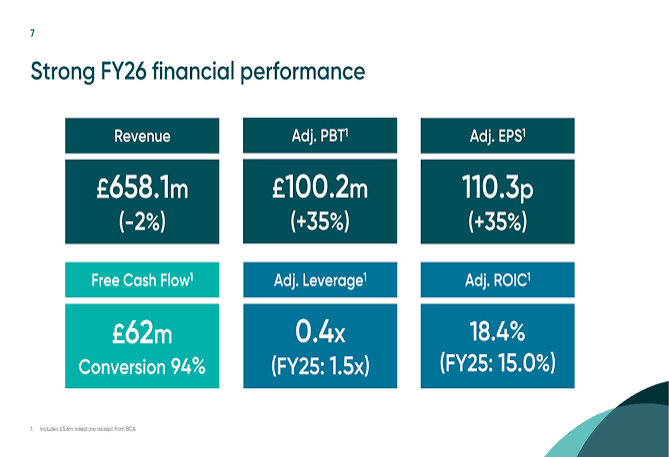
Basingstoke, UK — September 10, 2026 — Genus plc has reported a strong FY26 performance, with adjusted profit before tax rising 35% to £100.2 million, despite a 2% decline in group revenue to £658.1 million.
The UK-based animal genetics company also announced a £60 million share buyback programme, expected to be completed during FY27, following a substantial strengthening of its balance sheet after the formation of its strategic Chinese porcine joint venture. The more strategically important development, however, is the continuing regulatory expansion of Genus’s PRRS Resistant Pig (PRP) gene-editing platform.
Genus now has approvals and/or favourable regulatory determinations across eight jurisdictions — the United States, Canada, Brazil, Colombia, Argentina, the Dominican Republic, Uruguay and Peru — while regulatory work continues in Mexico, Japan and China. Commercialisation is now beginning in selected Latin American markets.
FY26 financial performance – Genus reported:
FY26 metric |
FY26 |
FY25 |
Change |
|---|---|---|---|
Revenue |
£658.1m |
£672.8m |
-2% |
Adjusted operating profit |
£94.8m |
£81.1m |
+17% |
Adjusted operating profit incl. JVs |
£116.0m |
£93.1m |
+25% |
Adjusted PBT |
£100.2m |
£74.3m |
+35% |
Free cash flow |
£62.0m |
£40.9m |
+52% |
Adjusted EPS |
110.3p |
81.8p |
+35% |
Full-year dividend |
35.2p |
32.0p |
+10% |
Net leverage |
0.4x |
1.5x |
materially lower |
Revenue declined — but the underlying business was more resilient
Group revenue declined 2% to £658.1 million. The principal reason was structural rather than a broad deterioration in the underlying business: PIC China was deconsolidated from 31 January 2026 after Genus transferred the business into a new strategic joint venture with Beijing Capital Agribusiness (BCA).
Excluding PIC China, Genus said group revenue was essentially flat in constant currency and down only 1% in actual currency. That makes the revenue decline materially less concerning than the headline number suggests.
PIC remains the principal growth engine
Genus’s porcine genetics business, PIC, performed strongly across its major regions. Total PIC volume, including joint ventures, increased 12%. Adjusted operating profit including joint ventures increased to £130.8 million, up 17% in actual currency and 16% in constant currency.
Growth was particularly strong in:
-
Latin America;
-
China and wider Asia;
-
Europe.
North America remained more challenging because customer and multiplier health issues affected volumes during the second half. Strategically important royalty revenue increased 1%, while Genus’s adjusted royalty revenue measure — incorporating its share of relevant joint-venture royalty revenues — increased 5% to £196.9 million.
This is important for investors because royalty-based genetics revenue can provide a more attractive and potentially more scalable economic model than relying exclusively on the sale of breeding animals.
ABS turnaround continues
Genus’s bovine business, ABS, also delivered significant profitability improvement. ABS adjusted operating profit including joint ventures increased to £22.9 million, with a margin of 7.6%.
The business benefited from Genus’s Value Acceleration Programme (VAP), which generated approximately £9 million of benefits during FY26, including £7 million from Phase 3 initiatives. However, lower global dairy prices continued to pressure customer demand and product mix.
Genus said its medium-term ambition remains to achieve double-digit operating margins in ABS.
£60m Buyback: Balance Sheet Has Become a Strategic Asset
One of the most important financial developments in the FY26 results is the transformation of Genus’s balance sheet. Free cash flow increased from £40.9 million to £62.0 million. In addition, Genus received approximately £98 million of net cash proceeds from the formation of the PIC China joint venture.
As a result, year-end leverage fell from 1.5x to 0.4x EBITDA, significantly below Genus’s unchanged target leverage range of 1–2x EBITDA. The company is now using part of that balance-sheet flexibility to return capital to shareholders.
Genus announced a £60 million share buyback, expected to be completed during FY27. This is significant because the buyback is not being funded by financial engineering or materially increased leverage. It follows stronger operating cash generation and the cash proceeds associated with the Chinese JV transaction.
What the buyback signals
The decision potentially signals three things:
1. Management sees the balance sheet as overcapitalised – At 0.4x leverage, Genus is well below its stated 1–2x target range.
2. Management has confidence in future cash generation – The company is committing £60 million to shareholders while simultaneously maintaining investment in R&D and the PRP commercialisation programme.
3. Capital allocation is becoming a bigger part of the Genus investment story – Genus is no longer purely a livestock-genetics growth story. It increasingly combines: genetic royalties + recurring customer relationships + biotechnology + strong cash generation + shareholder returns.
PRRS Resistant Pig: The Most Important Long-Term Value Driver
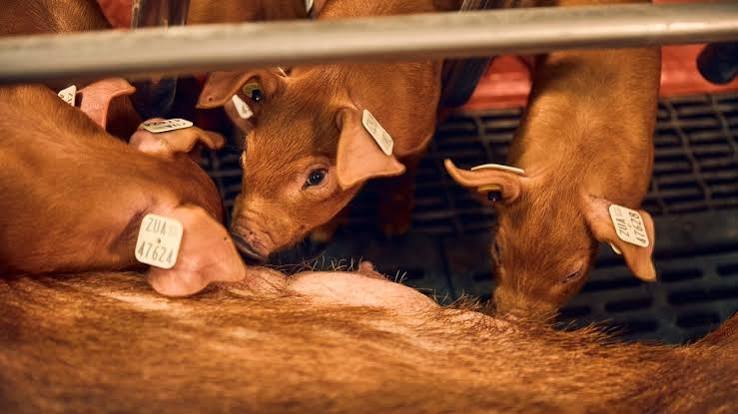
The most strategically significant component of the FY26 results remains Genus’s PRRS Resistant Pig (PRP). PRRS — porcine reproductive and respiratory syndrome — is one of the most economically important infectious diseases affecting intensive pig production.
It can cause reproductive failure in breeding animals, respiratory disease in young pigs and increased vulnerability to secondary infections. WOAH describes PRRS as a widespread viral disease of domestic pigs.
Genus’s PRP technology uses gene editing to remove the genetic entry point used by PRRS virus to infect pigs. Genus describes the resulting animals as resistant to PRRS virus rather than simply relying on vaccination or disease management.
This creates a potentially different economic proposition from conventional veterinary pharmaceuticals. Instead of repeatedly treating or vaccinating animals against disease, the genetic trait is designed to be inherited through conventional breeding once introduced into elite genetic lines.
Eight Jurisdictions Now Have Regulatory Approval or Positive Determinations
Genus has now reached an important regulatory milestone. The PRP technology has approvals and/or favourable regulatory determinations in:
-
United States
-
Canada
-
Brazil
-
Colombia
-
Argentina
-
Dominican Republic
-
Uruguay
-
Peru
Genus’s PRP regulatory information confirms favourable determinations in Brazil, Colombia, Argentina, Dominican Republic, Uruguay and Peru, alongside FDA approval in the US and Canadian approval. Canada’s Health Canada and CFIA announced in January 2026 that their independent safety assessments had concluded that PRRS-resistant pigs were safe for food and feed uses.
Mexico, Japan and China remain important
The regulatory map is not complete. Genus continues to work toward approval in:
-
Mexico
-
Japan
-
China
These markets matter particularly because of the integrated nature of global pork production and trade. The US approval alone did not automatically create a commercial market because regulatory acceptance in key export destinations is important for US pork producers and supply chains.
Genus therefore needs to continue building a sufficiently broad regulatory footprint before PRP can reach its full commercial potential.
Commercialisation Has Now Started in Selected Latin American Markets
The FY26 results contain an important change in language. Genus is no longer describing PRP simply as a technology awaiting future commercialisation.
The company states that: commercialisation of PRP is now beginning in certain Latin American countries. This represents a transition from regulatory-risk story to early commercialisation story.
However, the company is not yet providing sufficient information to estimate the full financial contribution from PRP.
The initial commercial rollout is likely to be gradual because gene-edited breeding animals must enter elite breeding populations and the resistant trait then needs to propagate through conventional genetic multiplication.
Genus itself has previously explained that commercial availability will take time because the trait must be introduced into breeding systems before sufficient numbers of PRRS-resistant animals can be supplied to the broader pork industry.
Why PRP Could Change the Economics of the Swine Genetics Market
The potential economic value of PRP extends beyond Genus selling another premium breeding animal. If the technology demonstrates meaningful reductions in PRRS-related disease losses, it could potentially influence:
-
piglet survival;
-
reproductive performance;
-
growth performance;
-
antibiotic usage;
-
mortality;
-
veterinary expenditure;
-
farm-level biosecurity costs;
-
production predictability;
-
environmental efficiency.
Genus’s FY26 report cites its life-cycle assessment indicating that eliminating PRRS could reduce greenhouse-gas emissions by approximately 5% in the US, although that is a company-reported modelling result rather than evidence from broad commercial deployment.
The company also reported consumer research in which 94% of surveyed consumers were open to purchasing pork from gene-edited pigs, with responsible reduction in antibiotic use identified as the strongest motivator. This should be interpreted as Genus’s consumer research rather than an independently established market-wide acceptance rate.
China Adds Another Layer of Strategic Optionality
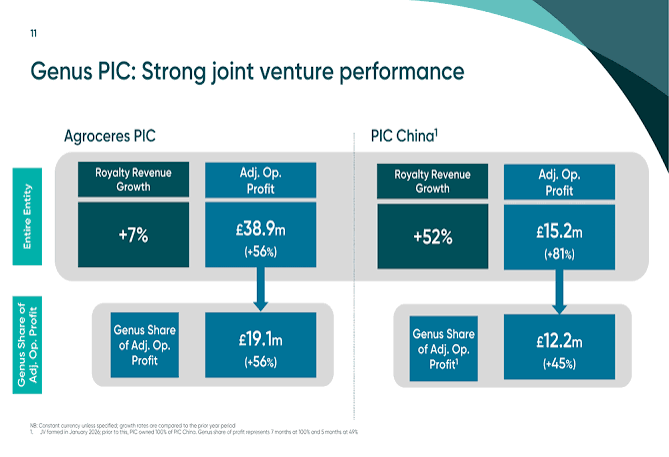
Genus’s January 2026 formation of its Chinese porcine joint venture with Beijing Capital Agribusiness is also strategically important. Genus transferred PIC China into the JV and retained a 49% interest, receiving approximately £98 million of net cash proceeds.
The structure reduces Genus’s direct capital requirements in China while retaining exposure to the world’s largest pork market. More importantly, Genus says the partnership creates a stronger platform for eventual PRP commercialisation in China.
However, China remains a regulatory-development opportunity rather than an approved PRP market.
AHI Analyst View: Genus Has Entered a New Phase
The FY26 results suggest that Genus is entering a potentially important new phase. The investment case can now be divided into four layers:
1. Core genetics – PIC and ABS continue to generate operating profits from proprietary genetics and established customer relationships.
2. Recurring royalty economics – The growing importance of royalty revenues provides Genus with potentially more scalable and defensible economics.
3. PRP biotechnology option – The PRRS-resistant pig creates a potentially transformational technology platform if regulatory approvals translate into meaningful commercial adoption.
4. Balance-sheet and capital-return discipline – The reduction in leverage to 0.4x and the £60 million buyback materially change Genus’s capital-allocation profile.
The critical point is that PRP does not need to contribute heavily to FY26 earnings for the investment thesis to improve. The core business is already generating stronger cash flow, while PRP represents a potentially large future growth option.
What Animal-Health Investors Should Watch Next
For the animal-health and livestock biotechnology sector, Genus provides an important case study in how genetics can move upstream into disease prevention. The key FY27 indicators will be:
Indicator |
Why it matters |
|---|---|
PRP commercial volumes |
First evidence of customer adoption |
Revenue/royalty contribution from PRP |
Determines economic value of the technology |
Mexico approval |
Important for US pork trade |
Japan approval |
Important export-market milestone |
China regulatory progress |
Potentially transformational long-term market |
PRP breeding penetration |
Determines speed of industry-scale adoption |
PIC royalty growth |
Core recurring-growth indicator |
ABS operating margin |
Measures success of turnaround |
Free cash flow |
Supports R&D and shareholder returns |
Buyback execution |
Demonstrates capital-allocation discipline |

