


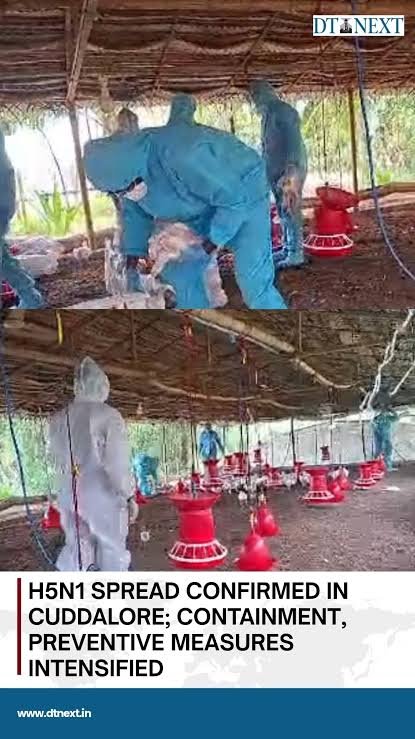
India’s Southernmost Province – Tamil Nadu confirms H5N1 following substantial poultry mortality
The Department of Animal Husbandry and Veterinary Services, Tamil Nadu, has confirmed highly pathogenic avian influenza H5N1 in Cuddalore district following a major poultry mortality event involving 35,647 birds.
Laboratory confirmation was received on 13 November 2026 from samples associated with poultry farms in Kattiyankuppam village, Kurinjipadi taluk. The initial report of unusual poultry mortality was received on 30 October.
The outbreak has prompted an extensive containment operation involving culling, carcass disposal, movement restrictions and surveillance of neighbouring farms.
Laboratory confirmation and disease investigation
The initial investigation began after sudden bird deaths were reported at a poultry farm in Thamanampatti village. Veterinary teams inspected the affected premises and collected samples.
Samples were subsequently examined by several diagnostic facilities, including:
-
Poultry Disease Diagnostic Laboratory, Namakkal.
-
Poultry disease diagnostic facilities in Erode.
-
Central University Laboratory, Madhavaram, Chennai.
-
National Institute of High Security Animal Diseases (NIHSAD), Bhopal.
The carcass sample sent to NIHSAD confirmed H5N1 on 13 November. The reported mortality across the affected area had reached 35,647 birds by that date.
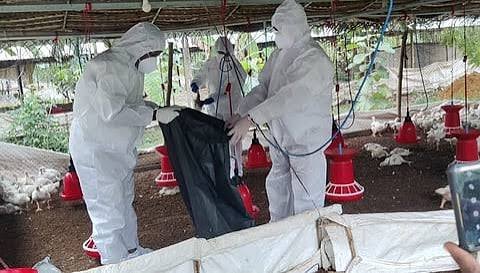
Government launches culling and containment
Following laboratory confirmation, the department initiated measures under the Government of India’s 2021 avian influenza action plan. The response includes:
1. Culling – All birds at the infected premises and within the designated one-kilometre radius are subject to prescribed culling operations.
2. Carcass disposal – Dead and culled birds are being disposed of through controlled procedures, including deep burial.
3. Movement restrictions – Transportation of poultry to and from the affected premises is being restricted.
4. Cleaning and disinfection – Veterinary teams are undertaking cleaning, disinfection and fumigation operations.
5. Surveillance – Neighbouring poultry farms are being monitored for unusual mortality and clinical signs.
6. Farmer communication – Advisories are being circulated to improve early reporting and farm-level compliance.
The state has also deployed rapid-response teams to coordinate the control programme.
Why the delay between initial mortality and confirmation deserves attention
The interval between the first reported mortality on 30 October and confirmation on 13 November is an important operational aspect of the outbreak. It does not, by itself, establish that there was a delay in official action or laboratory processing.
However, it reinforces the importance of rapid diagnostic escalation when poultry mortality is unusual or increasing. Commercial farms should not wait for mortality to reach exceptional levels before contacting veterinary authorities.
Implications for the Indian poultry industry
The event is particularly relevant because Tamil Nadu has an important poultry production and distribution ecosystem. The immediate concerns include:
-
Mortality losses at affected premises.
-
Disruption to local poultry movement.
-
Costs associated with culling and disinfection.
-
Risks to neighbouring commercial farms.
-
Potential market uncertainty.
-
Increased surveillance and testing costs.
Veterinary industry opportunities and responsibilities
The outbreak increases the importance of diagnostic capacity, disinfection systems and biosecurity solutions. However, companies must distinguish between legitimate outbreak-control interventions and products with no demonstrated role in controlling HPAI. Priority areas include:
-
Laboratory surveillance.
-
Validated diagnostic kits.
-
Farm disinfectants.
-
Protective equipment.
-
Biosecurity consultancy.
-
Farm-level disease monitoring.

