


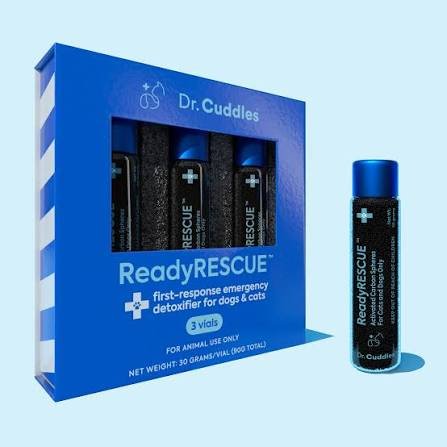
New York, November 9, 2026 — Veterinary technology company ReadyRESCUE has drawn attention at the 2026 New York Vet Show with a compact activated-carbon product designed to make gastrointestinal decontamination in dogs and cats cleaner and easier to administer. Manufactured as synthetic carbon spheres, ReadyRESCUE is positioned as a less bulky alternative to conventional powdered or liquid activated-charcoal preparations used in selected cases of accidental toxin ingestion.
The product’s appearance at the event is notable because it follows the publication of a University of Georgia-associated research study comparing its toxin-binding performance with conventional activated charcoal and ToxiBan®. The findings, published in Frontiers in Veterinary Science, provide laboratory evidence that the spherical formulation can adsorb several common veterinary toxicants at levels broadly comparable with the established charcoal products tested.
However, the distinction between laboratory adsorption and demonstrated clinical effectiveness is important: the study was conducted in simulated gastrointestinal environments, not in poisoned animals.
A different delivery format for activated charcoal
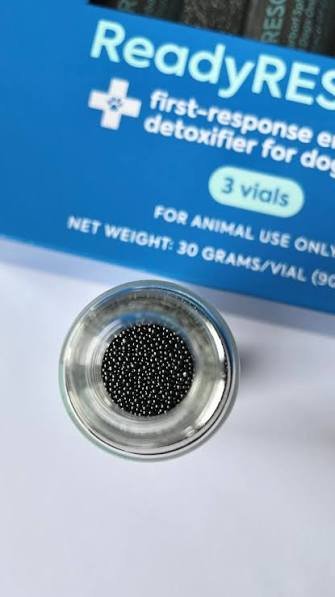
ReadyRESCUE is developed by AllPet/Dr. Cuddles and uses a resin-based manufacturing process to produce dense, uniform spherical granules of activated carbon. The underlying adsorbent remains activated carbon; the innovation is principally its physical form and delivery format, rather than an entirely new toxin-binding mechanism.
The research paper describes a surface area of approximately 1,362 m² per gram for the spherical material, based on company-provided information. Its greater density allows the same mass of activated carbon to occupy substantially less volume than conventional non-spherical products. The paper estimates the spherical formulation occupies approximately one-third of the volume of comparable non-spherical material.
At the New York Vet Show, ReadyRESCUE founder and CEO Mat Glassman told dvm360 that the product is designed to reduce the mess associated with charcoal administration. He also reported a five-year shelf life, compared with approximately two years for traditional charcoal, and said the product is priced at about the same level. These shelf-life and pricing statements are company-reported claims, rather than findings established by the published adsorption experiment.
The product is supplied in 30-gram vials, with the company describing weight-based dosing. It is marketed to veterinary practices and pet owners, with home use presented as a potential bridge to professional veterinary care.
What the University of Georgia-associated study found
The peer-reviewed study, titled Comparison of adsorptive capacity for different types of activated charcoal for common veterinary toxicants, was authored by Anika Chaganti and Benjamin M. Brainard.
Researchers compared three products:
-
ReadyRESCUE resin-bound activated-carbon spheres.
-
Conventional powdered activated charcoal.
-
ToxiBan, a proprietary activated-charcoal formulation.
The investigators examined toxin concentrations in simulated acidic and neutral gastrointestinal environments. The experimental conditions included an acidic solution at approximately pH 1.5 and a neutral solution at pH 6–7, maintained at 38°C with continuous agitation.
The test panel included nine toxicant categories or compounds: naproxen, ivermectin, bromethalin, xylitol, ethylene glycol, delta-9 THC, chocolate-derived theobromine and caffeine, roquefortine from mouldy cheese, and tartaric acid.
Equivalent amounts of the charcoal products were introduced into the test mixtures, and samples were analysed at 30, 60 and 240 minutes.
The principal findings were:
-
Naproxen and ivermectin: All three charcoal products produced substantial reductions in measured concentrations. The researchers reported that more than 96% of naproxen and 98% of ivermectin had been adsorbed within 30 minutes across the tested environments.
-
Theobromine and caffeine: Concentrations decreased over time with all three products, with no statistically significant differences in adsorption rates between formulations.
-
Delta-9 THC: All three products demonstrated adsorption, although the rate and pattern varied with the simulated pH conditions.
-
Bromethalin: Adsorption was inconsistent. In acidic conditions, none of the products demonstrated effective removal over the four-hour experiment. In neutral conditions, ToxiBan showed the most prominent reduction at the 60-minute measurement.
-
Xylitol and ethylene glycol: Neither showed reliable adsorption by the tested charcoal formulations. These substances should not be treated as suitable targets for charcoal-based decontamination.
-
Tartaric acid: The tested products did not demonstrate meaningful adsorption.
The overall conclusion was that the three activated-charcoal formulations reduced concentrations of most of the tested toxicants in the laboratory system, with no consistent evidence that ReadyRESCUE was universally superior to conventional products.
Important limitations: laboratory adsorption is not a clinical outcome
The research is useful, but it should not be interpreted as proof that ReadyRESCUE improves survival, reduces hospitalisation, prevents organ damage or produces better outcomes in poisoned dogs and cats.
The authors identified several limitations. Most importantly, only single adsorption trials were performed for each toxicant and timepoint, rather than replicated experiments. The researchers also used commercially available toxin-containing products and substrates rather than pure compounds in several experiments. This may have influenced measured concentrations and complicated interpretation.
The study did not evaluate clinical outcomes in live animals, nor did it establish how the product performs under the full range of real-world ingestion conditions. The authors also noted that mixing charcoal with food, a common approach to encourage administration in pets, was not evaluated in their experiment.
The study was funded by AllPet Inc./Dr. Cuddles, the manufacturer of ReadyRESCUE, which supplied the test product. This relationship should be considered when interpreting the findings and reinforces the value of independent replication.
Safety and clinical use remain essential
Activated charcoal is not a universal antidote. Its usefulness depends on the substance ingested, the time since ingestion, the animal’s clinical condition and the likelihood that the toxin can be adsorbed.
ReadyRESCUE’s own veterinary guidance identifies poor binding of xylitol, ethylene glycol, alcohols, heavy metals and corrosive substances. Its guidance also cautions against administration to animals that are unconscious or have a compromised airway or gastrointestinal obstruction. As with other activated-charcoal products, it can bind orally administered medicines and potentially interfere with their absorption.
These limitations matter particularly in emergencies: attempting home administration must not delay veterinary assessment or appropriate treatment. Product selection and administration should be directed by a veterinarian or veterinary poison-control professional.
Industry implications: formulation and usability as product differentiation
ReadyRESCUE illustrates an interesting product-development direction in companion-animal emergency care: improving the usability of established therapeutic materials through formulation and delivery engineering.
The product does not replace the underlying role of activated charcoal. Instead, its commercial proposition rests on reducing volume, improving handling, simplifying weight-based administration and potentially making the product more practical for veterinary clinics and selected home emergency situations.
For veterinary practices, the proposition may be relevant where charcoal administration is indicated but handling conventional preparations is difficult. For manufacturers, it demonstrates how improvements in dosage form, packaging and administration experience can create differentiation even when the active adsorbent is already well established.
The next important evidence milestones will be independently replicated adsorption studies, controlled clinical evaluations of administration and delivered dose, and real-world safety and outcome data.
Bottom line: ReadyRESCUE has a credible formulation innovation supported by a published in-vitro comparison. Its compact synthetic activated-carbon spheres may offer a cleaner and more convenient delivery format, but claims of clinical superiority or universal toxin protection would go beyond the available evidence.

