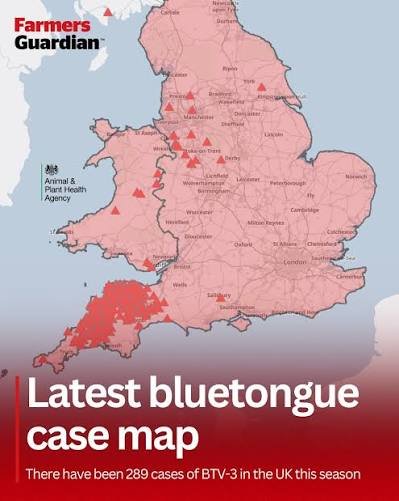


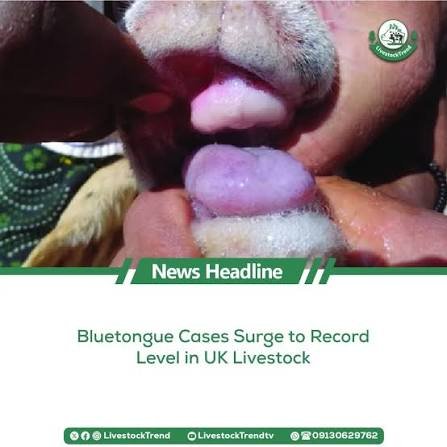
England records 64 new bluetongue cases, while Wales and Scotland report six additional BTV-3 cases combined, according to the UK government’s 10 October update.
Bluetongue virus (BTV) activity continued across Great Britain in the latest official surveillance update, with 70 new cases reported across England, Wales and Scotland for 9 October 2026. England accounted for 64 new cases, while Wales confirmed five additional BTV-3 cases and Scotland reported one. The figures were published by the UK Department for Environment, Food & Rural Affairs (Defra) and the Animal and Plant Health Agency (APHA) on 10 October.
The continuing detections underline the importance of surveillance, veterinary reporting, vector-risk management and compliance with animal-movement requirements for cattle and sheep producers.
England accounts for 64 new cases
Of the 64 new cases recorded in England on 9 October, the official update identified:
-
40 cases of BTV-3, comprising 22 sheep-related and 18 cattle-related cases
-
23 cases of unknown BTV serotype, comprising 12 sheep-related and 11 cattle-related cases
-
One clinically confirmed case involving cattle
The new cases were reported across Cornwall, Cumbria, Derbyshire, Devon, Dorset, Gloucestershire, the Isle of Wight, Lancashire, North Yorkshire, Somerset, Wiltshire and Worcestershire.
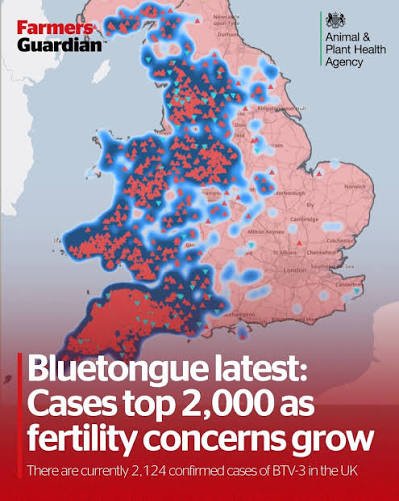
These figures refer to confirmed cases on premises, not the total number of individual animals infected. The distinction is important when interpreting disease-surveillance statistics.
Wales and Scotland also report new BTV-3 detections
Wales reported five new BTV-3 cases on 9 October, in Gwynedd, Denbighshire, Carmarthenshire and Wrexham. Scotland reported one additional BTV-3 case in Dumfries and Galloway.
Across the 2026–27 bluetongue season, the UK government’s update recorded 3,235 confirmed premises cases: 2,709 in England, 478 in Wales and 48 in Scotland. No cases were reported in Northern Ireland in the published season totals. The same update recorded 545 potential cases under investigation across Great Britain.
The seasonal total should not be interpreted as a count of infected animals or as a measure of disease severity. It represents premises with confirmed disease under the government’s reporting definition.