
HomeLivestockNamibia FMD Outbreak: Livestock Trade Suspended After Virus Detected in FMD-Free Zone

Namibia FMD Outbreak: Livestock Trade Suspended After Virus Detected in FMD-Free Zone

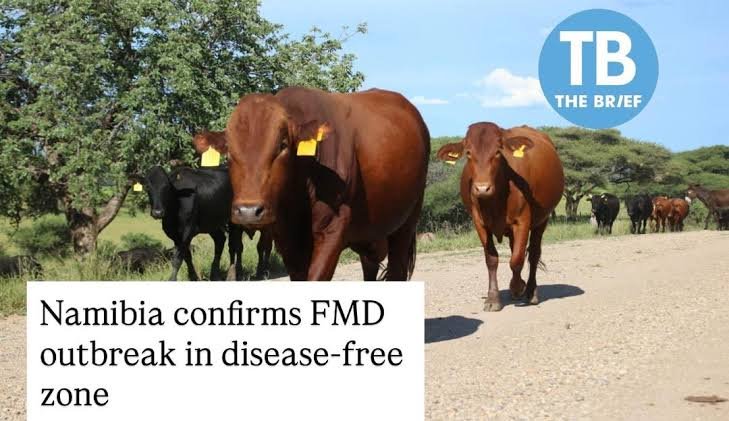
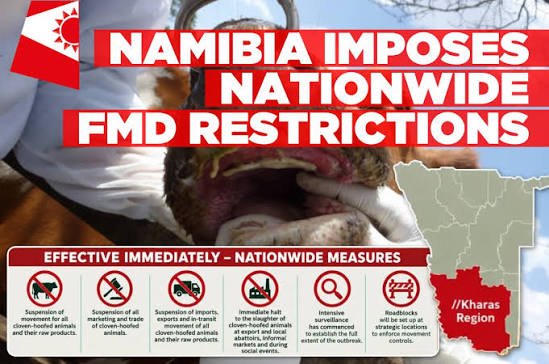
Namibia has imposed nationwide restrictions on the movement, marketing, trade and slaughter of cloven-hoofed animals following the confirmation of foot-and-mouth disease (FMD) in the Karasburg State Veterinary District in the //Kharas Region. The outbreak is particularly significant because it occurred inside Namibia’s World Organisation for Animal Health (WOAH)-recognised FMD-free zone, a status formally suspended by WOAH with effect from 22 September 2026.

63 cattle showed clinical signs; 10 of 11 samples positive

The outbreak was identified during routine veterinary surveillance on 22 September, when 63 cattle displaying clinical signs compatible with FMD were identified in Karasburg. Samples from 11 cattle were submitted to Namibia’s Central Veterinary Laboratory in Windhoek, with 10 testing positive for FMD virus on 23 September. Namibia subsequently activated its National FMD Contingency Plan under the Animal Health Act of 2011.

The confirmed outbreak has triggered an unusually broad national response because of the potential implications for Namibia’s disease-free status and export market access.
Namibia FMD Outbreak

Nationwide movement and slaughter restrictions

The Directorate of Veterinary Services has suspended:

  • Movement of cloven-hoofed animals and their raw products nationwide

  • Marketing and trade of affected livestock and products

  • Imports, exports and transit movements

  • Slaughter at local and export abattoirs

  • Slaughter at informal markets and social events

Authorities are establishing roadblocks at strategic locations and conducting intensive surveillance to determine the geographical extent of the outbreak. The measures affect cattle, sheep, goats, pigs and other susceptible cloven-hoofed species.

Export exposure is the major economic risk

The outbreak has implications well beyond animal-health containment. An economic assessment cited by Namibia’s Informanté estimates that the FMD disruption could cost the economy approximately N$1.8 billion across 2026–27 in its base case.

Namibia’s annual beef exports are estimated at around N$5.5 billion, with approximately N$3.3 billion associated with the EU, UK and Norway markets. The assessment estimates potential 2026 export losses of approximately N$1.5 billion, while farmer sales income could decline by roughly N$890 million under the base scenario.

The impact is amplified because livestock that cannot be marketed remain on farms, creating a mismatch between physical livestock inventory and farmer cash flow. Feed, labour, veterinary and financing costs continue even when animals cannot be sold.

Meatco export operations affected

Namibia’s meat industry has already begun responding. Meatco suspended further beef exports and slaughter operations following the government restrictions, highlighting the immediate linkage between disease status and export logistics.

For Namibia, therefore, FMD is not simply an outbreak-control issue. It is simultaneously a trade, livestock productivity, abattoir utilisation, rural-income and agricultural-finance issue.

Analyst / Animal-Health Industry View

The Namibia event illustrates the economic value of maintaining a recognised disease-free zone. A relatively localised epidemiological event can rapidly become a national commercial event when export certification depends on geographic disease status.

The immediate priorities are likely to be:

Rapid epidemiological mapping → movement control → laboratory confirmation → surveillance → containment → restoration of disease-free status → bilateral export-market revalidation.

For animal-health companies, the episode reinforces demand for FMD diagnostics, surveillance technologies, vaccination where appropriate, livestock identification, traceability, biosecurity and veterinary field services.

It also demonstrates why disease intelligence increasingly functions as trade infrastructure: a veterinary-status change can affect farms, processors, exporters, logistics companies, banks and rural households simultaneously.

Source basis: Namibia Ministry/Directorate veterinary notification, WOAH status information and contemporaneous reporting.

Animal Health India Editorial Team
Animal Health India Editorial Teamhttps://animalhealthindia.com
Animal Health India (AHI) is an independent news and intelligence platform covering the global animal health, veterinary, livestock, poultry, companion animal and pet food sectors. Our editorial team comprises veterinary journalists, animal health professionals, regulatory affairs specialists and industry analysts with over 30 years of combined experience covering India, Asia, Europe and North America. AHI publishes news, regulatory updates, market intelligence and company news drawn from primary sources including DAHD, EMA, USDA, AVMA and leading veterinary publications worldwide.
RELATED ARTICLES